Letter writer ANTHONY SENTI, of Kaleen, is thinking twice about donating books with “politically incorrect” for fear that they will be “binned by a ‘faceless’ individual in the bowels of Lifeline”.
THE other morning, I dropped off a number of books at Lifeline’s Mitchell Depot as I am an avid supporter of all the work it undertakes for those in need and the community generally.

Included in the books were some dating back to the ’60s titled ” A Man’s World” (four volumes), which obviously reflected those times.
As a teenager growing up on a farm, in a small country community, I did not have access to the extensive information, communication, media, internet, Facebook, systems, etcetera that young people have access to today. One had to make do with what was available to find out what life and the real world was all about.
These books covered subjects such as economics, business, finance, personal development and life’s challenges. When I dropped off the books the attendant quickly took them inside as if they were “dangerous” and then returned to inform me that they had been binned as they were not appropriate for the development of today’s males or words to that effect? I was left speechless.
I was unaware that Lifeline has a policy of censorship of books whose titles are not “politically correct”? Are their “customers” being shielded from such horrendous titles to protect them from the emotional damage that would eventuate?
One faceless person, at Mitchell, decided, in the best interest of humanity, to censor and bin books that I had kept for more than 50 years, without so much as a discussion, let alone return them to me.
I found this somewhat disturbing, particularly when free speech is always promulgated in our society or have I been living on another planet?
The books, conservative in content, merely reflected the era in which they were published and where as out of date as the Bible is, to some present-day readers.
Leaving aside their curiosity value, they could have been useful in researching just how much society’s norms have changed since the ’60s. Incidentally, I can’t recall the words, “political correctness” being used in those books.
Should I now think twice about donating books with “politically incorrect” titles to Lifeline for fear that they will be binned by a “faceless” individual in the bowels of Lifeline?
Anthony Senti, Kaleen
Women verbally abusing other women, but why?
I WONDER if the women of Canberra have noticed a marked rise in the amount of street abuse they receive from other women, typically middle aged?
In the past week, I have been twice verbally abused in public, both times when I was acting in complete privacy. The first, on public transport, when a bus route went down the wrong road; I alerted the driver (I was right), but a toothless female passenger yelled out that I was a “stupid [name-of-a-female-dog]”.
And then in the car park of an animal hospital, collecting the ashes of my recently-deceased pet, another middle-aged woman who had just blocked my and another vehicle’s access with her own car (I said nothing, but patiently waited for her to unblock access), screamed (yes!) at me over the car park because I did not speak with her, yelling: “I am apologising, you [name-of-a-female-dog]!”
In both cases, I had zero interactions with either of these females, but they hurled disgusting abuse in public, to someone they do not know (me).
I hold a doctoral degree and my career is dedicated to advocating for women in professional fields. It seems that many women in the ACT community are appallingly misogynistic, themselves.
How sad that some in Canberra’s middle-aged female population should behave in this way. Even more regrettable that Canberra’s hard-working women such as myself, should be subjected to this gutter-level abuse, in the streets, by other women.
Is it too much, to walk out one’s own door, mind one’s own business, and be treated with respect on the street? In Canberra, of all places?
Natasha Bourne, via email
Young tradie’s ‘beautiful’ act of kindness
I WISH to acknowledge a beautiful random act of kindness shown to me on February 2 at the 7/11 petrol station in Holt.
After filling up my car with petrol, $7212, I proceeded to the checkout to pay. Unfortunately, unbeknown to me my credit card had been blocked, and after several attempts to pay, I became very upset.
I approached the service station attendant, who told me a young tradesman had paid the account for me.
I pleaded with him to give me his personal details, however he refused, saying to accept it as a random act of kindness.
I feel very privileged to have met this young man, who was so generous.
Colleen Thornton, via email
Do we still hold the Japanese to account?
JOEL Pearce and Patricia Watson (Letters, CN February 9) bring up the same tired, old ideas about changing the date of Australia Day. Don’t they realise that the change of date would do nothing to dispel the anti-Australia Day, anti-colonial, anti-white, race-baiting, self-hating activists that would never be happy having Australia Day regardless of the date?
The reasons they have suggested still mark the arrival of colonialism, which is what the previously mentioned activists can’t get their muddled heads around.
Our parliament is a product of the British Westminster system that obviously we would not have if it was not for the arrival of the First Fleet. It is the fairest, democratic, respected, safest type of government in the world. I am surprised they did not mention Federation Day nor the ridiculous suggestion of May 8 (mate).
Invasion Day? Fifteen hundred people half of them in chains and irons sailing into Sydney Harbour on 11 rickety old ships no bigger than a Sydney ferry, who had spent the last eight months battling the ocean including the roaring forties, responsible for many shipwrecks along the south-west coast of Australia and Tasmania. Half a million natives apt at spear throwing and a familiarisation of the country.
Compare that to February 19, 1942 when 242 Japanese aircraft attacked Darwin dropping more bombs than on Pearl Harbour, killing at least 235 people and continuously bombing northern Australia until November 1943.
Japan bombed Australia on 97 occasions between 1942 and 1943. In May/June 1942 Sydney harbour came under attack from Japanese midget submarines. HMAS Kuttabul was hit and sank resulting in 21 sailors dying and the Australian hospital ship HMAS Centaur was torpedoed and sank off Point Lookout, Queensland, resulting in the loss of 268 innocent lives.
Do we still hold the Japanese to account for events that happened only 70 years ago? What about the Germans, too?
As for the term First Nations, why use a word without legal definition that Canadians invented and considering Australia was not a nation until 1901 how are they the first?
Whether you like colonialism or not it is a huge part of our history and is the main reason why we live in the Australia we have today. January 26, 1788, no Aboriginals were harmed and there are plenty of stories of a shared history between the original European settlers/convicts and Aboriginals that many of the activists don’t want to know about.
January 26, 1824, was also the date of the first union/marriage between an Aboriginal Australian and a European Australian, how many people know that?
Ian Pilsner, Weston
Then there’s February 6…
FEBRUARY 7 has been suggested by Patricia Watson (Letters, CN February 9) as an appropriate alternate date for Australia Day.
Good idea, but I prefer the day before; February 6, the day the female convicts in the ships of the First Fleet were brought ashore.
Arthur Bowes-Smith (surgeon on the Lady Penrhyn) reported that when the women reached the shore: “The Men Convicts got to them very soon after they landed, and it is beyond my abilities to give a just description of the Scene of Debauchery & Riot that ensued during the night”.
Given our national predilection for re-enactments, the opportunities for celebration seem endless.
Malcolm Murray, Garran
Elizabeth, get Libs behind decriminalisation
ON February 9, Opposition Leader Elizabeth Lee gave the ACT government a nudge to better address the shameful situation she described of “one in 10 of Canberrans living in poverty including 9000 children”.
She was right to then observe that, “whatever the ACT Labor/Greens government is doing is not working”.
You could help, Ms Lee, if you got your party behind decriminalisation. Doing so eliminates a potent driver of disadvantage that the criminalisation of drug use and possession represents. The prospect of arrest and prosecution compounds the common co-occurring mental health and complex psychosocial problems like poverty, homelessness and unemployment that people with a substance dependency often experience.
Bill Bush, Turner
The tram v social housing, health and high debt
JACK Kershaw (Letters, CN February 16), in his quest for an alternative route for the light rail extension to Woden, argues the “optics” and “permanence of trams makes them appealing and reassuring” and, without evidence, suggests this “can justify the cost over time”.
Jack needs to consider the opportunity cost of the tram. In the context of unmet needs in social housing and health, high debt, inadequate city maintenance, the need to increase the use of public transport by increasing the coverage and frequency of the bus network and to electrify the bus fleet, to proceed with the extension would be obscene, when more cost effective bus-based alternatives are available.
Jack also suggests his alternate route, including a yacht-friendly lake crossing, would be assisted by “due substantial financial assistance from the Commonwealth”.
It would be egregious if the project, not supported by the Productivity Commission or Infrastructure Australia, received Commonwealth funding when severe unmet needs exist in many areas including housing, health and in indigenous communities.
Mike Quirk, Garran
It’s logical to stick with road transport
I AGREE with Jack Kershaw (Letters, CN February 14) that current plans for public transport between Civic and Woden don’t service enough national attractions; and critically, are mired in major planning, heritage, cultural-landscape, aesthetic, engineering, traffic, time and cost problems, mostly unresolvable.
The current plan is to increase public transport travel time, between Civic and Woden, from less than 20 minutes to more than 27 minutes. That will probably result in fewer people using public transport, and consequently more people driving cars.
On Canberra’s roads the average car trip causes less emissions than the average public transport trip.
The “optics” and permanence of roads make them appealing and reassuring, and can justify the cost, over time. However, road “land-value-capture” property development needs to be carried out more sensitively.
Users testify that roads are popular and operating well; and it’s now surely logical to continue with the citywide system, sensitively and expeditiously, for long-term benefit.
Leon Arundell, Downer
Give the Reserve Bank the GST lever
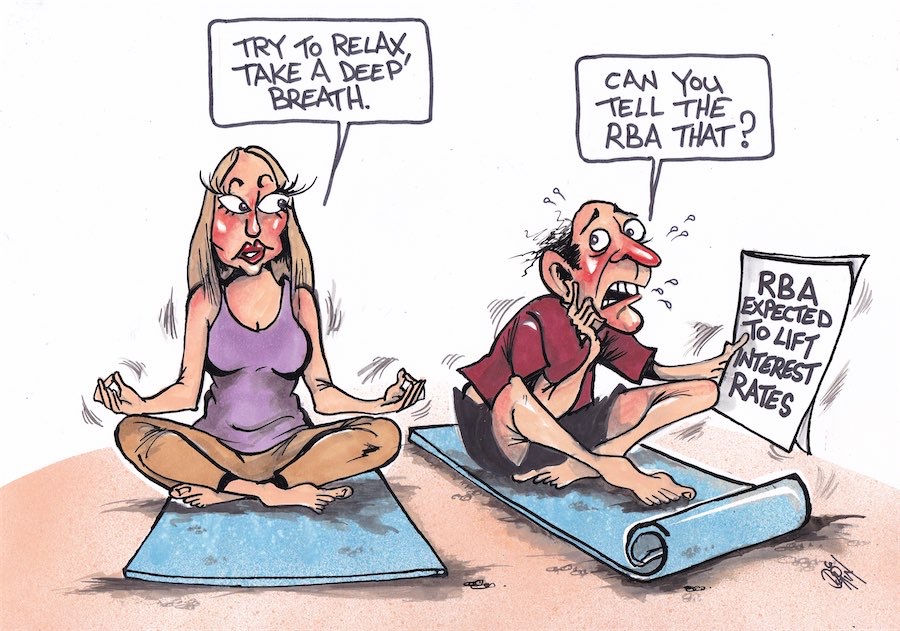
A MORE equal method of managing inflation may be to curb consumption by giving the Reserve Bank a discretion to increase and decrease (as required) the GST above the current 10 per cent. Government would then have the funds to compensate those on lower incomes. It may also be prudent to exempt food and medicine.
Peter Norton-Baker, via email
Sorry saga now seems hauntingly familiar
IN his column “When leaders veer off into a strange universe” (CN, February 16) Paul Costigan expressed puzzlement as to how former prime minister Scott Morrison could have been allowed to take a Coalition government down the road to ruin.
Members of that government cannot credibly claim that they were not told, nor warned, about Morrison’s record in working with government.
In 1998, Morrison was appointed director of the NZ Office of Tourism and Sport. Within weeks, he had quietly arranged the removal of the chairman, deputy chair and chief executive of the NZ Tourism Board, who received almost $NZ1 million in secret payouts.
An auditor-general’s report subsequently found that Morrison had exceeded his remit: the minister for tourism was forced to resign, and prime minister Jenny Shipley’s conservative government was defeated by Labour in 1999. Morrison left abruptly in 2000 with a year left on his contract.
In 2004, Morrison was appointed managing director of Tourism Australia, and spent $180 million on the now infamous “So, where the bloody hell are ya” campaign. This expenditure was allegedly never authorised by the minister, Fran Bailey. Morrison was promptly sacked.
How much of this sorry saga now seems hauntingly familiar?
Dr Douglas Mackenzie, Deakin
News all day, every day at CityNewsQBN.com.au.



Leave a Reply