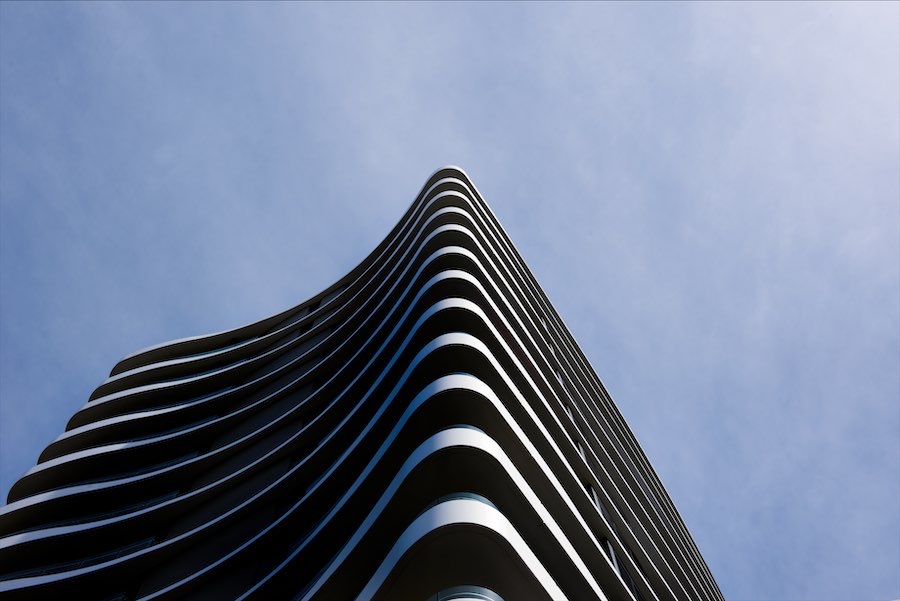
High-rise buildings reduce our ecological footprint, right? Not really, says BEATRICE BODART-BAILEY, who offers proof that living in a house might be better for the environment…
SOME pesky perennial critics maintain that the motive for the government’s infill policy with high-rise housing is to increase rates without the cost of new infrastructure and fill the tram to show some return for the billions spent on it.
No, says Labor/Greens. It is to reduce our ecological footprint. This argument is backed by the US Energy Information Administration (EIA) stating that: “Households living in apartment buildings with five or more units use about half as much energy as other types of homes.”
Rather ironically, a paper presented at the annual International Conference on Tall Buildings and Urban Habitat in Sydney in 2017 dropped the bombshell that a detailed study comparing energy consumption in Chicago high-rise and free-standing buildings
showed that energy consumption per person in the latter was lower.
The EIA study ignores that a statistically significant number of apartment dwellers in the US are of a lower economic status than single-house dwellers and forced to economise on living space, heating and cooling costs.
Attempting to avoid such distortion, the Chicago study compared the energy consumption of apartment and single-house dwellers of comparable socio-economic status and income.
In Canberra the gap between the socio-economic status of apartment and single-residence dwellers is much smaller than in the US and further reduced by the occupants of new luxury apartments. Hence the Chicago study is relevant.
The results are startling. As one would expect, the average Gross Floor Area (GFA) per household in free-standing houses is 53 per cent greater than that of high-rise flats (226sqm compared to 147sqm).
But when the GFA is calculated per person, free-standing homes show a greater GFA efficiency with 68.6sqm per person, compared to 77.4sqm per person in the high-rise setting.
The same applies to cars. Calculated per household, the number of cars per household is slightly higher with free-standing houses, but lower when calculated per person: 0.5 versus 0.6 for high-rise occupants.
Energy use, including heating and cooling, hot water and all other appliance and equipment operations show a similar result. Calculated per square metre, high-rise living shows a 5 per cent increase over single homes.
With many of the single houses in this study of an older type and likely to have higher energy consumption than the more recently built energy-efficient high-rise, this is again unexpected.
The reason is that beyond the space of individual flats, a considerable amount of common area, such as indoor pools, whirlpool spa and fitness centres with changing rooms and showers, as well as entrance halls, libraries and, of course, lifts and long corridors are part of the equation. With individual houses, savings can be made when all occupants are away or asleep, but this is not possible in the common areas of apartment buildings which are usually heated or cooled and lit 24/7, consuming a considerable amount of energy.
An important and often neglected factor is the so-called “Home Embodied Energy Cost”, the energy consumed in all on- and off-site activities necessary to construct and maintain the building, plus the embodied energy in the materials themselves.
Calculated on a 100-year life span, this resulted in an average annual value of 0.101 GJ per square metre for high-rise living and some 30 per cent less, 0.068 GJ per square metre, for free-standing homes (to convert GJ to kWh, multiply by 277.8).
Water consumption was, of course, higher for suburban single homes surrounded by gardens with 91,857 litres a year per person, as compared to 66,820 litres for high-rise occupants.
In Canberra where rainwater tanks connected to toilets, washing machines and garden taps are mandatory for all new houses, water consumption would be lower. An increasing number of solar panels is reducing electricity consumption for single houses, while the roofs of multi-story buildings frequently become entertainment areas and have little or no space for solar panels.
Similarly, saving energy by means of solar-passive design is problematic with apartment buildings. With free-standing houses, overhanging eaves and deciduous trees can protect the structure and its inhabitants from the heat of the summer sun while the low rays in winter can enter, warming the dwelling.
Thus, the claim that the ecological footprint of high-rise is less than that of free-standing houses is false. Moreover, the large amount of concrete of tall buildings and their surroundings produces the urban heat island effect, the much-feared increase of temperatures when the sun heats up large amounts of concrete. Residents need air conditioners to survive in the heat of summer, emitting hot air, causing a vicious cycle.
This also happens with other infill, namely when additional homes replace the gardens of free-standing houses. The result is an increase in heat-related deaths which, according to the CSIRO, are much underestimated.
Rather than destroy WB Griffin’s world-famous garden city with infill housing, model suburbs using ecological building materials in gardens mitigating heat would add to Canberra’s reputation as an environmentally advanced city.
Columnist Jon Stanhope has established that the ACT government is banking urban-capable land for at least 30,000 individual blocks (CN March 16).
Further, a faster train to Sydney would permit the construction of satellite towns, reachable in less time than the outer suburbs of Canberra.
Historian Beatrice Bodart-Bailey is an honorary professor at the ANU School of Culture, History and Language and an emeritus professor of the Department of Comparative Culture, Otsuma Women’s University, Tokyo.
News all day, every day at CityNewsQBN.com.au.


Leave a Reply