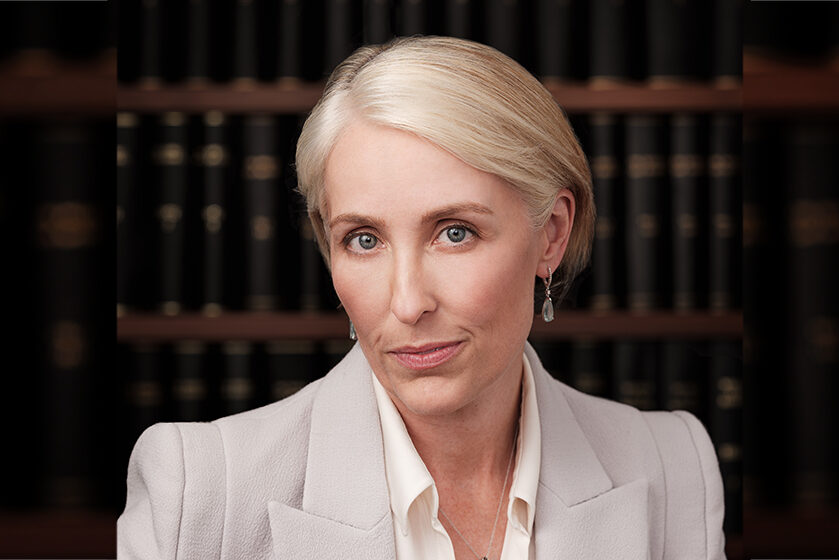
“Sally Dowling’s extraordinary explanation is that the decision to do over the judge was made at a meeting attended by her, but at which she was – as if she was an early teenager – preoccupied with her mobile phone to the exclusion of all else,” writes HUGH SELBY.
I am pondering the fate of the NSW Director of Prosecutions (DPP), Sally Dowling SC, whose present plight I wouldn’t wish on anyone with hopes of being offered a judicial appointment.

How should I start a difficult open letter? A letter that has to get across the message that she needs to resign now with some residual honour, rather than waiting for the vultures to pick over the bones of her cut short career.
If she’d resigned when the story broke then she could have left her career options in good shape. She didn’t.
I wonder if she sought, or was offered, good advice on damage control, loss minimisation, creating the best options for her future and that of the organisation (ODPP), how to be seen and heard to understand and respect the checks and balances within our legal system.
I wonder because I’ve not read any evidence of such advice being followed.
For those who have been having a Rip van Winkle nap for some months the precis is that staff from her office provided a Sydney radio jock with information to attack a well-respected, experienced NSW District Court judge.
Complaint pathways
For those who work in our legal system there are two pathways to follow where it is thought that a judge is wrong. One is to appeal the decision. The other is to seek to resolve the matter with the judge and/or make a complaint to the Judicial Commission.
Both these pathways were well known to the NSW DPP. She has had success with complaints about judges who “crossed the line” with statements about unmeritorious matters taken to trial by her office.
There is no third pathway for a DPP or an Office of the DPP.
A DPP “stands in the shoes of the attorney-general”, making decisions about whether or not to prosecute. That decision is not reviewable. This puts a DPP in the special position of being unaccountable, save for parliament’s power to remove them from office.
One might say that the quid pro quo for this independence is that as “Ministers of Justice” the DPP office holder is obligated to protect the standing of her office, preserve the independence of the judiciary and the reputation of the courts.
It follows that as soon as there was suspicion that the source of the radio story was the ODPP then the DPP should have released a carefully crafted, checked and re-checked statement that deplored the leak, affirmed the quality of our courts and judges, apologised to the judge and the court for the damage done, restated that the ODPP pursued matters by appeals and, when appropriate, complaints to the Judicial Commission, and said that steps were being taken to prevent this misuse of media happening again.
So far the most that has happened is that the DPP has been reported to have said that the incident was “deeply regrettable”.
This phrase brings to mind the oft repeated line that when someone is caught out and says, “I’m sorry”, there can be the issue of sorry for what: being caught, for the damage done, for both?
Instead of a statement addressing causes, results and “I am sorry for this undermining of my office and the courts”, we have been entertained, and disappointed, by a saga punctuated with gaffes that, as is common, has become more significant than the starting cause.
That is because her extraordinary explanation is that the decision to do over the judge was made at a meeting attended by her, but at which she was – as if she was an early teenager – preoccupied with her mobile phone to the exclusion of all else.
Faced with apparent disbelief that this is the best she can do the NSW DPP is reported to have been “aggressive” in her responses in her most recent appearance before a Parliamentary Committee.
Evaluating the explanation
Let’s dissect the explanation that she wants us all to accept.
Suppose that she was on the phone while a plan to attack a sitting judicial officer before whom her staff appeared was being discussed. Such a plan is unusual. Its legal implications would have to have been discussed. Who better than the DPP, a senior counsel with years of high-level experience, who is sitting right there among them.
There has been no suggestion that the meeting was one which she didn’t need to attend, that she was multi-tasking, while sitting separately from everyone else, simply available if they brought an issue to her attention.
Putting to one side the issues of her attention to what was being discussed and any queries from her staff about what could and could not be done, let’s now turn to supporting evidence for her explanation, something more than her assertions.
Instead of one or more of those present coming forward to corroborate her version, the Parliamentary Committee now finds that at least one important witness has declined to attend. We are left to wonder why this has happened.
But that’s not all. Just how much of the director’s time and attention was given to her phone can be easily enough determined by the mobile phone records.
Because phone records are so commonly used as evidence these days it is inconceivable that those records haven’t been obtained and checked. If those records supported the DPP’s recollections then those records would have been front and centre.
All of which illustrates a foundational principle when assessing evidence: when a witness or evidence that could support a version of events is not presented then the fact finders – in this case the Parliamentary Committee and we members of the public – are entitled to draw the inference that such witness or evidence would not help the DPP.
Which leaves Ms Dowling SC in an invidious position. She is now rather worse off than when the story broke.
Imagine a cross-examination: not pretty
I am not aware that any of this will lead to any “in court” repercussions for Ms Dowling. That said, if she had to defend her position under oath a reasonably competent cross-examiner would have a field day.
There are many roads to a successful cross and the following is but one example of an approach that could convince the audience that the current explanation, while possible, has little support.
Start by having her confirm her knowledge and following of the procedures for complaining about judges, such as jointly approaching the judge with the defence, approaching the chief judge, and complaining to the Judicial Commission.
Point to all the publicity about her spats with other judges that led to complaints to the Judicial Commission.
Suggest that all that publicity about the process and complaints would have been discussed with the ODPP media staff as a matter of course.
Hence, giving information to a radio show was unusual, therefore requiring all angles to be explored.
Move to her role as director responsible for the management of the ODPP and all who work there, to ensure public confidence in prosecutions in NSW.
Have her accept that the media is important to the public being accurately informed about ODPP policies and action.
Have her acknowledge that her media team is proficient with media, but not with the law and legal protocols, and therefore need legal advice when anything out of the ordinary is proposed.
She was competent to give such advice.
She was available, at the meeting, to give that advice.
Did she trust her media team? If so, she’d expect them to directly raise with her any novel action. If she didn’t trust them then she needed to pay close attention to the topics discussed at that meeting.
Just wondering about evidence that would support her recollections. Does she have mobile phone records that show her being entirely taken up with matters on the phone?
If so, would she like to share them?
Of those present at that meeting who has given a public account? Who has declined the invitation to give such an account?
Does she agree that a corroboration of her recollection would put her in a much better position?
There is, up to now, a lack of corroboration.
Best earlier, better sooner than later
The director’s position is untenable. Her explanation may be true; however, the manner of its telling, the atmospherics and optics both at the time and now, and lack of witness or evidential support are all against her.
She must go, either by resigning or an amendment to the Director of Public Prosecutions Act 1986 that simply states: “The holder of the office of DPP holds no office”.
She must go, not because of any adverse findings (there are none), but because the incident and its aftermath have tarnished the office of DPP. Public confidence requires that someone else do the job.
My open letter would start, “Dear DPP”. It would end with, “May you have a wonderful future as a highly regarded advocate sought after by both prosecution and defence”.
Hugh Selby, a former barrister, is the CityNews legal affairs columnist.
News all day, every day at CityNewsQBN.com.au.





Leave a Reply