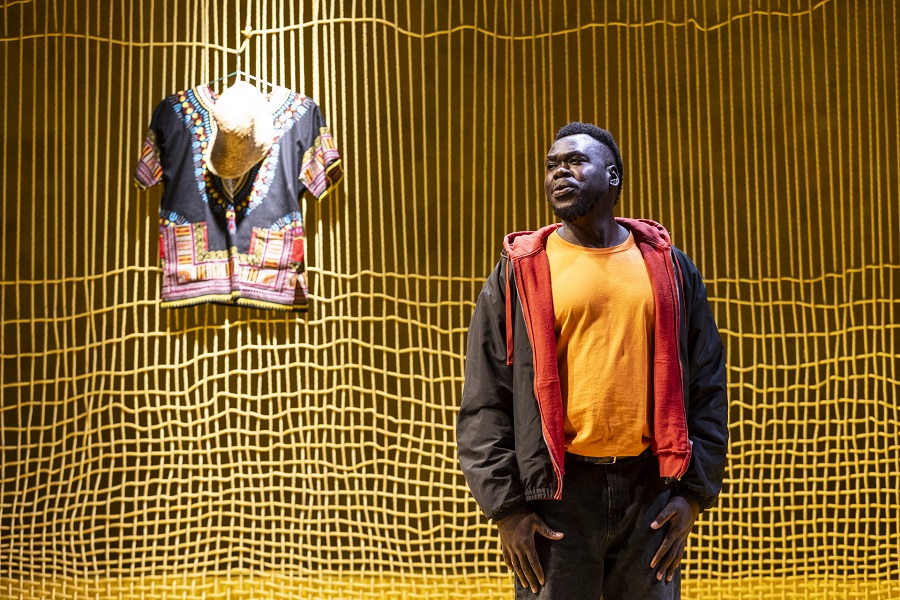
Lose to Win, coming to The Q on Saturday, follows the story of actor Mandela Mathia, from a war-torn South Sudan to Egypt, and then to Australia as a refugee.
The first thing Mandela remembers is not fear – but hunger. “In this country, you think it’s your right to have three meals a day. Me, where I came from? I think it’s a miracle,” he will tell the audience.
“This show is about events of my life from birth all the way to Australia, where I explore the themes of self-acceptance, perseverance and hope.
“This show kind of helps give young people ‑ everyone ‑ the hope to reinvent themselves and feel like there is light at the end of the tunnel,” adding that it has also become a celebration of the South Sudanese community’s resilience.
He is accompanied on stage by musician Yacou Mbaye, one of Australia’s leading West African drummers and dancers, in a Belvoir St Theatre production directed by Jessica Arthur (The Dictionary of Lost Words), whom he met in his final year studying acting at the National Institute of Dramatic Art.
Arthur recalls: “One day in rehearsal he walked up to me and asked: ‘In the future, will you make a play with me?’
“Jump forward to us emerging from lockdown four years later, we both had some time on our hands. Mandela and I would meet in our local park and he told me the story of his life, every single incredible detail.”
Other key creatives in the ensuing Belvoir production include set and costume designer Keerthi Subramanyam, lighting designer Kate Baldwin and sound designer and composer Brendan Boney.
Mathia has spoken extensively about who he is, where he comes from, and what has shaped him, saying: “I felt it was necessary to use my story, the power of theatre and storytelling, to shed light on what my community was experiencing for the past 12 years.”
Growing up in Sydney as a young refugee, he became increasingly aware of how the broader Australian community engaged with and treated South Sudanese people.
He observed young South Sudanese boys and youths feeling rejected and often unwanted by wider society, sometimes coming into conflict with law enforcement. Media and politicians voiced their concerns, contributing to the demonisation of his entire community.
After finishing at NIDA in 2017, Mathia felt a strong responsibility to use his story, alongside the power of theatre, to shed light on what his community had endured.
One of the most affecting aspects of his story is the loss of his parents. As a child in South Sudan, when his biological mother died amidst the surrounding chaos, he and his brother had no choice but to keep moving forward.
It was only later in life, after growing up in Australia, and particularly after losing his second mother in 2018, that he truly understood the depth of grief, something he says Arthur helped him realise on stage.
Mathia believes imagination, too, played a crucial role in his childhood. In the environment he grew up in, it was essential, not just for creativity, but as a way to mentally escape harsh realities and maintain a sense of safety.
His experience as a South Sudanese actor in the Australian arts industry, he says, has been mixed. After graduating, he quickly found opportunities in both theatre and screen, reflecting a growing desire within the Australian arts sector to create space for artists of colour. But more effort and more open conversations are needed to truly bridge the gap.
“I hope audiences will be able to see themselves in this Australian play. That beautiful cake, that promised land… That the Australia I wish for, is the Australia they also wish for,” he has said.
Lose to Win. The Q, Queanbeyan, May 2.
News all day, every day at CityNewsQBN.com.au.




Leave a Reply