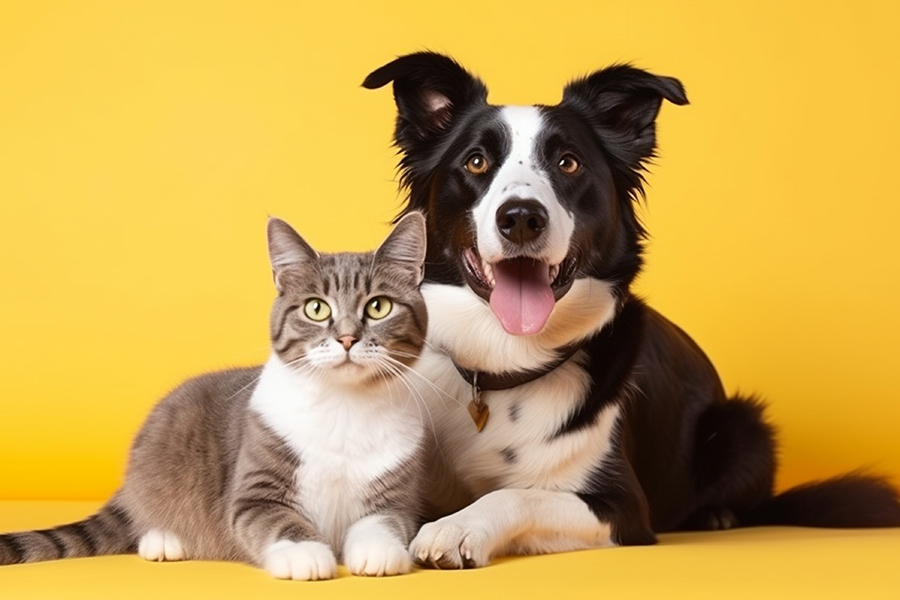
“Evidence from neuroscience, ethology and comparative psychology shows that both species engage in forms of thought, including memory, problem-solving, anticipation and social cognition,” writes Whimsy columnist CLIVE WILLIAMS.
“Dogs come when they are called. Cats take a message and get back to you.” –Mary Bly
It’s said that dogs have owners, but cats have staff. Anyone who has owned both species knows they’re very different in their attitudes and behaviour, and that each individual has its own distinct personality.

Dogs clearly like to please their owners with approved behaviour. Cats are seemingly aloof and indifferent to their owner’s wishes.
Dogs and cats are often described in anthropomorphic terms by their owners – meaning that their owners attribute to them human characteristics, emotions or intentions.
Modern empirical research provides a clearer picture of their mental processes.
Evidence from neuroscience, ethology (the scientific study of animal behaviour) and comparative psychology shows that both species engage in forms of thought, including memory, problem-solving, anticipation and social cognition. Their mental lives differ in focus, reflecting their distinct evolutionary histories: dogs as co-operative pack animals and cats as solitary hunters.
Domestication has profoundly shaped canine cognition. Dogs’ brains share structural similarities with humans, particularly in areas associated with emotion and social processing.
MRI studies indicate that dogs process human voices in dedicated brain regions, suggesting they interpret not only human sounds but also feelings and emotions.
Memory research also supports the presence of episodic-like thinking. Fugazza et al showed that dogs could recall actions they had observed after delays, even without explicit training. This indicates dogs can mentally represent past experiences and apply them to current contexts.
Dogs also demonstrate advanced social cognition. Experiments reveal that they outperform even great apes in interpreting human behaviour. This suggests dogs think about human attention and intention, forming mental models of approved co-operative interactions.
Cats have been less extensively studied but also demonstrate sophisticated cognition. Spatial memory is a notable strength: Macrì et al found cats could remember the location of hidden objects, supporting the idea that they form internal spatial maps.
Cats too are capable of social recognition. In controlled experiments, cats reliably distinguished their owner’s voice from strangers, despite often appearing indifferent. Selective auditory recognition suggests cats mentally acknowledge familiar humans.
Cats also display causal reasoning. Mendes et al demonstrated that cats could infer the presence of hidden food based on sound cues, indicating mental inference rather than simple reflex. Moreover, research suggests that cats think about their owners as sources of safety and comfort.
How do they handle being left alone by an owner going to work?
Dogs are descended from wolves, which are pack animals and naturally social. Many find it stressful to be left alone for long periods. Some dogs bark, howl, chew furniture, scratch doors or even soil the house when anxious about being left. Puppies are affected after only one to two hours. Adult dogs can manage four to six hours, sometimes up to eight with training, exercise and enrichment. Long walks before/after absences, interactive toys, puzzle feeders or leaving the radio/TV on for background noise can help.
Cats are descended from solitary hunters, so they’re generally more independent. Adult cats often do fine being left for eight to twelve hours, and many cope with their owners being away overnight if food, water, and a clean litter tray are provided.
Neither dogs nor cats should be left outside when no one is home – dogs because they bark and disturb the neighbours; cats because they hunt and kill small creatures up to several hundred metres from their home.
On a lighter note: Townsfolk are leaving Dodge because they hear Bad Bart is coming. Bad Bart has a reputation for property damage and shooting people he dislikes.
Soon, in a cloud of dust a hard-looking cowboy rides into town on a bear and hitches it up outside the saloon. He shoots down the hotel sign, strides into the saloon and decks the largest cowboy he can see. He then sweeps the barstoolers aside with one arm and orders neat whisky. He drinks for an hour, then kicks a hole in the wall to get out to the hitching rail.
The barman follows him out saying nervously: “Are yuh leaving town already, sir?”
“Sure am,” the cowboy replies. “I hear Bad Bart’s coming t’town.”
Clive Williams is a Canberra columnist
News all day, every day at CityNewsQBN.com.au.




Leave a Reply