Our interest in electric vehicles has grown due to oil price spikes. And it’s likely to remain, writes TAUEL HARPER.
The US military action in Iran may have an unintended secondary effect – ending the cultural dominance of the internal combustion engine and ushering in the age of electric vehicles.
Back in the 1970s, a sudden increase in the price of oil led to the public embracing smaller and more fuel efficient cars; similarly, the choking of the Strait of Hormuz, and the resultant high cost of oil, is driving a historic surge of interest in electric vehicles.
Google Trends data shows that almost three times as many Australians searched for “electric vehicles” on March 23 when compared to February 27, the day before the US started to bomb Iran and the cost of oil (and fuel) started to skyrocket. The increase in RSV (Relative Search Volume) represents a 278% increase in Australians searching for “electric vehicles”.
While research shows a number of factors influence Australians’ choice to own an electric vehicle, the price and availability of energy clearly plays a central role and the weight of public opinion is slowly shifting towards embracing EVs.

EV interest remains over time
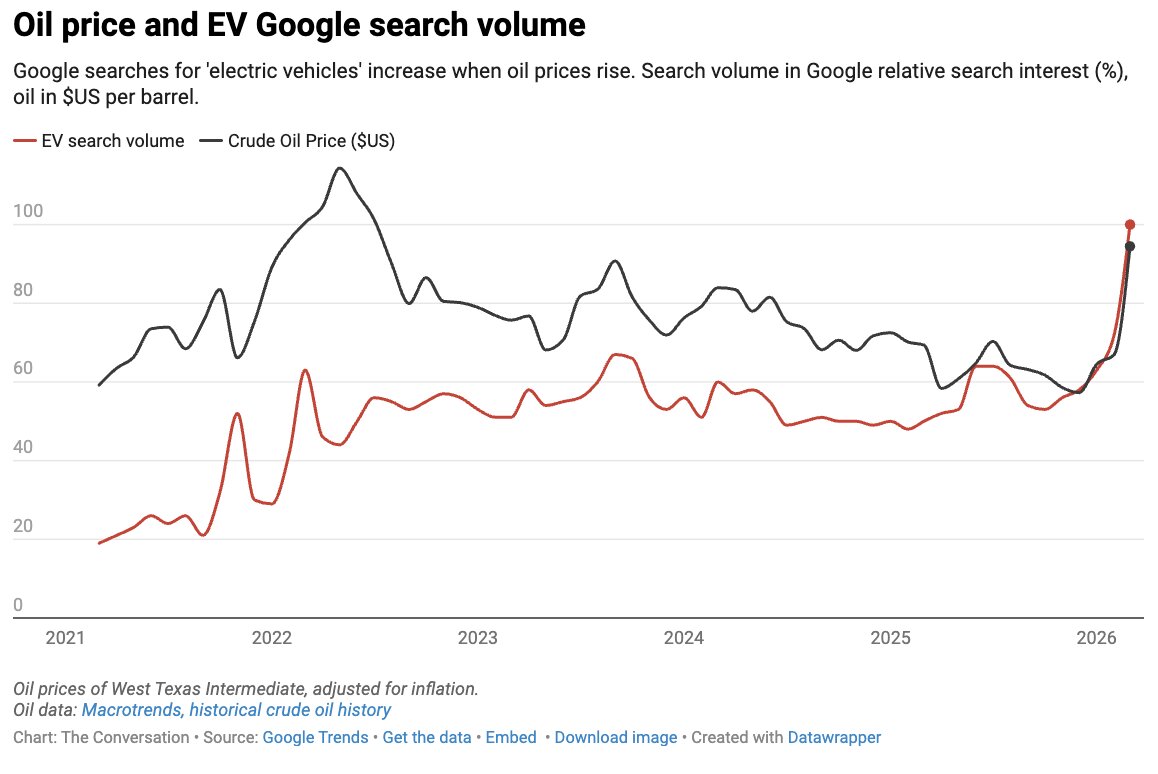
Historically, the relationship between the cost of petrol and interest in electric vehicles (EVs) is even more telling. The graph below shows a clear pattern of higher petrol prices leading to more searches for EVs.
While the most notable feature of this data is the dramatic increase in searches for EVs since the US attacks on Iran began, it’s also interesting that while interest in EVs often drops as oil prices return to “normal”, it never drops back down to its previous level. Once sparked, our interest in EVs remains higher than before.
For instance, after the spike in oil prices following Russia’s invasion of Ukraine in 2022, you can see a similar spike in searches for EVs. However, even after the oil price had dropped back down and stabilised, the Relative Search Volume (RSV) of Google searches for EVs remained at a higher level than before the invasion.
This suggests consumers retain some interest in EVs after the increase in oil prices has passed. Perhaps these global oil crises prompt the realisation that relying on energy imported from the other side of the world is more tenuous than relying on energy from your own rooftop.
A pragmatic interest in saving money
My colleagues and I recently explored Australia’s cultural attitudes to EVs. We argued increasing access to household solar energy was driving an enthusiasm for a new relationship with energy. But long-held anxieties around range, infrastructure, gender roles and national image, as well as traditionalist hold outs like enthusiast car culture and engine sounds, as factors that inhibit the take up of EVs in Australia.
However, the clear signal this trend data sends is that Australians are a pragmatic lot. If using an EV might save them money, then they are interested.
The data also presents a warning to car makers that have “bet against” the rise of the electric vehicle. Porsche, Lambourghini and Ferrari have all recently announced plans to reconsider or scale back their production of EVs. This is based on their assessment of shifts in the “political climate”, with security and trade taking precedence over “environmental concerns”.
While economic driving may not be a concern for many Ferrari drivers, Toyota has also made the decision to “not go all in” on electric. Instead, it offers only one full EV in Australia, amid a range of internal combustion and hybrid options. This bet against electric vehicles may look foolish if oil prices continue to rise.
Is this the ‘critical mass’ for EVs?
Google trends data is an enigmatic metric. It tells you how interest in things changes but not how much interest there is overall. According to sales data, there was a slump in EV sales in 2024, but EV sales in February 2026 were already 95% higher than they were in February 2025. The evidence of Google Trends suggests March’s results will show even more of an increase.
While technological change can be difficult to initiate, new technologies tend to reach a tipping point when they reach a “critical mass” of public adoption. Like the move from LPs to CDs to streaming services, what starts out as idiosyncratic can soon become a norm. Similarly, technology that once seemed here to stay can quickly become outdated.
With the cost of petrol rising once again, and Australians increasingly harnessing their solar electricity, we are rapidly normalising the benefits of electric vehicles.
I’d like to acknowledge the contribution to this article of my colleague, car enthusiast and academic Damian Fasolo, whose understanding of car culture contributed significantly.
Tauel Harper, Associate Professor in Communications and Media, Murdoch University. Republished from The Conversation.
News all day, every day at CityNewsQBN.com.au.





Leave a Reply