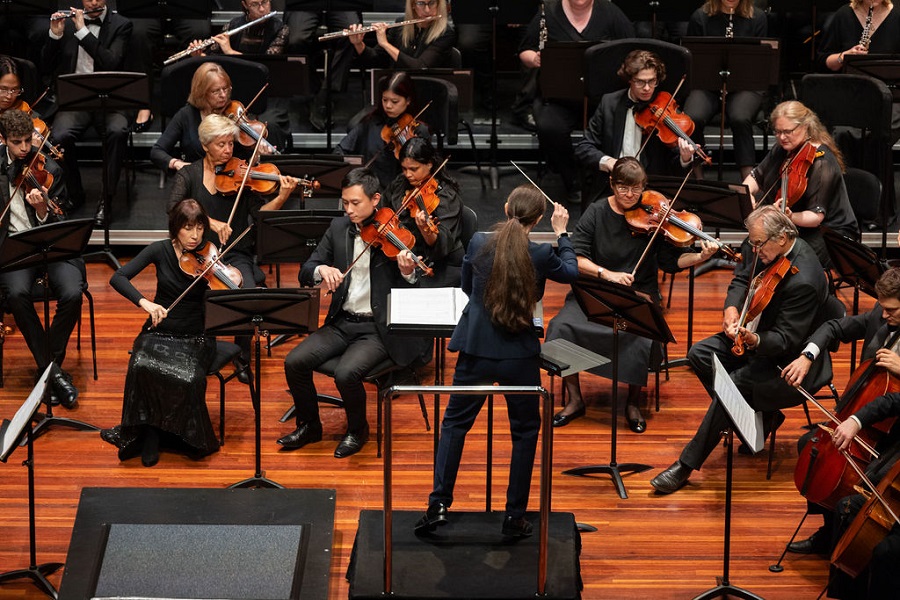
Music / Canberra Symphony Orchestra and cellist James Morley. At Llewellyn Hall, March 19. Reviewed by SAM WILSON.
Around a loose theme of friendship, conductor Jessica Cottis combines the beloved Enigma Variations with a contemporary Australian piece, and the bold Symphony-Concerto for cello and orchestra by Prokofiev, starring the young Australian cellist James Morley.
Through Changing Landscape, a piece by Australian composer Alice Chance, began the concert by sweeping the audience into its vibrant textures and moving harmonies. Around a constantly sounding E, passed throughout the orchestra, the textures, dynamics, and chords shift, all underpinned by a strong pulse. According to the composer, this movement is inspired by train journeys, and how individuals are shaped by the people around them.
Next, Cottis introduced Prokofiev’s Symphony-Concerto, a piece that was the culmination of the friendship between Prokofiev, a composer whose work had been censored by the Soviet Union, and Rostropovich, a cellist who persistently vouched for him. Writing for the legendary Rostropovich, Prokofiev created some of the most fiendishly difficult music in the cello repertoire, but Switzerland-based Australian cellist James Morley was more than up for the challenge. Throughout the piece’s approximately 40-minute runtime, Morley’s strong sound shined through fast runs, double stops and high-register playing.
The first movement establishes a long melody that constantly changes key, and Prokofiev’s flamboyant orchestration works well to complement the cello line. Morley exhibited a strong, projecting sound that was able to sit above the orchestra. The second movement was a virtuosic display of stamina, opening with a fast solo passage before the cello and orchestra exchanged melodies, as Cottis masterfully kept the orchestra in time with the cello through changing tempos and rhythms.
Morley then wowed the audience with an extended cadenza, featuring fast chords and high octaves. Mercifully, Prokofiev gives our cellist a brief respite with a lyrical melodic section, in which Morley showcased his range of dynamic and textures. The third and final movement closed the piece with energy, as Morley closed out the piece on a high E – above the fingerboard.
This thoroughly enjoyable and impressive concerto was very well received, with Morley’s virtuosic marathon being rewarded by thunderous applause and standing ovation.
After an interval, Cottis brought us back into a friendly atmosphere with an orchestral classic: Elgar’s Enigma Variations. She explained that each of the 14 variations on an original theme were Elgar’s musical characterisations of each of his friends.
The sombre theme was established, before the tonality, mood and dynamic shifted dramatically with each of the variations. The Canberra Symphony’s skill was on full display through the fast second variation (H.D.S.P) and the energetic seventh variation (Troyte) with its thunderous timpani part.
The orchestra was also able to bring the energy right down for the opening of variation IX (Nimrod), which turned a serene slow melody into a soaring, majestic orchestral sound. The piece ended in triumphant fortissimo, bringing the concert to a close.
Cottis’ dynamic conducting style combined with her carefully considered interpretation kept this oft-performed piece interesting, and her thoughtful programming gave us a range of pieces that were all well received by the audience.
News all day, every day at CityNewsQBN.com.au.




Leave a Reply