You have more of a chance of being struck by lightning or kicked to death by a donkey than dying through meteorite impact. But should we be concerned? ROSS FITZGERALD & DICK WHITAKER say the short answer is no, but the long answer is yes!
Planet Earth is enshrouded by a protective blanket – the atmosphere – that enables life as we know it, in all its forms, to exist.
But of equal importance, it provides an invisible shield that protects us from the fusillade of “space rocks” that constantly bombard us from outer space.
There are three basic kinds of these “rocks” – asteroids, meteoroids and meteorites, each with differences in their origins and potential for impact with Earth.
- Asteroids are rocky bodies orbiting the Sun, mostly between Mars and Jupiter. They can vary in size from around 10 metres across to the dimensions of a city and travel at hypersonic speeds of around 50,000km/h.
- Meteoroids are generally smaller space rocks that could originate as asteroid fragments or just random chunks of rock travelling through space. They vary greatly in size from that of a pebble to boulders around 10 metres across. They too can travel at hypersonic speeds.
- Meteorites are fragments of meteoroids that survive entry through Earth’s atmosphere and actually reach the surface. After entering the atmosphere at hypersonic speeds, they are slowed down through friction with the air but still travel at supersonic speeds (above the speed of sound) before striking the ground. Collisions of this type with the Earth’s surface are known as “extra terrestrial impacts” and form a fascinating facet of our geologic history.
Meteors, on the other hand, are not rocks but visible streaks of light (called shooting stars) produced when a meteorite enters Earth’s atmosphere at high speed and burns up due to friction.
This “burnout” produces bright streaks of light across the sky that are normally only visible at night. If you are to go outside on a clear night and observe the sky for, say, half an hour you will usually see one or more of these luminous, transient streaks that normally last only a second or two.
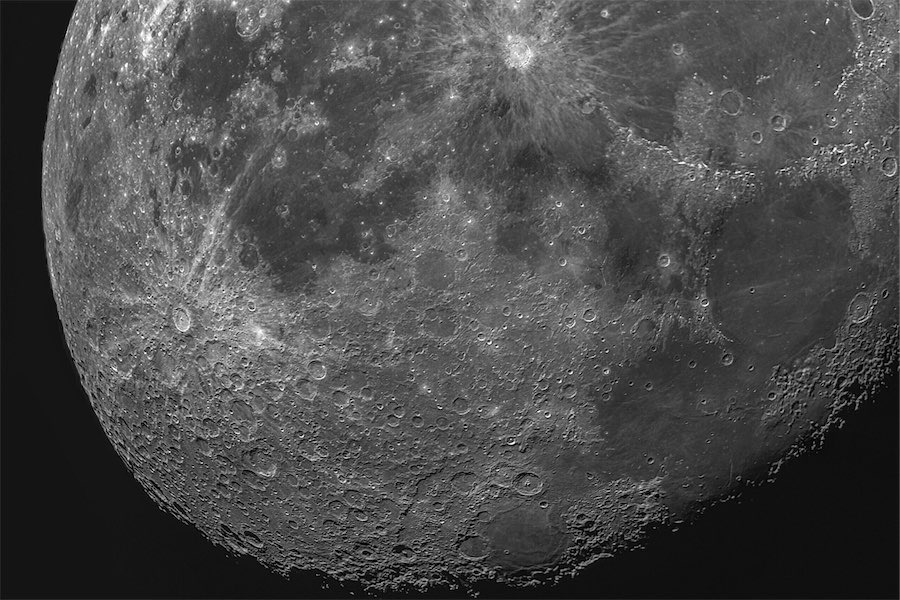
In most cases the rock will burn up or vaporise before reaching the ground, and it is this protective property of the atmosphere that has played a big part in the survival of life on Earth. Without it we would look like the Moon that has no such protection and is pockmarked with impacts from many thousands of meteorites.
In some cases fragments will reach the surface of the Earth as a shower of smaller rocks and these are fascinating to scientists as they are ancient objects from the far-flung reaches of outer space and often have a different structure and composition to rocks we find on Earth.
On rare occasions much larger space rocks – such as asteroids – will enter the atmosphere, with a size massive enough to reach the lower levels of the atmosphere as a large coherent body. Their speed will usually drop from hypersonic to supersonic and as a result produce a sonic boom that sounds like a roll of thunder.
There are usually two outcomes from this.
The first is a massive mid-air explosion – an airburst – that generates a blindingly bright flash, together with a shock wave and sound of rolling thunder. Smaller rock fragments will then shower across the area as meteorites.
But if the rock is extremely large, it will remain mostly intact all the way to the surface, eventually striking the ground with colossal force, producing a large-impact crater. If the impact is over the ocean, a gigantic tsunami is almost certain.
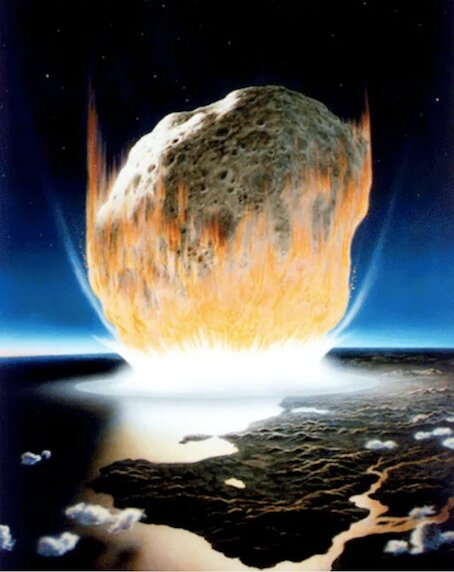
It is believed that an event like this – some 66 million years ago – produced a cataclysmic explosion of such a scale that the atmosphere around the world was affected, with the extinction of the dinosaurs a consequence.
It was produced by a space rock (likely an asteroid) about 10km across travelling at hypersonic speed. The resultant crater, located near Mexico’s Yucatan Peninsula is still detectable, around 200km across and one kilometre deep.
Some interesting geological detective work was used to come to this conclusion, with the presence of the element iridium a key issue.
Iridium is one of the rarest elements on Earth but more common in meteorites.
So when a thin clay layer was discovered in a gorge in Italy, in the late ’70s, that carried high iridium concentration, geologists immediately began to suspect an extraterrestrial impact.
This distinct layer was traced to many locations across the world and dated back to 66 million years ago. The epicentre appeared to be located near the Yucatan Peninsula and became known as the Chicxulub crater.
Large and ancient impact craters have also been discovered in other areas, including the US and Australia, such as Meteor Crater near Winslow, Arizona, that was created about 50,000 years ago when a large meteorite slammed into the area. The crater is about 1.2km across and 170m deep.
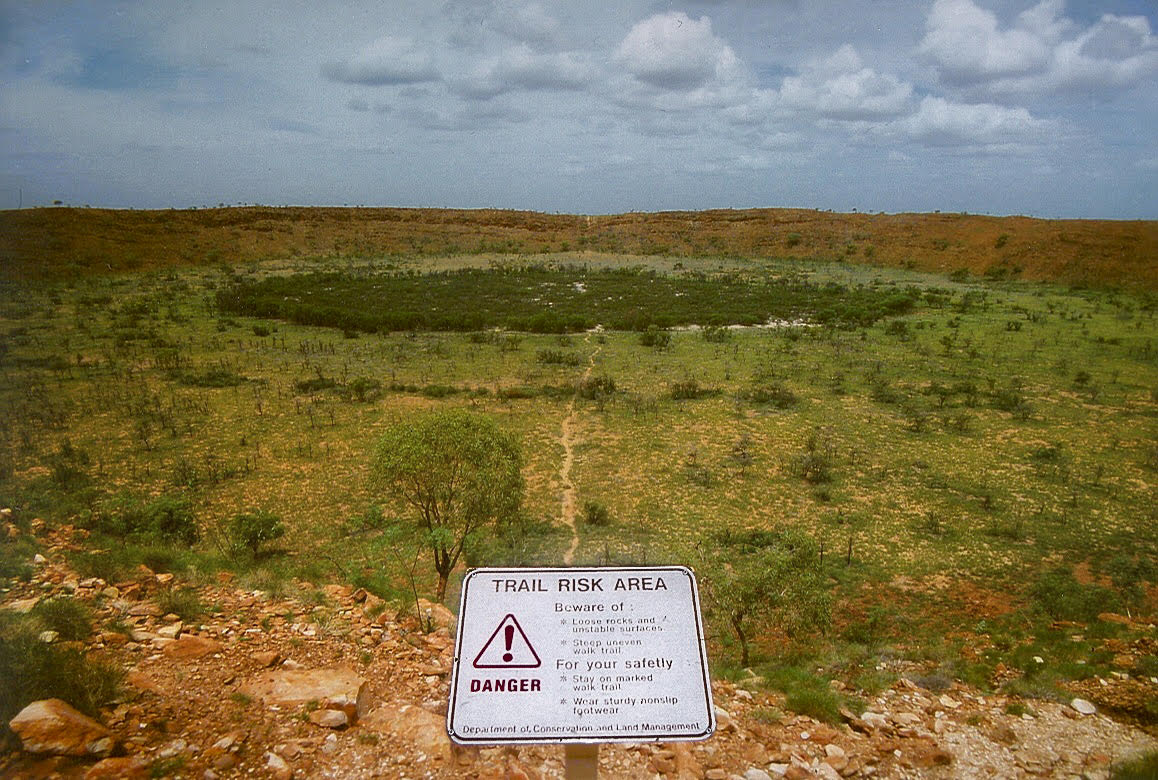
In Australia, Wolfe Creek is a large-impact crater located in the desert of WA, about 150km to the south of Halls Creek.
It is estimated that this crater was produced by a meteorite that had a mass of some 14,000 tonnes striking the surface at hypersonic speed around 120,000 years ago. The crater is about 900 metres across and 60 metres deep.
It is considered a significant cultural site by indigenous Australians whose Dreamtime Heritage explains it as the site where the giant Rainbow Snake emerged from the ground, or the place where “a star fell from the sky” – a neat intersection with modern science. The indigenous name for the location is Kandimalal.
So what would happen if such an object were to strike a modern city – such as Sydney or Melbourne? Well, the short answer is – disaster.
The actual impact crater would likely take out a suburb, and the associated shock wave and impact vibrations would probably destroy much of the city.
So should we be concerned?
The short answer is no but the long answer is yes. Events such as Wolfe Creek probably only occur about once every 200,000 years, and in the great majority cases the actual impact point would likely be in a non-urban area such as an ocean. You have more of a chance of being struck by lightning or kicked to death by a donkey than dying through meteorite impact.
Nevertheless, the late Professor Stephen Hawking, an eminent astrophysicist and cosmologist, considered a major asteroid impact on Earth to be inevitable, especially when considered over a long time period of millions of years. He regarded such an event to be one of the greatest threats to our planet.
A house-sized meteorite, say 20m across, initially travelling at hypersonic speeds, would cause a major explosion, similar to several Hiroshima atomic bombs.
As a result, space rocks of this type (NEOs or near Earth objects) are monitored carefully with the US-based National Aeronautics and Space Administration (NASA) and the European Space Agency (ESA) carefully tracking them using various instruments such as telescopes, infrared sensors and planetary radar.
If a large asteroid with a trajectory on a collision course with Earth is detected several solutions have been proposed to save us. These include interception with a nuclear missile to destroy the object or change its path before it reaches us. The use of a so-called “gravity tractor”, has also been suggested, that is the manoeuvring of a large spacecraft near the asteroid so that the gravity of this machine would, over an extended period, exert a continuous gravitational pull on the asteroid and deflect it from a collision with Earth. It is not known whether these ideas would be effective.
Asteroid collisions have been the subject of several science fiction films, including When Worlds Collide (1951), Armageddon and Deep Impact (both 1998), Melancholia (2011) Greenland (2020) and Don’t Look Up (2021).
Whether science fiction becomes science fact sometime in the far distant future is not known. The answer lies way out there somewhere in the black infinity of the night sky.
Ross Fitzgerald AM is emeritus professor of history and politics at Griffith University. His most recent book is Chalk and Cheese: A Fabrication (Hybrid) is co-authored with Ian McFadyen.
Dick Whitaker is a widely published author and lecturer in the fields of meteorology and Australian history.
News all day, every day at CityNewsQBN.com.au.





Leave a Reply