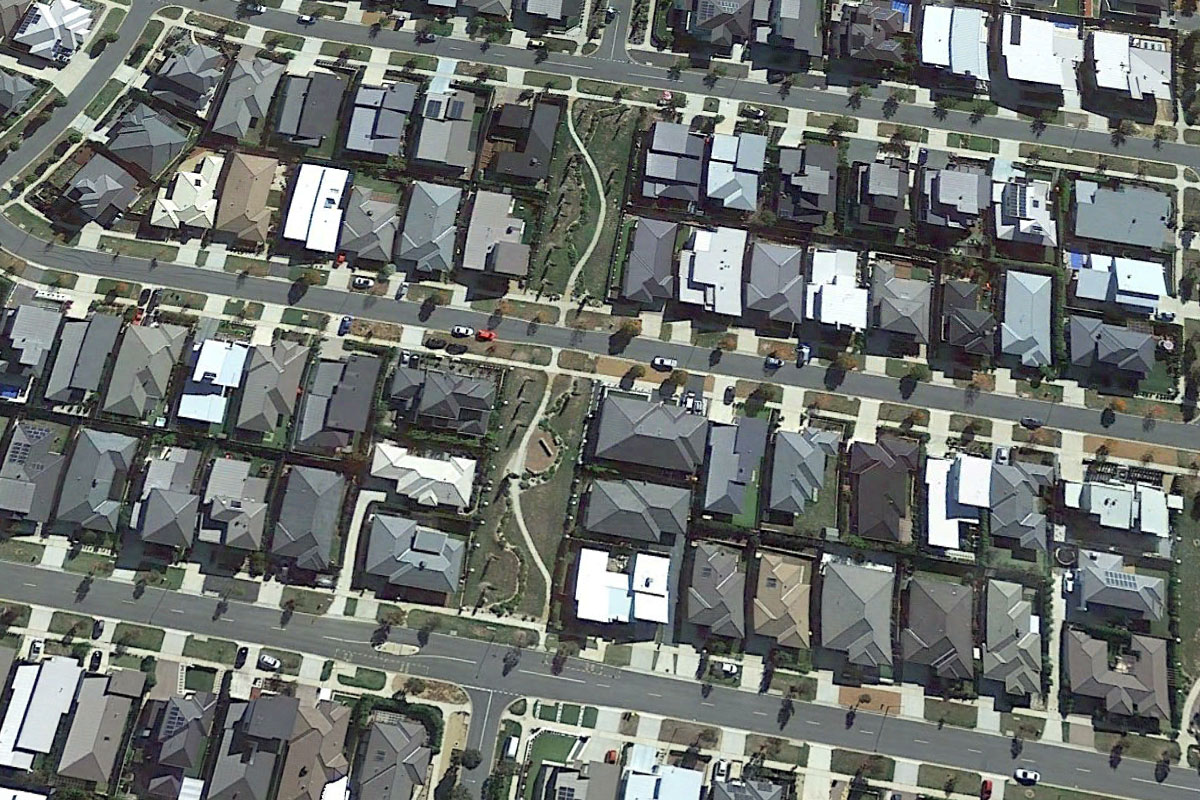
“There’s no question that substantial quality infill is essential. However, this shouldn’t be by strangling detached housing in greenfield areas, which denies the housing preferences of many households,” writes former planner MIKE QUIRK.
A KEY component of Canberra’s compact city policies is for 70 per cent of new housing demand to be accommodated in existing and 30 per cent in greenfields areas.

This share (coincidentally?) is the same as that advocated in Plan Melbourne 2017-2050. While the challenges of Canberra, a city of under 500,000, are of a different magnitude to those of Melbourne, a city of over five million, they both have the growth management objectives of producing enough housing in the right places and improving the functioning of the city.
Economists, planners and spatial analysts, SGS Economics and Planning, in its “Melbourne’s Growth Management Opportunity” report last month argues the successful delivery of Melbourne’s 70 per cent share aspiration requires a change from reactive planning, where the private sector is responsible for implementing policies and strategies, to a system where governments becomes involved in site amalgamation, undertakes master-planning, fills infrastructure gaps in order to create a sizeable and reliable pipeline of opportunities in established areas for the development sector.
SGS also highlights the lack of density and housing diversity in new Melbourne suburbs, the inefficient delivery of infrastructure from the poor sequencing of development and their poor accessibility, especially to employment.
Whereas historically new suburban areas were affordable and had good access to jobs, this is increasingly no longer the case. Using the Effective Job Density (EJD) index, which measures economic connectivity (the number of jobs in the area plus the number of jobs that can be reached from the area divided by the travel time in getting to them), SGS found Melbourne’s growth area residents had only a fraction of the economic connectivity of the average Melburnian.
In contrast, central city suburbs have a relatively high EJD and have better access to higher-paying jobs and have greater availability of education, training, heath, retail, recreational and cultural services.
In response to the pattern of increasing disadvantage, SGS argues for improved transport connections and increased employment dispersal to greenfield areas.
They calculate increased dispersal could deliver a net community benefit of around $400 million and given the size of the challenge, in terms of housing provision and jobs access, for a whole-of-city Commonwealth/state partnership.
The state and local government would commit to planning and housing delivery reform and infrastructure investment while the Commonwealth would commit to transfer substantial additional untied funding to the state in line with achievement of agreed transformation milestones.
How should Canberra respond to its growth challenges?
The ACT government, despite the poor outcomes of current infill policies including the failure to provide the ”missing middle” and the loss of vegetation, overlooking, reduced solar access, inadequate parking and increased congestion associated with many redevelopments, is continuing its reactive approach to private-sector proposals.
It needs to explain why it is not considering government site amalgamation or the introduction of site amalgamation regulations to better implement its infill policy.
The population size of Canberra means its greenfield residents have a lower level of locational disadvantage than the greenfields residents of larger cities.
Canberra also has the advantage of most greenfield land being in government ownership of which, with good planning, has led to greenfield suburbs with a diversity of housing, services and facilities planned within a hierarchy of centres and the efficient sequencing of development.
This is not to say greenfields planning cannot be improved, it clearly can. The government ownership of land has enabled it to reduce greenfields supply to facilitate the development of a more compact city.
This has resulted in an upward pressure on prices and increased sprawl in the surrounding region. It is important greenfields areas continue to be well-planned with strong transport connections to existing urban areas. Poor management led to delays in the provision of the Molonglo Group Centre reducing access to retailing and services to residents.
Molonglo, Ginninderry and Belconnen CSIRO have been identified as prime areas of greenfields development over the coming decades.
Areas with relatively low EJD include south Tuggeranong, north and western areas of both Belconnen and Gungahlin. As advocated by SGS in relation to Melbourne, such areas need improved access to jobs from increased employment dispersal and improved transport connections.
This suggests the government should reconsider its transport priorities, especially the extension of light rail, and develop a “city deal” with the Commonwealth aimed at increasing housing choice and affordability and employment in the new towns.
What is fundamentally important, and what has been missing, is a planning strategy based on evidence.
There is no question that substantial quality infill is essential. However, this should not be delivered by strangling detached dwelling supply in greenfield areas which denies the housing preferences of many households.
Canberra’s future development should be managed in the context of the parameters facing the city and not solutions derived to manage much larger cities.
Mike Quirk is a former NCA and ACT government planner.
News all day, every day at CityNewsQBN.com.au.





Leave a Reply