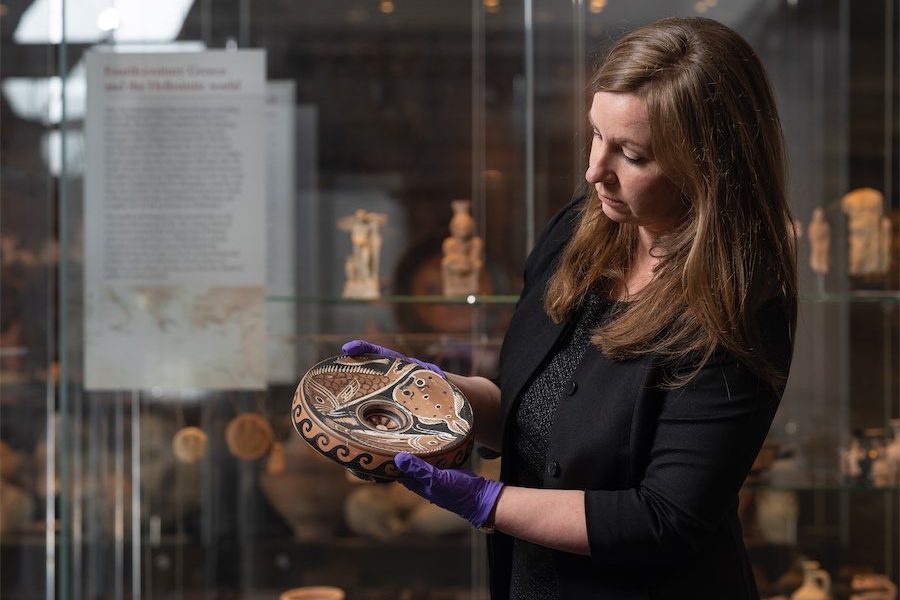
 Dr Pike-Rowney with the Apulian fish plate possibly smuggled from Italy in a batch of pasta. Photo: Jamie Kidston/ANU
A TWO-handled vessel, dating back to 530 BCE and connected to a notorious illicit antiquities dealer, will be returned to Italian ownership under a repatriation agreement between the Italian government and the ANU.

The amphora, which has been known as the Johnson Vase, is more than 2500 years old and has been a key object in the ANU Classics Museum for almost 40 years.
ANU purchased the vase in good faith in 1984 from Sotheby’s in London in honour of the founding professor of Classics at ANU, Richard St Clair Johnson.
Curator of the ANU Classics Museum, Dr Georgia Pike-Rowney, said the Carabinieri Command for the Protection of Cultural Heritage, a specialist art squad of Italy’s military police force, brought the vase to the attention of ANU after connecting it to the activities of a notorious dealer who was active in the Italian illegal antiquities trade from the 1970s to the 1990s.
They were able to match the ANU-held vase for one in a Polaroid photo discovered in an earlier criminal investigation, which proved that it was illegally excavated and sold.
“ANU and the Carabinieri have been working to repatriate the vase to Italy since 2022,” Dr Pike-Rowney said.
Under the agreement, to be finalised later this year, ANU will be able to display the vase on loan for four years, with a possible four-year extension, for research and teaching purposes. Prof Johnson’s name will no longer be associated with the piece; instead, a reading room for students of classical studies will be renamed in his honour.
Dr Pike-Rowney said the vase was a “stunning example” of the craftsmanship the ancient Mediterranean world was famous for.
“A vessel with two handles, the amphora would have been used for storing olive oil or wine,” she said. “One side of the vase depicts the hero of Greek mythology and son of Zeus, Herakles, fighting the Nemean Lion. The other shows two warriors in combat.”
Following the discovery of the Johnson Vase, the Carabinieri asked to see all documentation relating to items in the ANU Classics Museum.
“This search revealed a second problematic item – an Apulian red-figure fish plate also purchased in 1984, which we now know was smuggled out of Italy by another well-known dealer of illicit items, David Holland Swingler,” Dr Pike-Rowney said.
“ANU purchased the fish plate from Holland Coins and Antiquities in the US in 1984, which was run by Swingler, who has since been revealed as a key player in the illegal antiquities trade in the 1980s and 1990s. “During trips to Italy, Swingler sourced material directly from tombaroli — literally ‘tomb robbers’ who undertake illegal excavations — then smuggled the items to the US hidden among bundles of pasta and other Italian foods.”
ANU has formally agreed to repatriate the amphora and fish plate to the Italian government. As with the vase, the Italian government has also offered to loan the fish plate to the museum under the same conditions.

A third item was identified by the ANU Classics Museum, which ANU brought to the attention of the Italian government as part of its own proactive investigations: a Roman marble portrait head bought from Sotheby’s in London in 1968.
The piece has been connected with a collection owned by the Vatican that was on display in the Lateran Palace in Rome. The Carabinieri have received permission to act on the Vatican’s behalf to repatriate the item.
The Carabinieri Command for the Protection of Cultural Property manages the cultural database “Leonardo” – the largest in the world, with eight million works of art surveyed, of which nearly 1.5 million have been stolen.
The Carabinieri have also created the application SWOADS (Stolen Works of Art Detection System), a search engine that uses artificial intelligence and semantic and image comparison systems, capable of conducting web, social media and deep web monitoring worldwide, searching for stolen cultural goods placed in the worldwide licit and illicit art markets.
News all day, every day at CityNewsQBN.com.au.




Leave a Reply