Former planner MIKE QUIRK explains how the ACT government adopted an infill target without an adequate consideration of housing choice, land economics or the city’s multi-centred urban structure.
INFILL is increasing Canberra’s density. Its underlying rationale – lower infrastructure costs, reduced travel, widening housing choice and lower ecological impact has formed the basis of planning policy since the 1990s.

Since 2018 the government has pursued a higher 70 per cent infill target arguing it is crucial for Canberra to be sustainable, compact and well-connected.
The policy was adopted without an adequate consideration of housing choice, land economics or the city’s multi-centred urban structure.
The outcomes of the 2018 Housing Choices Collaboration Hub are sometimes referenced as justification for the target. It consisted of a group of 36 (Yes, 36!) randomly selected individuals, stratified by age, gender, household type to discuss, deliberate and receive information on housing.
While participants indicated a preference for infill over greenfield, particularly along transport corridors, they did not recommend an infill target. There was some support for extending dual-occupancy development into the RZ1 zone.
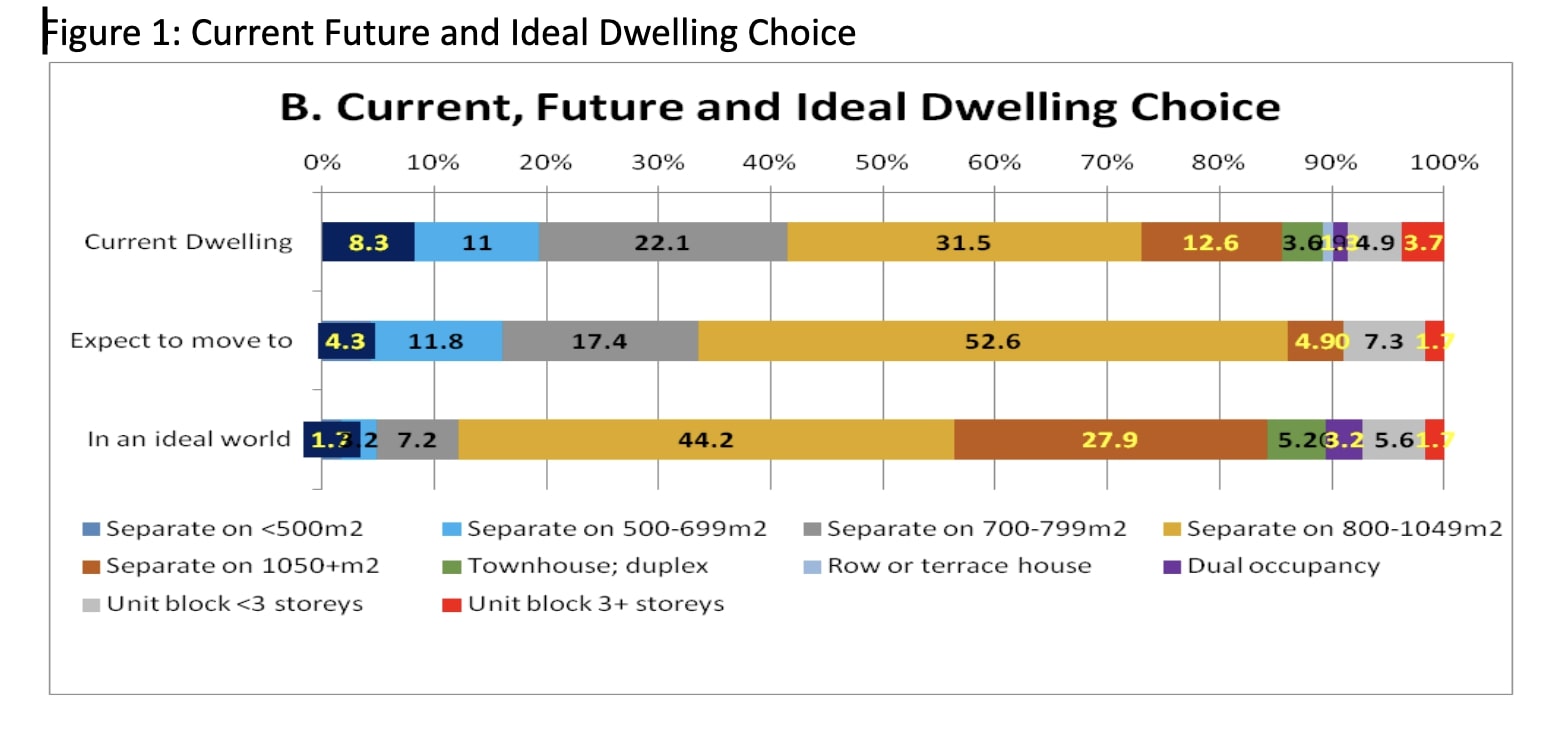
In determining the policy, the government ignored the findings of the 2014/15 Housing Choices Community Survey undertaken by Winton Sustainable Research Strategies. That survey found, of the 60 per cent of respondents anticipating to move in the next 10 years, 91 per cent expected to move to a detached dwelling. Some 48 per cent of households wanted a larger dwelling; of post or no-children households, 56 per cent wanted a larger dwelling.
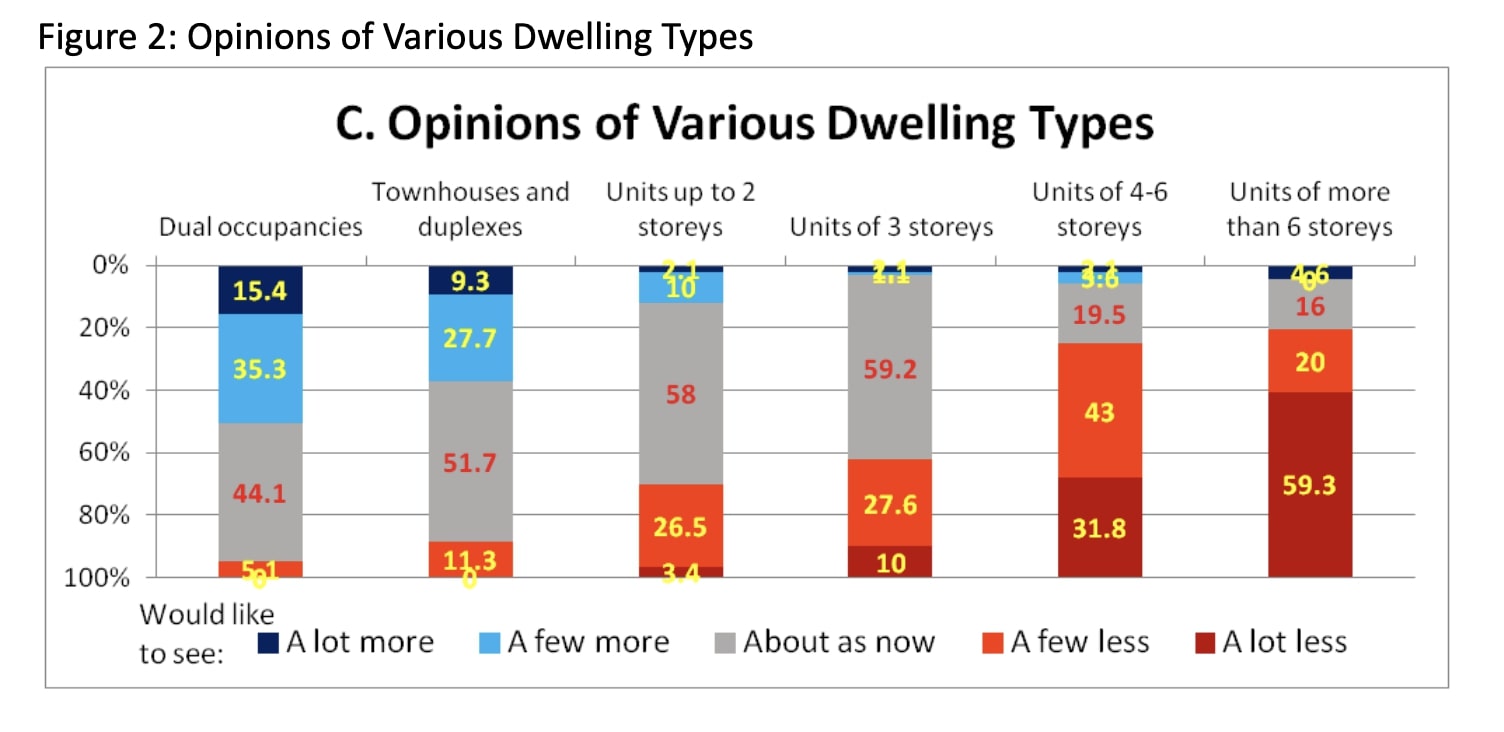
The survey found that dual occupancies and town houses had greater community acceptability than apartments, particularly those of four or more storeys.
 The market response to the policy has been to construct flats. Flats represented 74 per cent of higher-density dwellings provided between 2016 and 2021. Only 14 per cent had three or more bedrooms compared to 48 per cent of medium-density dwellings. While some households will trade off space for a central location, it is unlikely flats meet the needs of other households, especially those with children.
To increase the suitability and attractiveness of flats to a wider range of households a better understanding of requirements – number of bedrooms, storage space, quality of community space etcetera is needed.
Given high housing costs and the inadequate supply of social housing, some households would have had to occupy dwellings inappropriate to their needs.
The policy has not resulted in the provision of sufficient affordable town house and dual-occupancy dwellings to meet the needs of families with children or those wishing to downsize in a familiar location to a more energy efficient, lower maintenance dwelling.
It has not led to an increase in the provision of secondary residences (dwellings of 45sqm to 90sqm on residential blocks of over 500sqm, but not separately titled) which potentially could meet the needs of some older and lower-income households.
The efficacy of the policy has been reduced by the poor building quality and design of many redevelopments including overlooking, parking blight, increased congestion and loss of tree cover.
The policy has resulted in inadequate greenfield supply, reflected in the high number of bidders and high prices paid for the trickle of blocks being offered by the Suburban Land Agency and the demand for car-dependent dwellings in surrounding NSW, has contributed to increased housing costs in the territory.
Despite planning inadequacies – limited employment, delays in the provision of transport infrastructure, schools, shops and other facilities and reduced scope for soft landscaping – the greenfield areas of Gungahlin and Molonglo have met the housing preferences of many households.
Greenfield residents in Canberra do not experience the poor accessibility of residents in larger cities. The city’s size and multiple centres, linked by high-quality transport, enable most Canberrans good access to employment, services and amenities.
The accessibility reduces the relative price premium for scarce inner-city land by making new suburbs a more attractive alternative to established suburbs.
The government’s strategy is not achieving its aims and needs review. The review would consider:
a) Factors influencing housing choice including employment location, proximity to facilities and services, travel time, amenity, views, dwelling quality and size, scope for capital appreciation, demographic factors (including age, income, changing household structure and overseas migration), the financial and emotional cost of change; the disruption and transaction costs of moving; government policies on pensions and capital gains taxes and promoting ageing in place.
b) Infrastructure, travel and environmental/ecological costs and benefits (including revenue) of potential greenfield and infill areas;
c) Residential policies to improve the quality and acceptability of redevelopments, to increase the attractiveness of flats to a wider number of households, to increase the viability of medium density redevelopments and the take-up of secondary
residences; consider government facilitated block amalgamation and whether an undersupply of suitable land and land values make it difficult to construct medium density dwellings at a price attractive to households;
d) Greenfields planning to improve local employment, the provision of facilities and services and transport connections;
e) The role multi-centred development has in the sustainability of greenfield development.
The infill target should be reduced and greenfield releases increased pending the outcomes of the review and evidence flats are meeting the needs of a wider range of households and medium density infill and secondary residences are viable.
Mike Quirk is a former NCDC and ACT government planner.
News all day, every day at CityNewsQBN.com.au.





Leave a Reply