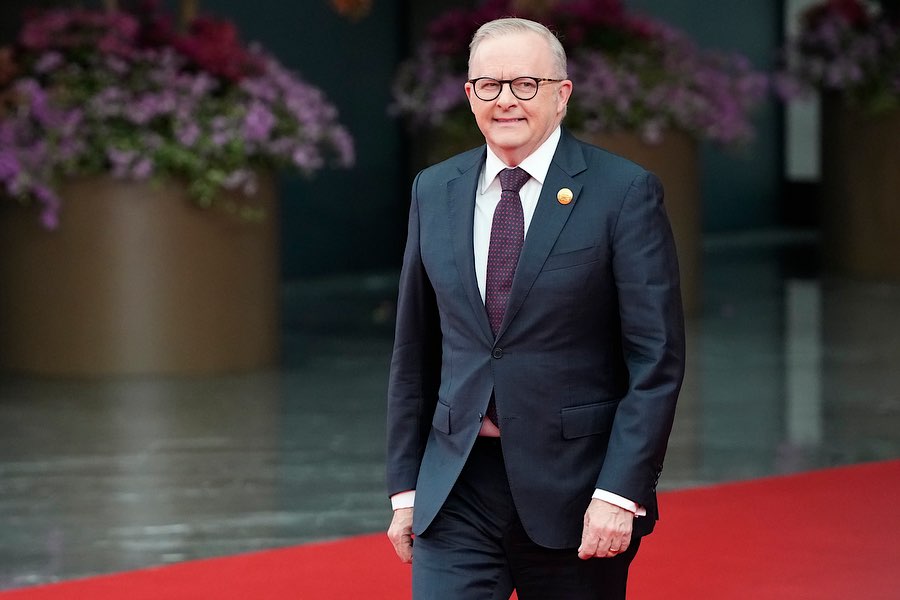
By Jacob Shteyman
Returning home from 11 days of being feted on the world stage, the economic reality will hit Anthony Albanese with a thud.
The prime minister was hailed by Chinese President Xi Jinping for helping achieve a “full turnaround” in relations between the two nations in Shenzhen on Friday, held after the conclusion of the APEC summit.
It was the final leg of a three-nation tour, taking in the COP climate conference in Turkey and the ASEAN summit in the Philippines.
With 21 of the world’s top nations gathered at the APEC summit, it gave Mr Albanese an opportunity to spruik Australia’s agenda for AI standards, open trade and deescalation of wars in Ukraine and the Middle East.
But his contributions were overshadowed by a historic trilateral meeting between the leaders of China, Russia and the US held on its sidelines.
The talks, held a day before Mr Albanese met with Mr Xi, drew comparisons to the 1945 Yalta conference, where the US, Britain and the Soviet Union divided up the ruins of Europe between themselves.
The fear was that the meeting could herald a return to major powers carving the globe up into spheres of influence, leaving middle powers like Australia, Japan and Ukraine with little autonomy.
Ukrainian President Volodymyr Zelenskiy feared his country’s future being decided without him in the room.
But Nick Bisley, an international relations expert at La Trobe University, said while the meeting was long on symbolism, it was short on substance.
“Trump will be gone in two years and while the domestic focus is likely to remain, the kind of personalised leadership he has pursued, that allowed this kind of meeting, is unlikely to persist,” he told AAP.
In the end, Ukraine barely rated a mention in the meeting.
Rather than heralding a shift away from multilateralism, the fact the meeting occurred on the sidelines of a multilateral meeting showed they remain relevant, Professor Bisley said.
Indeed, Mr Trump’s attendance at the Quad leaders’ meeting – with Mr Albanese, Japanese Prime Minister Sanae Takaichi and India’s Narendra Modi on the sidelines of ASEAN in Manila – revitalised the institution, which analysts argued had shrunk in stature during Mr Trump’s second term.
The fact that the four nations agreed to hold military exercises together for the first time, with Australia contributing P-8 and P-C3 patrol aircraft, was an indication that the US still devotes at least some of its focus to the Asia-Pacific.
“Australia’s real focus is on East Asia, and the agreements at ASEAN and the revitalisation of the Quad are probably the most important achievements,” Prof Bisley said.
“More generally, Australia has a vital interest in ensuring the multilateral structures function and deliver, and in contributing to this, Australia had advanced its interests.”
Whether this is enough to justify his 11-day trip to voters back home is another matter.
Much of the focus was taken up by criticism about spending at the COP climate conference in Turkey, a ribald conversation with Climate Change Minister Chris Bowen caught on hot-mic, and his appearance in a staged group photo with Russia’s president.
But arguably the most critical development during the trip happened at home, when the Australian Bureau of Statistics revealed unemployment jumped to a five-year high of 4.9 per cent in October.
Mr Albanese will get little reward from voters for taking China-Australia relations to new heights, but if the economy slides into a recession, he will shoulder all of the blame.
News all day, every day at CityNewsQBN.com.au.





Leave a Reply