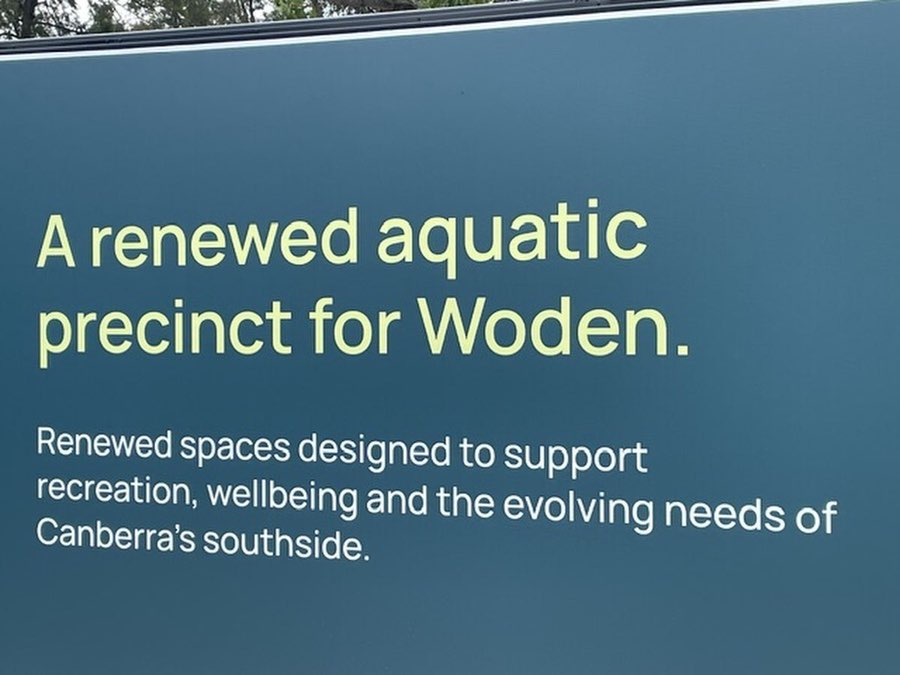
“So having taken away two pools for toddlers and the only shady areas where families could relax, we are meant to be feeling “well being”. We are meant to be looking forward to a 25-metre pool inside an apartment block. Really!” Letter writer PENNY MOYES isn’t happy…
On my first swim of the season at Phillip pool, I was confronted by fences roping off the only grassy, shady area and a sign announcing the Phillip Aquatic Centre.

Apparently this is to be a “renewed aquatic precinct for Woden with spaces designed to support wellbeing”.
So having taken away two pools for toddlers and the only shady areas where families could relax, we are meant to be feeling “well being”. We are meant to be looking forward to a 25-metre pool inside an apartment block. Really!
And let’s not forget, this development started with a stroke of a pen allowing Geocon to build only a 25-metre pool. This process is being examined, but whatever the outcome nothing will change.
It’s hard not to feel very angry.
Penny Moyes, Hughes
Long grass is a win for environment and budget
There are regular complaints to the paper about the long grass along Canberra’s roadsides, but the long grass is actually a win for our local environment and the ACT budget.
Leaving verges to grow naturally creates vital wildlife corridors. Native birds, lizards, and pollinators like bees and butterflies rely on taller grasses for food and shelter, especially during breeding seasons.
It also helps our native grass species – like kangaroo grass – set seed and thrive, outcompeting invasive weeds over time.
Beyond biodiversity, unmown grass acts as a natural sponge. Longer blades and deeper root systems trap stormwater, reduce soil erosion, and filter runoff before it hits our lakes and waterways. It also keeps the ground cooler, reducing the urban heat island effect during blistering Canberra summers.
Finally, there is a practical upside for ratepayers. Prioritising mowing for high-risk bushfire zones, playgrounds, and road sightlines rather than every single suburban verge saves significant public money and cuts down on fuel emissions from constant mowing.
A slightly wilder roadside isn’t a sign of neglect – it’s a sign of a healthier, more sustainable Bush Capital.
Clive Williams, Forrest
Hoons hold Belconnen residents ‘hostage’
Belconnen residents are being held hostage every weekend by an escalating wave of dangerous driving, burnouts, and aggressive antisocial behaviour.
Late at night along Eastern Valley Way and Emu Bank – particularly around the Emu Bank McDonald’s car park – modified cars congregate to rev engines, race and intimidate other road users and pedestrians. Beyond robbing nearby residents of sleep, it is only a matter of time before reckless driving or aggressive confrontations result in a serious collision or violent incident.
Occasional territory-wide police blitzes are clearly not deterring repeat offenders in Belconnen. We need sustained, targeted patrols in known hotspots, streamlined channels for residents to submit dashcam footage, and far tougher consequences.
If repeat offenders continue to treat suburban streets like a racetrack, their vehicles should be permanently seized and crushed – and ACT Policing should follow the lead of other jurisdictions by publishing the footage on YouTube.
Stripping away the bragging rights with a public crushing is the kind of visible deterrent that might finally get the message through.
Residents shouldn’t have to wait for a tragedy before our MLAs and ACT Policing take decisive action.
Mark Micallef, Belconnen
Crush their cars, problem fixed
In a previous letter to CityNews titled “Hoons control the streets”, I highlighted evidence of increasing rubber being laid in our suburbs by burn-out Bathurst wannabees and called for action to counter this rot.
Nothing much has changed in the intervening period. While my earlier remedy might have appeared excessive to some (the impounding of offenders’ vehicles and judicial crushing) it would have an immediate effect when the skids are put under the first couple of offenders.
The message will pass through them like a bolt of lightning and create a reality check for the nonsense we see unfolding.
This is all probably too much for our leaders given the modern tendency to protect the rights of all, no matter the wider impact.
If that’s the case, it’s a tragedy so you’d be wise to stay safely off the road and revert to public transport.
John Lawrence, via email
Scared by electric bikes on shared paths
I regularly walk my dog along the shared paths in Isaacs, usually in the morning
It is generally a peaceful and enjoyable experience, but I have become increasingly concerned about electric motorbikes using these paths.
Recently, I have observed a father and son riding electric motorbikes along paths intended for pedestrians and cyclists. These are not ordinary bicycles, and their speed and relative silence present a real danger to other path users.
I am hearing impaired and have undergone a hip replacement. Consequently, I am not always able to hear an approaching vehicle or move quickly out of its way. What might be a minor inconvenience for a younger, more agile person could result in a serious injury for someone like me.
I certainly don’t begrudge families enjoying outdoor activities together, but surely there are more appropriate places to ride motorbikes than paths shared with people walking their dogs, elderly residents and children.
This raises two questions. Why aren’t these electric motorbikes required to be registered and identifiable, as other motor vehicles are? And why don’t the police take a more active role in discouraging their use on shared paths?
Our shared paths should be places where everyone can walk or cycle without fear of being struck by a motorised vehicle. I would hate to see someone seriously injured before this issue receives the attention it deserves.
David Evered, via email
Well, that was a strange week
It was a strange week, Gentle Reader.
First, the (Anglican) rev Sandie Kaine branded the wife of the Ukrainian ambassador and two supporters as “bigots” when they declined to share a space with the wife of the new Russian ambassador whose country is waging a bloody, unprovoked war in Ukraine.
It was surely the only moral thing to do. Do they have Confession in the Anglican Church?
Then, in the letters column, the reiteration by Ben Gershon (CN November 12) of the tired, empty excuse for Israel’s vicious campaign of murder and destruction in Gaza (not even the Israeli propaganda machine uses it anymore – the scale of destruction is so far in excess of any conceivable Hamas infrastructure) is followed by Rebecca Marks’ moving, harrowing account of the leftovers of the ACT’s “humane kangaroo cull” – gunshots, pools of blood, dead bodies, body parts, traumatised orphans.
I can’t be the only Gentle Reader who sees the similarity with Gaza today.
John Griffin, via email
Arafat failed to prepare his people for peace
John Griffin is right that Rabin and Arafat shook hands on a peace deal, and John and Peter Curtis are right that Rabin was subsequently shot by an Israeli extremist (letters, CN November 11).
However, Rabin’s successors as prime minister, including Netanyahu, continued to honour the deal, progressively handing more land to the Palestinian Authority and ultimately offering a state, whereas Arafat never honoured it.
Arafat failed to psychologically prepare his people for a two-state peace as required and, when the statehood offer came, he not only rejected it outright without even making a counter-offer, he then launched the second intifada, which killed more than 1000 Israelis.
If Clinton’s reaction to Camp David was because of his bruised ego, as Peter claims, he would have blamed both sides, not just Arafat.
Peter mentions that a Jewish extremist destabilised the process by perpetrating the Hebron Mosque massacre. Hamas destabilised it more with a sustained campaign of bombings, mainly of buses.
Peter also repeats the falsehood of an Israeli genocide in Gaza, but Israel was fighting terrorists who were hiding among civilians, and it was warning civilians to leave before attacking and evacuating them to safe zones, not trying to kill them.
David Bates, via email
Strong advocate for health education
Thank you for the feature story about Michael Moore and the reminders of a few of his many contributions to public health (“There’s much more to Moore than meets the eye”, CN November 12).
Dr Moore’s tenure as ACT Minister for Health (April 1998 to November 2001) came at an important and often controversial time in the ACT for several areas of public health, including tobacco control.
After becoming the first Australian jurisdiction to enact smoke-free enclosed public places legislation (in 1994), the ACT then strengthened controls on tobacco advertising and retail displays and also introduced tobacco retail licensing.
Minister Moore recognised that complex public health issues often require a multi-faceted approach and was a strong advocate for health education and information.
He regularly talked with young people about their knowledge, attitudes and beliefs about tobacco smoking.
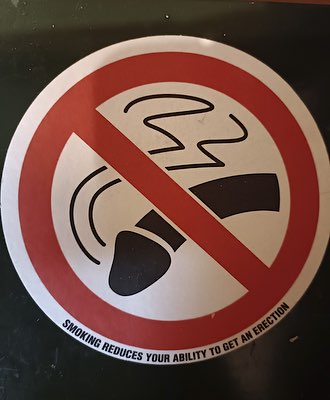
One concern expressed by young males about the impact of an important, but rarely discussed, smoking-related health issue became the inspiration for the launch, in 2001, of a striking variation on the traditional no-smoking sign.
Margo Saunders, former Senior Tobacco Policy Officer, ACT Health
Importantly, cricket has changed
Usman Khawaja comes across as a decent man. On the ABC’s 7.30 program he did not want to name any of his fellow players out of respect for them.
He had made a statement, which had been corroborated by some of his teammates; it was not in conflict with the aggressive culture of Australian cricket at the time. There was no need for him to elaborate on his statement.
Mr Khawaja also feels he was overlooked for the captaincy after Steve Smith and David Warner were stood down, partially because of his Pakistani background.
I have some experience of cross-cultural relationships. There is no doubt that Asians, in particular, often feel a bias against them – it is difficult to discern unless you are in a deep relationship with them.
As the recent saga will see to it that ball tampering will no longer be attempted on a large scale, there is no need for a further inquiry. Importantly also, Australian cricket has changed.
Herman van de Brug, Holt
Mr Barr, show us what you’re hiding
Rebecca Mark’s letter (“Winter fills me with dread”, CN October 12) gives a graphic picture of the true nature of the ACT Government’s so called “conservation cull”.
The government’s heavily redacted operational reports from the recent “cull” tell their own story. Clearly, the government is hiding aspects of the cull it does not want the public to know about. Were some animals simply wounded with time having to be spent searching for them in the dark, as has happened at times in the past?
The blood pools and trails observed by members of the public the morning after the shooting would suggest this is highly likely.
If that is not the case, then un-redact all those parts of the operational reports. Redacting shooters and other personnel names is fair enough, but there should be no other legitimate reason to redact any part of the reports.
Mr Barr, please show us what it is that you do not want us to read about. Un-redact those reports immediately!
Jennifer Macdougall, Farrer
Where is the hard evidence on guns?
It’s not often I agree with Liberal members of the ACT Legislative Assembly; however, I agree with their querying the reasons for caps on the number of licensed firearms a person can own.
I have a good friend who lives rurally and has a large firearm collection. As a Wildcare volunteer, my friend is called out to assess injured wildlife; sadly, he is often required to euthanise animals suffering untreatable injuries/illnesses by shooting them. This is a quick and humane way to end a terminal life.
He collects firearms, the same way he and others collect stamps, number plates, old typewriters, memorabilia etcetera. Many of the guns he owns are unusable.
I can’t find statistics that reveal how many people have been killed by people using licensed firearms and how many by unlicensed firearms.
Please don’t get me wrong, I totally agree with firearms being seized from domestic and family violence alleged and convicted offenders, people engaging in terrorism activities, people struggling with mental ill-health etcetera. However, where is the hard evidence that it is registered firearms that are the problem?
Quite simply, people kill people, with or without firearms. Or as a T-shirt our daughter bought my husband, states: “Guns don’t kill people, dads with pretty daughters do”.
Janine Haskins, Cook
News all day, every day at CityNewsQBN.com.au.



Leave a Reply