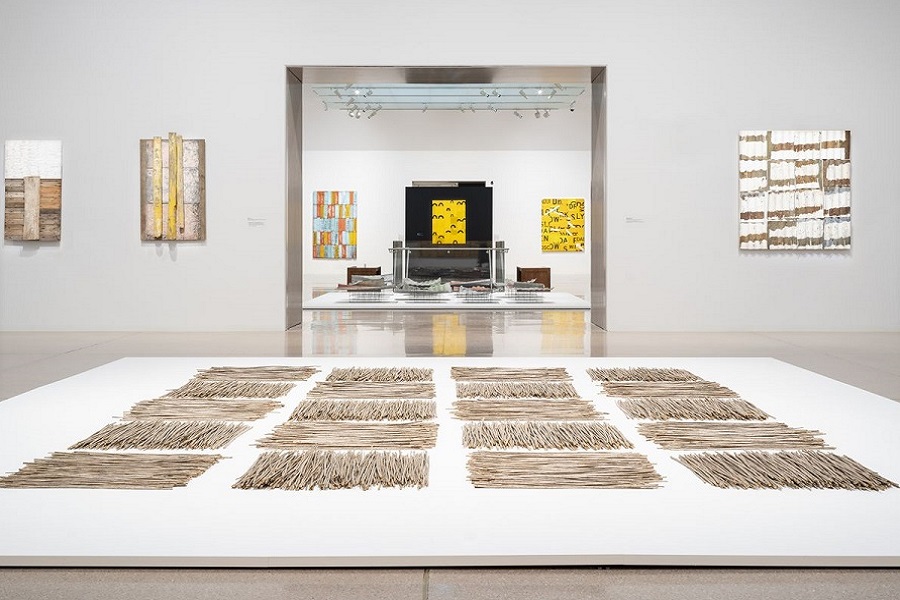
Visual Arts/ Rosalie Gascoigne. At National Gallery of Australia until February 14. Reviewed by KERRY-ANNE COUSINS
Much has been written recently in reference to this important retrospective exhibition about the life and career of Rosalie Gascoigne at the National Gallery of Australia.
Recognised as a unique talent in her lifetime, the artist has been well served by the insightful scholarship of Dr Deborah Hart who has been the guiding light behind this exhibition.
In view of all the scholarly writing about Gascoigne, mine is a more personal approach. I am encouraged by Gascoigne who wrote, “People don’t need your experiences; they need their own.”

I always found myself thinking of Rosalie Gascoigne every time I drove along the Federal Highway to Sydney and breasted the hill just before Lake George. That was when Gascoigne’s monumental work called Suddenly the Lake would come to mind.
She captured perfectly that moment as you come to the rise between two low hills where, before you, as she wrote, “is that water, that straight line (of the Lake)?”.
It is a strong work made from galvanised iron and weathered wood impregnated with the colours of the landscape.
In works such as these I see the strong connection with the work of fellow NZ artist Colin McCahon – whose equally evocative 1950 landscape Six Nights in Nelson and Canterbury also reduces the landscape to its powerful essential presence.
Related to the Lake George work is a floor installation called Swan made of swan feathers collected from the lake shore. Bound together so that the gathered feathers form an uneven fringe they arch across in a line and carry with them associations with the appearing and disappearing fences that traverse the shallow reaches of Lake George.
Among the many other fine works in this exhibition is another iconic work simply called Monaro 1988-89 that will resonate with anyone who knows the Canberra region. The artist was drawn to the country around the Monaro with its contours and stretches of yellow grass.
In this work the long wooden yellow strips of reclaimed wood with their printed black text are joined together to form a rippling surface of golden colour and line.
It has an impressive presence transcending the materiality of its creation – a visual impact that gives the viewer a jolt of recognition, a message to the senses, as the work magically seems to evoke the effect of wind across the grass plains.
Rosalie Gascoigne is an artist who drew on the discarded detritus of our material lives as well as the natural world around her and in doing so made art that transcends it all.
News all day, every day at CityNewsQBN.com.au.




Leave a Reply