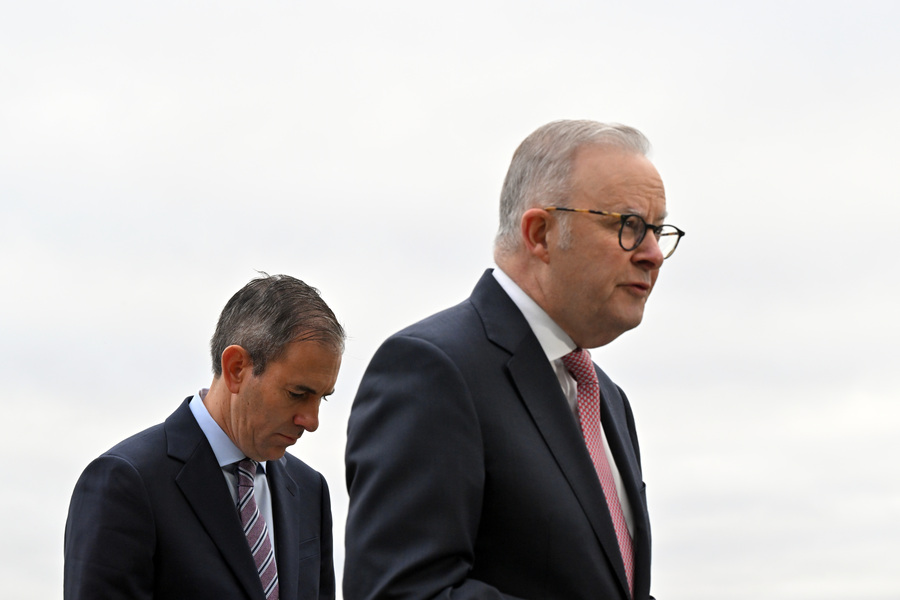
Anthony Albanese promised a government that would leave no one behind, but economic pressures are testing his care agenda. AAP Image/Susie Dodds
Can Labor remain the party of care while tightening the purse strings? JOSHUA BLACK examines how economic pressures are reshaping Anthony Albanese’s social reform ambitions.
In 2022, Anthony Albanese offered Australians a future in which “no one is held back, and no one is left behind”. He pledged reform in health, aged care, child care and disability services, along with a more self-consciously empathetic style of leadership.
Albanese’s origin story as the child of a disabled single mother who raised him in public housing endowed his election pitch with an important personal touch.
Rhetoric and style are important elements of leadership. As political scientist Blair Williams has argued, Albanese and state counterparts such as Premier Peter Malinauskas in South Australia modelled a more “caring and inclusive” masculine leadership. The contrast with self-appointed “strong” leader types, Donald Trump and Peter Dutton, was clear.
Vibes can be hard to change, policy regimes arguably even more so. The stakeholders are numerous and noisy. In the care economy, advocates and bureaucrats have different ambitions. The legislative opportunities are scarce.
Four-and-a-half years into the government’s tenure, there are still intractable problems in the care economy. So, what has been achieved, and where did the going get tough?
First-term transformations
When Labor came to office, urgent change was needed on several policy fronts.
Bulk billing rates in general medical practices were falling. By one estimate, staff turnover in the child care sector had reached between 20 per cent and 37 per cent. Royal commissions into aged care and the unlawful Robodebt scheme showed how neglect and hard-heartedness had harmed Australian citizens.
Aged care was first cab off the rank, with the introduction of new assessment tools for gauging patient need and costs, requirements for round-the-clock registered nurse attendance and new targets for the minimum number of care minutes per patient.
As of mid-2026, roughly two-thirds of Australia’s self-reporting residential aged care homes were meeting those care minutes targets. Home care reforms soon followed.
The revival of Medicare – a Labor creation that celebrated its 40th birthday in 2024 – was another urgent priority. Large investments were made to increase bulk-billing incentives covering children and concession card holders, and then eventually – at a cost of $8.5 billion – all GP patients.
In 2025-26, the share of non-referred patients who were “always” or “usually” bulk billed rose to 77.4 per cent, up by nearly 5 per cent on the previous year. New Medicare urgent care clinics and a 1800Medicare telehealth service were also added to the mix.
On children’s side
There were echoes of an older Australian state paternalism in the government’s quest to protect children from online harm.
The under-16 social media ban was one reform, albeit experimental, imperfect and subject to High Court deliberations.
Another example is Labor’s ban on the distribution of deepfake pornography and restrictions on Nudify apps, designed to protect young children and girls in particular.
Child care was Albanese’s cause celebre. In 2025, he said the move to a universal three-day guarantee (for families earning less than $533,000) was his most important legacy.
By then, the government had also grasped the challenge of worker retention, delivering a 15 per cent pay rise grant in 2024, which has since been extended.
Still, regulatory failure and appalling sexual abuse cases have generated public alarm. The policy response involves mandatory training, workforce registers and CCTV monitoring trials, among other measures.
These initiatives are earnest, but their burden falls chiefly on workers, and adds to an unhelpful social ambivalence towards the sector’s male educators.
Historian Bede Nairn showed early Labor figures set out in the 1890s to civilise capitalism. Civilising techno-feudalism (as author Yanis Varoufakis describes our digital servitude to tech lords) may be its current equivalent.
But doing both is proving hard.
Caring in tough times?
The current term of parliament has brought tougher conditions for reformers. A sustained cost-of-living crisis, stubborn inflationary pressures, a sticky budget deficit and the populist revolt to One Nation mean that savings, not spending, are the order of the day.
The National Disability Insurance Scheme (NDIS) – another Labor creation – was an obvious target. Labor’s first term brought renewed focus on the scheme’s costs, systemic fraud and the retreat of state governments from the field.
Most states have agreed to play a greater role, and Commonwealth hospital funding proved useful leverage in negotiations.
Health Minister Mark Butler, South Australian left MP and the face of Labor’s care agenda, is increasingly discussed as a possible successor to Albanese. Butler has signalled the NDIS should cost $55 billion by 2030, not $70 billion as is currently projected.
In August, federal parliament passed Butler’s changes, which included tougher registration requirements for providers, access to funding on the basis of “functional capacity” assessments rather than diagnosis, and fewer unplanned, costly reassessments.
The reforms remain contentious, with many details yet to come.
Productivity problems and ageing pains
In the mid-1980s, the Hawke government was criticised for its preoccupation with economic reform and spending restraint (though plenty of social reform still got done, it has to be said). There are some similarities with the current environment.
As in the 1980s, high inflation and weak productivity growth have proved stubborn, the causes domestic as well as global. Now, as then, tax reform absorbs much of the government’s – and bureaucracy’s – capacity.
Economic urgencies have bumped social policy innovation to a lower tier. A dedicated Care and Support Economy Unit in the prime minister’s department, formalised two years ago, was disestablished this year.
Treasurer Jim Chalmers’ “wellbeing budget” framework – called Measuring What Matters – was feted on release in 2023, but now languishes with the Australian Bureau of Statistics for occasional reporting.
Measuring What Matters is about tracking our progress so we can better align our economic and social goals in our communities and right across our country. Learn more at: https://t.co/kLR08BEH4Xpic.twitter.com/i0UkANvtYC
Departments were asked to cut 5 per cent of their budgets last year, while fuel security has dominated the scene this year.
Larger problems loom on the horizon. Hospital emergency rooms are teeming with older Australians who have fallen through the system’s growing cracks.
The new intergenerational report predicts a third of growth in health spending over the next 40 years will be driven by ageing. Projections show future workforce shortages across the health and care sector but, as health economist Stephen Duckett argues, there are few solutions on offer.
Proceeding with care?
In the early 1900s, Australia seemed to outsiders a “social laboratory” in which the state provided citizens with unique services and supports. The Labor Party itself was founded in the 1890s with a mission to “make and unmake social conditions”, as one early parliamentarian put it.
Today’s leaders are easily condemned by way of comparison. The care and profit motives pull in different directions, and Labor struggles to reconcile them.
There are health inequities in regional communities and likely gaps in care arising from recent NDIS changes. The market forces that many parliamentarians trust are not always trustworthy for those in need.
For decades, Australians were told the public sector was the poor, inefficient cousin of private-sector service provision. That mentality bred institutional failure and policy neglect.
Of course, when Labor attempts redistribution – as with Butler’s plan to divert funding from the generous over-65s private health insurance rebate to cover 5000 aged care beds each year – there is swift backlash.
There is still a whiff of the social laboratory about Australia. The under-16s social media ban was world-leading and novel. A proposed “digital duty of care” reform bill, which would give Australians control of their social media algorithms and require tech providers by law to protect children from harmful content, is also substantial (and hated by American lawmakers and libertarians).
Future policy might involve more subsidies, mandates and targets, with modest effects on service access and quality.
Alternatively, there may be greater public ownership and provision of care, funded through hard budgetary choices. The Commonwealth’s Building Early Education Fund allocates half a billion dollars for the government to “build, own and lease” child care centres. The NSW government assumed full public ownership of the troubled Northern Beaches hospital earlier this year. These are positive steps on a road less travelled in recent years.
One Nation’s rise threatens to upend the political order in NSW, while high inflation and the prospect of another interest rate rise deepen Labor’s difficulties, writes political columnist MICHELLE GRATTAN.
Anthony Albanese wants politicians to turn down the heat, but a crossbench senator’s angry outburst and fresh questions over a $6 million golf club grant have turned it back on him, writes political columnist MICHELLE GRATTAN.
"To be credible, the ACT Government has to stop its obfuscation and commission an independent assessment to evaluate if bus rapid transport could deliver the benefits of light rail at lower cost," writes planning columnist MIKE QUIRK.




Leave a Reply