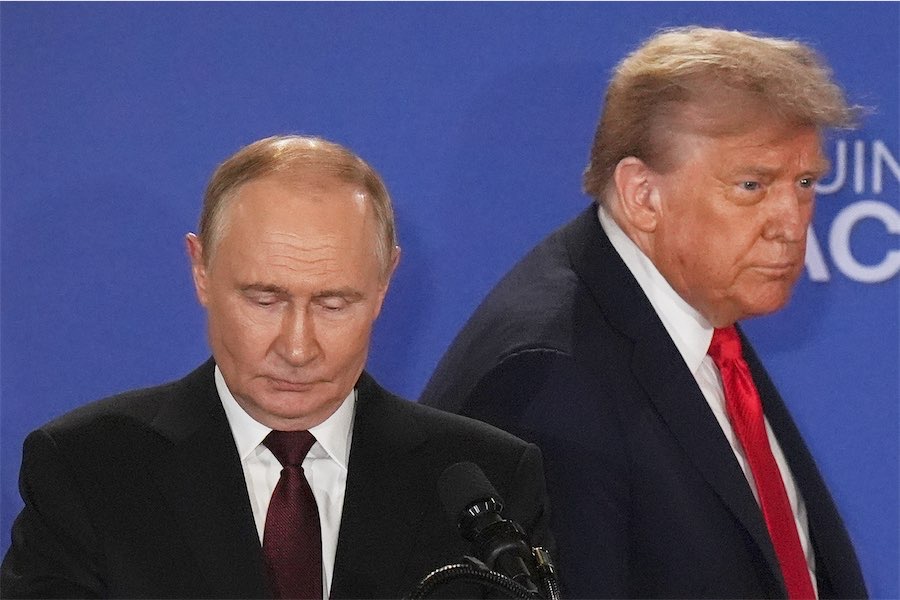
Putin and Trump… the 2019 Mueller investigation’s conclusions did not establish that Russia was blackmailing Trump or that Putin controlled his decisions. Photo: AP
“Allegations that Russia possesses compromising material on Trump date principally from 2016-17. The Steele dossier alleged that Russian intelligence had collected damaging personal information,” writes CLIVE WILLIAMS.
Donald Trump’s recent decisions favouring Russia raise an uncomfortable question: does Vladimir Putin possess compromising material that enables him to influence the US president?
Clive Williams.
The question is legitimate given the consequences of Washington’s changing policies towards Moscow. But evidence that a policy benefits Russia is not, by itself, evidence of blackmail.
On October 9, Trump announced an arrangement allowing Russia to supply more than 300,000 metric tonnes of diesel, equivalent to about 2.25 million barrels, to international markets, with further shipments proposed.
Washington temporarily relaxed sanctions to facilitate the exports.
Trump presented the arrangement as a way to ease fuel prices ahead of November’s midterm elections.
Russian diesel exports subsequently resumed to traditional markets, including Turkey and Brazil, although the effect on consumer prices remains uncertain.
Critics argue that the arrangement provides Russia with additional revenue while its war against Ukraine continues.
On October 22, Senate Democrats prepared to investigate companies involved in the arrangement, adding to scrutiny of the administration’s decision.
On October 16, Trump issued an executive order invoking waiver provisions in the Lindsey O Graham Sanctioning Russia and Iran Act, signed into law on September 18.
The legislation was intended to increase pressure on Moscow and countries purchasing Russian energy. Trump invoked national-interest grounds to suspend the application of key provisions, weakening the immediate impact of Congress’s initiative.
Relations with Ukraine have also deteriorated. Trump has criticised President Volodymyr Zelenskyy, pressed Kyiv to negotiate a settlement and sought to discourage attacks on energy infrastructure.
US intelligence-sharing with Ukraine was briefly interrupted but had resumed by October 18, according to Zelenskyy. These developments have fuelled Ukrainian and European concerns that Washington’s approach could weaken Kyiv’s negotiating position.
The decisions have attracted bipartisan criticism in Congress. Russian officials, meanwhile, have welcomed the easing of economic pressure.
The consequences are significant. But consequences alone do not establish motive.
The blackmail hypothesis
Allegations that Russia possesses compromising material on Trump date principally from 2016-17.
The Steele dossier alleged that Russian intelligence had collected damaging personal information, including the story popularly known as the “pee tape”. Other suspicions have concerned Trump’s financial dealings and business interests.
These allegations have not been substantiated by publicly verified evidence.
The Mueller investigation concluded in 2019 that Russia had interfered in the 2016 presidential election. It examined contacts involving Russian individuals and Trump campaign associates, as well as discussions about a proposed Trump Tower project in Moscow during the campaign. It did not establish that Russia was blackmailing Trump or that Putin controlled his decisions.
That distinction matters. The investigation did not establish that compromising information could not exist. Equally, the absence of public evidence does not justify treating blackmail as the default explanation for every controversial presidential decision.
The responsible conclusion is that Russian kompromat remains an unproven hypothesis, not an established explanation for Trump’s present policy.
Commercial interests and political calculations
A further concern is the intersection of diplomacy and commercial interests. Negotiations over ending the war in Ukraine have reportedly included discussions about a possible multibillion-dollar acquisition of Lukoil’s international assets, a portfolio initially valued at about $US22 billion.
Reporting by the New York Times, subsequently carried by Reuters, identified US investor Todd Boehly, Middle Eastern business groups with connections to the families of Trump envoys Steve Witkoff and Jared Kushner, and a US government investment body among the reported participants in a prospective bid.
According to that reporting, Putin raised the possibility of the transaction with Witkoff and Kushner as a demonstration that US-Russian business relations could resume.
These reports require careful interpretation. They describe a proposed transaction, not a completed sale or a confirmed consortium with settled financial commitments. The precise roles of the reported participants, the proposed ownership arrangements and the eventual beneficiaries remain uncertain.
The reported connections between some business interests and the families of US negotiators also do not, without further evidence, establish improper conduct.
The US private equity firm Carlyle, which had agreed to acquire Lukoil’s international assets subject to US Treasury approval, ceased actively pursuing the transaction in October after the agreement expired without approval. On October 22, Washington extended the deadline for prospective buyers to negotiate with Lukoil until November 21. The sale process therefore remains open.
The episode warrants scrutiny of whether commercial opportunities are becoming entangled with diplomatic negotiations.
However, there is no established evidence that Trump personally stands to benefit from the proposed transaction or that the prospect of a sale determines his Russia policy.
There are also straightforward political explanations for Trump’s approach. Lower fuel prices would be advantageous before the midterms. He has consistently favoured personal diplomacy, negotiated settlements and commercial engagement, often placing less emphasis than previous administrations on sustained economic pressure and alliance solidarity.
His administration also appears to prioritise China and the Western Hemisphere over maintaining the previous level of American involvement in European security.
This is a contested strategic choice with potentially serious consequences for NATO and Ukraine, but it does not, in itself, demonstrate personal compromise.
Suspicion is not proof
Three conclusions seem justified.
First, Trump’s recent decisions have eased economic pressure on Russia and undermined Ukraine’s position. The diesel arrangement, sanctions waivers and reported commercial discussions are legitimate subjects of scrutiny.
Second, domestic political calculations, a preference for negotiated settlements, strategic priorities and prospective commercial opportunities offer plausible explanations for Trump’s approach. These motives may coexist, and their relative importance cannot be established with certainty from public evidence.
Third, the claim that Putin is blackmailing Trump remains unproven. Historical allegations of compromising material have not been substantiated publicly, and the Mueller investigation did not establish Russian control of the president.
None of these conclusions requires accepting Trump’s explanations at face value. His decisions should be judged against their stated purposes, actual consequences and the interests they serve. Commercial dealings involving political associates deserve particular scrutiny, especially where diplomatic negotiations and potential private gains intersect.
The central question is not whether Trump’s policies benefit Putin; in several respects, they plainly do. It is whether credible evidence shows that this outcome results from blackmail rather than political judgment, strategic preference or commercial calculation.
The responsible conclusion is neither that Trump is Putin’s puppet nor that Russian leverage can be definitively ruled out. The policy shifts are real, their implications are serious, but the blackmail explanation remains unproven.
Professor Clive Williams MG is a former Australian defence intelligence analyst (clive.williams@terrint.org).
Barack Obama pointed out that people – being hungry for solutions to the problems they now face – need to see what real leadership looks like. But, says HUGH SELBY, we have no such leadership in Australia. "We're in a bad place".



Leave a Reply