By Jacob Shteyman in Canberra
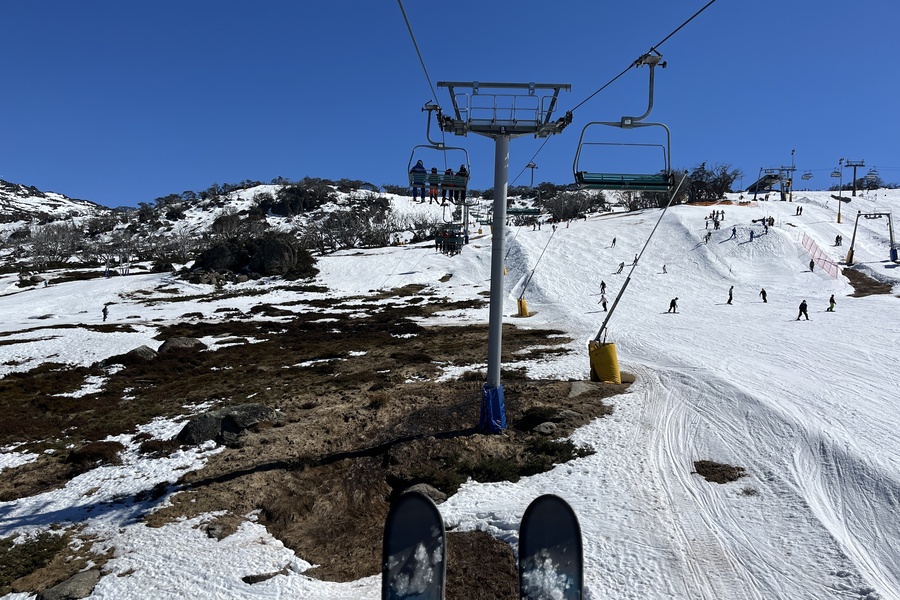
Winter is coming to an end, but for many the ski season finished much earlier.
According to snowfall data compiled by Snowy Hydro, 2026 is officially the worst end to a season since records began in 1954.
The natural snow depth on Friday at Spencers Creek between Perisher and Charlotte’s Pass in the NSW alps was 56cm, the lowest for the end of August.
Only 1973 comes close.
A mark of 57cm was recorded on August 30 that year before a late-season dump pushed the peak to more than 123cm in September.
While forecasts offer hope of light falls in the coming weeks, high temperatures and more rain on the outlook mean the snowpack will only shrink.
Rain has done the real damage, Monash University climate scientist Andrew Watkins says.
“What we’ve been seeing this season in particular has really been a combination of both climate change and El Nino,” he tells AAP.
El Nino years typically correlate with lower snowfall. But while they tend to have warmer temperatures, they can also lead to less rain, which can be conducive to good conditions.
However, 2026 has not been short on precipitation, with a few significant rain events washing away limited snowfalls.
Selwyn Snow Resort in NSW, Mt Baw Baw in Victoria and Ben Lomond in Tasmania have already closed for 2026, while major resorts such as Perisher, Thredbo and Mount Buller are operating at reduced capacity.
Usually, late August is peak season.
But as global warming continues, early ends to winter are likely to become more common.
Perisher hit a balmy 14.4C on Saturday, while the mercury showed 11.1C in Mt Hotham, both breaking records for their highest August temperatures.
Climate advocacy group Protect Our Winters, which includes Prof Watkins, estimates snow cover declined 30 per cent from 1954 to 2012.
Over the same period, the length of the ski season has contracted 17 to 28 per cent across most alpine resorts.
Under a mid-emissions scenario, the average ski season will be 44 days shorter by 2050, according to a 2025 report by the group.
No resorts will have enough snow to maintain a 100-day season, threatening their economic viability.
The financial impacts of this season were laid bare earlier in August when EVT, the ASX-listed company that owns Thredbo, slashed the resort’s value by more than half to $143 million.
The write-down reflected slower trading due to poor snowfall, as well as the need for greater investment in snowmaking infrastructure and to replace ageing chairlifts.
“Seasons like this have really demonstrated the importance and value of the investment in snowmaking,” says Josh Elliott, chief executive of Snow Resorts Australia.
He says projections of the climate impact on resorts don’t factor in increased investment in snowmaking, grooming and active snow management to extend the length of seasons.
Adoption of new snowmaking systems that can produce snow at temperatures up to 25C – albeit at a smaller scale than traditional snow guns – enabled Thredbo and Mt Buller to offer limited skiing and boarding throughout June, despite zero natural cover.
“In terms of being able to deliver a consistency of product, the technology is enabling that to occur and we envisage it will continue to adapt and evolve well into the future,” Mr Elliott says.
Collectively, Australian resort operators have invested more than $100 million in capital expenditure since 2020, including on lifts, accommodation and hospitality.
“Resort operators wouldn’t be making investments of that significance if they didn’t see a strong, vibrant and viable long-term future for the industry,” Mr Elliott says.
Some resorts, like Thredbo, are looking to reduce their reliance on increasingly fickle winters by investing heavily to attract visitors year-round, building new mountain bike tracks and a roller coaster.
Perisher’s Barakee Lodge proprietor Kylie Biggs has been pushing resort owner Vail to open during summer but has had little success.
“Summer trading obviously would attract a lot more investment into the mountain,” she says.
“The facilities would naturally be improved to suit the different demographic of guests who come in the summer.
“It’d be amazing for the mountain and for the region.
“It’s a hot topic and has been for many years but it doesn’t seem to get anywhere unfortunately.”
Ms Biggs says the ski season has been the worst she’s seen in 20 years and bookings for September have fallen off a cliff.
Rising costs, especially for insurance, have made it even harder to survive.
“After the bushfires (in 2019-20), several insurers left the market, so there were very limited options after that,” she says.
“Small business is tough in Australia anyway and especially in a niche industry like ours that has a limited peak period in winter. It’s extremely tough.
“So we do need to look at summer.”
Perisher general manager Nathan Butterworth says the resort will continue to invest in snowmaking to provide reliable cover but it is not looking at expanding its operations into summer.
“However, we are actively collaborating with the NSW government, community and other agencies on the Snowy Mountains Special Activation Precinct Master Plan, which aims to transform the region into a year-round tourism destination,” he says.
Independent federal MP Zali Steggall, who in 1998 won Australia’s first individual medal at a Winter Olympics, says reducing carbon emissions to mitigate the impact of global warming is the most important thing the government can do to protect the industry.
But she says plans are needed to diversify resorts away from relying solely on winters and to help fragile mountain ecosystems adapt to the changing climate.
“If I compare the focus the government has had on the impact to this region compared to the impact to the tourism industry of the Great Barrier Reef, for example, there’s just no comparison,” she says.
“They simply are not receiving that same level of attention and protection and support.”
While diversification offers some relief, it’s no replacement for the “magic” of skiing and boarding, Ms Steggall says.
A common refrain among punters this season, exasperated by walk-up prices as high as $278 for one-day lift tickets, is that there is no point skiing in Australia anymore.
Traveller numbers to Japan have exploded in recent years, aided by a strong exchange rate and relatively cheaper accommodation and lift tickets.
But Mr Butterworth says Australia will always have its own appeal.
“Having the ability to drive to the snowfields, sometimes within hours of the coast, is so special,” he says.
“As is being able to enjoy skiing through the beautiful snow gums. It’s uniquely Australian.”
News all day, every day at CityNewsQBN.com.au.




Leave a Reply