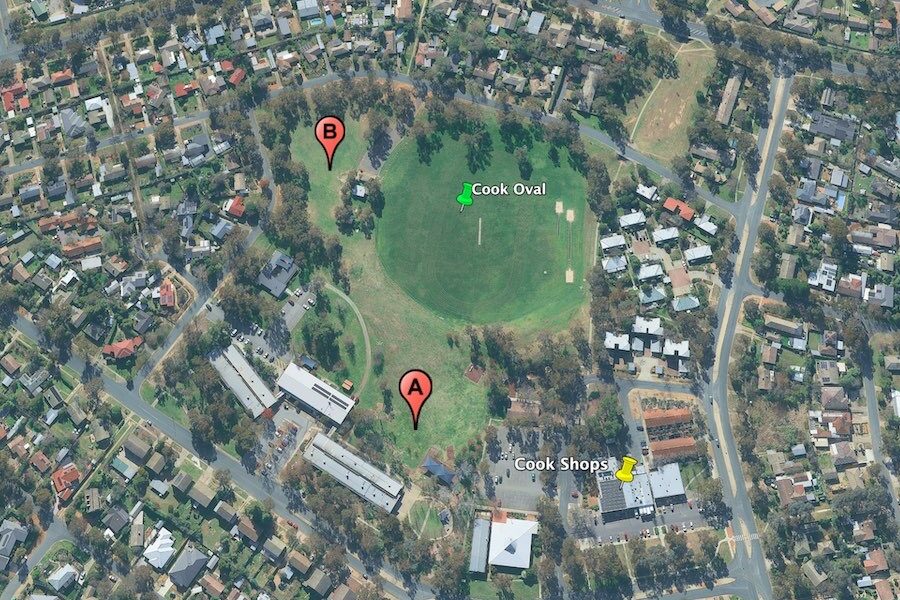
“Arcadia House drug and alcohol service should be relocated to an area that is less contentious and served by a Rapid Bus route,” says letter writer E WAL, of Aranda.
The proposed relocation of the Arcadia House drug and alcohol service from Bruce to green space in Cook is inconsistent with other ACT Government policies and initiatives.

For example, the ACT Government’s City Plan, November 2023, identifies a substantial area around the Jamison Group Centre for urban intensification.
If the number of dwellings and population in this area is to be increased, then there is a clear need to protect and enhance existing green spaces for community recreation.
There are already some community facilities on the site previously occupied by the Cook Primary School. Some of the green space in the adjacent suburb of Aranda has recently been taken over to accommodate a fire and ambulance station. Access to open space on public school sites has also been reduced by fencing.
Public transport access to Cook is particularly poor at the weekends, with bus services reduced to one every two hours on Sundays since 2019.
Arcadia House should be relocated to an area that is less contentious and served by a Rapid Bus route. One option would be to build a new facility on some of the community facility space currently used for CIT Bruce car parking.
E Wal, Aranda
Unbounded growth on a finite planet is impossible
Congratulations to Clive Williams on his excellent column (“How the obsession with growth holds us back”, CN July 9), which argued for a more sophisticated discussion about economic growth.
Growth in GDP does not necessarily lead to better lives for Australians. This is particularly so if the spoils disproportionately accrue to the wealthy.
Importantly, ongoing GDP growth leads to increased use of resources and creation of wastes. Green growth is a myth. In 1972, the landmark report, Limits to Growth, pointed out that humanity (particularly in western countries) is in ecological overshoot.
That is, we are collectively extracting resources and polluting more quickly than nature can remediate. Indeed, much of our current consumption depends on degradation of our planet.
We are seeing the fruits of this not only in climate change and rapid species loss, but also in increasing global water shortages and pandemics.
The national state of the environment noted that environment degradation was “a threat to humanity, which could bring about societal collapse with long-lasting and severe consequences”.
Unbounded growth on a finite planet is impossible. We need to live within the capacities of Earth’s natural systems, which are already starting to crumble.
Jonathan Miller, Curtin
A ‘hello’ can change a whole day
I spend my working weeks alongside older Canberrans and lately I keep noticing the same quiet thing.
Walk through any of our suburban shopping centres mid-morning – Jamison, Cooleman Court, the Hawker shops – and you’ll see them; older people sitting alone over a cup of tea they’ve made last an hour.
It’s not because they’re waiting for anyone, but because a café is somewhere to be around other human beings.
We talk a great deal in these pages about hospitals, aged care and health budgets. We talk far less about loneliness, which the research now tells us is as damaging to an older person’s health as smoking. It doesn’t show up on a waiting list. It shows up as a slow fade.
What I see, again and again, is how little it takes to turn that around. A genuine ‘hello’. Ten unhurried minutes. Someone who asks a question and actually waits for the answer. The change in a person’s face is immediate.
We can’t outsource all of this to services and government. Notice the older neighbour on your street this week and have a real conversation with them for five minutes. It matters more than you think.
Kimberley Creech, director, Golden Days ACT
Theatre’s answer may be thinking small
While there have been a series of high-profile closures in Australia’s theatre industry, smaller independent venues are killing it with the Mill Theatre’s Cocktail Cabaret show at Ambrosia Lounge selling so fast in June and July, it’s back for August.
When high-profile shows with big budgets aren’t attracting enough people to keep them going, maybe it’s the smaller, local, more immediate and engaging shows that can get us through this.
Lexi Sekuless, director, Mill Theatre
Minister Paterson is just caving in
I refer to Penny Moyes’ letter (CN, July 9) regarding Minister Marisa Paterson’s negative response to her question on the decision by the ACT Government to not revisit the changing of the territory plan for a 50-metre pool in Woden to a 25-metre one, despite the ACT Integrity Commission reporting due process had not been followed.
This is yet another example of the minister caving into the Labor Party machine since she was made a minister. Not only had she sought to justify the purchase of electric fire engines that have spent most of their time off the road, are disliked by brigade officers themselves, cost twice as much as the normal fire engines and are so heavy that they have to carry less water and cannot be used on rough fire trails, but she has done nothing about the increasing prevalence of gambling advertising on TV, radio and print despite her doctorate being about gambling issues. Gambling advertising is aimed at our vulnerable youth, results in suicide, family breakdown, violence against women, debt and homelessness. Do we really want more of this?
If ACT voters do not wish to vote for a Labor Party party machine person, then they should vote independent rather for Ms Paterson or any of Andrew Barr’s ministers.
Ric Hingee, Duffy
Go see the tram rails buckling in the heat, Mr Barr
May I suggest that our chief minister visits Western Europe next?
The ticket and hotels might be a bit on the pricey side, but seeing tram and train rails buckle and overhead wires sagging in the heat might lead to the understanding that our tram should not be extended any further and save us and future generations billions.
Prof Beatrice Bodart-Bailey, via email
Has self-government delivered on its promise?
As the ACT approaches the next election cycle, perhaps it is time for ratepayers and taxpayers to ask a fundamental question: has self-government delivered on its promise?
When self-government was introduced in 1989, it was intended to provide local decision-making while improving accountability and efficiency.
Nearly four decades later, many residents would argue that the opposite has occurred. The ACT Government now carries responsibilities that, for a relatively small jurisdiction, have become increasingly expensive to administer. Rising rates, taxes and charges have left many households questioning whether they are receiving value for money.
Unlike Australia’s states, the ACT has a comparatively small population and revenue base, yet it is expected to fund and manage many of the same services. As the cost of infrastructure, health, education and public administration continues to rise, the financial burden on residents has become increasingly difficult to justify.
One option deserving serious public debate is whether the ACT should return to direct Commonwealth administration. Before self-government, the federal government managed the territory, recognising Canberra’s unique role as the nation’s capital.
Reverting to that model could reduce duplication between territory and Commonwealth functions, simplify administration and potentially deliver more efficient use of public funds.
The years leading up to 2028 provide an opportunity for a mature public discussion about whether ACT self-government remains the best model for Canberra’s future. Ratepayers deserve an honest assessment of the costs, benefits and long-term sustainability of the current system, alongside consideration of whether returning administration to the Commonwealth could provide a more effective and affordable alternative.
Public policy should always be judged by outcomes, not tradition. If a different model would better serve the people of the ACT, then it deserves careful consideration.
Errol Good, Macgregor
Men’s shed repair cafe breaks its record
The Hawker Men’s Shed hosted their winter repair cafe and market recently with a record number of attendees.
Our wonderful volunteer repairers reached an impressive target of more than 2000 household items repaired and saved from landfill since the event’s inception.
This success is hugely attributed to the support we receive from our local media outlets with special mention to CityNews and both 2CC and ABC radio stations.
Our next repair cafe and market is on Sunday, September 20.
Jon Wells, co-ordinator, Hawker Community Repair Cafe and Made Local Market
Please stop killing wild brumbies
Why does the NSW government want to shoot those magnificent wild brumbies?
People like Geri Black and others are saving as many as they can. Please stop this killing. It is cruel enough what is happening to our kangaroos also.
Ruth Benson via email
Menzies’ legacy was all about a bigger Australia
Paul Temby mistakenly likens the capacity of Pauline Hanson to former PM Sir Robert Menzies (Letters, CN July 9). And Vili Kemenes thinks one sentence uttered by Hanson somehow negates the others.
Speaking on immigration and nation-building in the 1960s, Menzies expressed the aspiration that Australia should become “a nation made up of the old Australians, the new Australians, and the Aboriginal Australians, all working together as one people”.
In contrast, Hanson said there are no “good Muslims” and called for a “monoculture”.
When introducing the States Grants (Research) Bill in 1965, Menzies said government support for research should advance “science and scientific knowledge in Australia”. Hanson, on the other hand, called climate change a “hoax” and pledged to abolish the federal climate change department, end net zero policies, and withdraw from the Paris Agreement.
Menzies’ legacy was a bigger Australia built on immigration, education and science – not a smaller one like Hanson’s defined by fear and ideology.
Ray Peck, Hawthorn, Victoria
Pensioners should live here to draw payments
There are locations around the world where one can relocate and draw an Australian pension while living comfortably in a low-cost environment.
Why the government doesn’t stipulate future payments of this nature come with the condition that one must be domiciled here and actively contributing in our society has always been a mystery.
Coming to this country and hanging in to meet the residency qualification for overseas pension reward is a manipulation of generosity.
What then is the value of pension payments made worldwide because it is this sum that’s being taken from the Australian economy (never to return?). And this outpouring grinds on year after year.
John Lawrence via email
No one’s saying how little Safa died
As an advocate for coronial reform, I am sharing the unsatisfactory response of ACT police and the ACT Coroner’s office to the death of two-year-old Safa.
Safa arrived from Sudan with her family as refugees in 2017, making Canberra their home.
She died on April 30, 2018, just hours after speaking to her father on the phone. He had moved to regional Victoria for work, after separating from her mother.
A post-mortem revealed Safa had died of internal bleeding caused by blunt-force trauma.
A criminal investigation was commenced, however, eight years later, there have been no charges laid or a coronial hearing conducted. That’s eight years, not eight months. Why is this?
Safa’s father recently asked whether the public conversation would have been different if this tragedy had affected a family with greater resources, stronger networks or a better understanding of the legal system.
When a journalist from The Guardian asked our local authorities for an update, he was advised it was a matter for the coroner. The coroner’s office did not respond to his questions. Why not?
Safa, her father and our justice system have been cheated in this case.
Perhaps the AFP, the coroner and others with the authority within the ACT government will take steps now to put it right. But, will they?
Janine Haskins, Alliance for Coronial Reform
News all day, every day at CityNewsQBN.com.au.




Leave a Reply