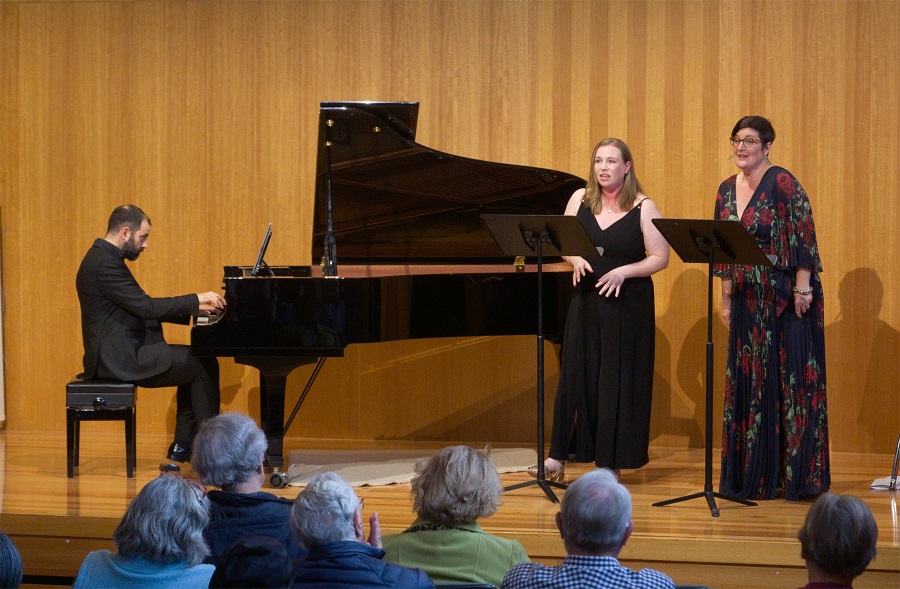
Music / Muse and Musings: The Chopin-Viardot Mazurka Dialogues, Anna Fraser, Claire Burrell-McDonald and Giulio Biddau, Wesley Music Centre, July 11. Reviewed by NICK HORN.
What was it like to hear a recital of art song 200 years ago?
Anna Fraser and Claire Burrell-McDonald, sopranos (from Sydney), with Giulio Biddau (from Sardinia), on piano, with other colleagues, are engaged in an impressive project to answer this question by studying a certain style of 19th century bel canto singing.
We heard some of the results of this project in a concert built around the music of Frédéric Chopin and his friend, singer/pianist/composer Pauline Viardot.
The program paired solo piano works by Chopin (Mazurkas and others) with Viardot’s transcriptions of the same works in poetic settings for voice, complete with historically informed ornamentation, approaches to dynamic and tonal contrast and use of techniques such as messa di voce (controlled swelling), all at the service of dramatic emotional expression. The performers offered informative insights between items into the research standing behind the program.
Viardot’s The Oak and the Reed created a stormy mood, with the surging accompaniment serving as a launch pad for Fraser’s gorgeous dark soprano. In Viardot’s setting of The Young Girl, Burrell-McDonald’s delivery matched the rhythmic bounce of its paired Mazurka, while conveying a lover’s yearning with aching octaves.
Lament of Love (Viardot) was a highlight. After a beautifully restrained, almost husky, start from Fraser, an irresistable vocal line emerged. Short, downward-sobbing phrases evoked exquisite anguish, concluding at the depth of her range, half-speaking, half-singing: “Alas! Death is in my heart”.
The singers performed a number of charming duets, harmonising and conversing in perfectly balanced and matched performances of Spanish, French and Italian songs (the Rossini in the encore was great fun). The energy of the Mazurka form pervaded Biddau’s pianism all afternoon.
Particularly notable was the Liszt transcription of a Chopin song (the Maiden’s Wish) with champagne bubbles and quicksilver descending runs culminating in a series of grand chords.
However, given Biddeau’s formidable technique, it was a shame that the piano’s tone came across as overly hard and loud, possibly leading the singers to over-compensate dynamically. The adjacent church might have offered a warmer sound—and perhaps the lid could have been lowered.
Biddeau’s Liszt was followed by Burrel-McDonald’s beguiling performance of “Love me!” (Viardot), with shifts in vocal tone, controlled jumps and clearly articulated ornamental filigree all deployed to demonstrate historical bel canto style.
But in a concert full of treasures, Fraser’s interpretation of Handel’s Lascia ch’io pianga was the jewel in the crown. Viardot’s personally annotated performance score unlocked a heart-rendingly intimate and expressive performance of this familiar aria.
From the simple recitativo introduction to the astonishing control of the final embellished repetition of the chorus, with Fraser’s subtle variations of tone colour, and the warmth and power of her voice, all we could do as listeners was to sit still and silently echo the song title (Let Me Weep!).
News all day, every day at CityNewsQBN.com.au.


Leave a Reply