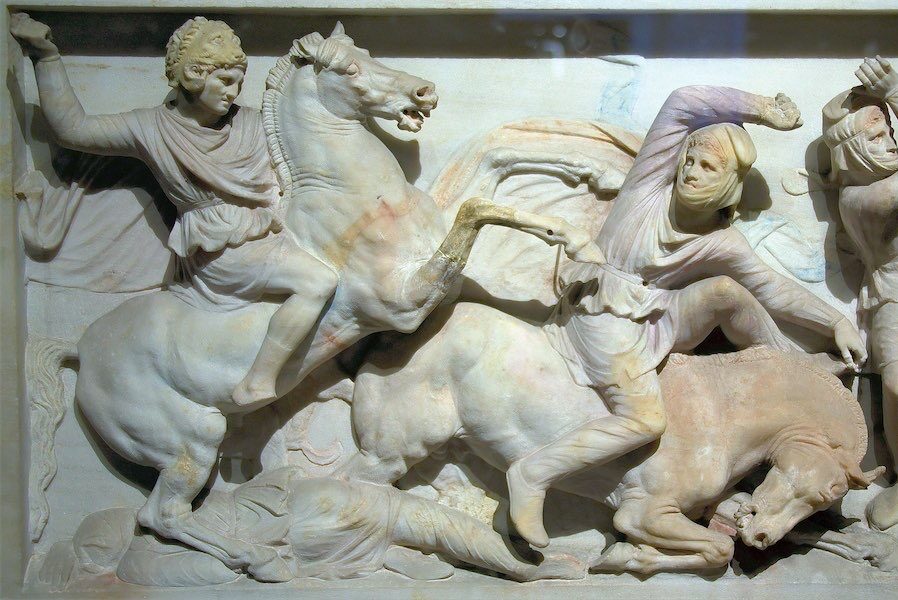
Leading her latest column of new books, ANNA CREER reviews a biography of Alexander the Great, a man its author says, “spent his whole life unsure of who he really was”.
To the ancient Greeks, Alexander the Great was “thaumastos”.

That is, “something which provoked astonishment, then fascination, then confusion, then sadness, something you will never fully understand”.
Alexander continues to fascinate, reflected in the multitude of biographies and articles offering different perspectives of his life.
He’s been described as a second Achilles, a philosopher king who longed to unite the world and the last of the Great Kings. For others, he was a genocidal psychopath or a megalomaniac schoolboy.
In a new biography, Alexander, God, King, Man (Bloomsbury), Edmund Richardson, professor of classics at Durham University, reveals newly unearthed evidence from the ruins of Alexander’s cities and the translation of accounts in 12 ancient languages, including Aramaic, Greek, Babylonian and Sanskrit, claiming that “for the first time, instead of the legend, we can meet Alexander the man”.
Richardson follows the ancient sources closely, while occasionally adding a literary context, which although familiar to ancient readers is less so today.
The result is a vivid retelling of Alexander’s military campaigns into Persia, Egypt, eventually reaching India. Alexander emerges as a brilliant if bloodthirsty strategist and a charismatic leader of a dedicated, loyal army, willing to follow him to the end of the known world. “Alexander told his men stories of empire and everlasting glory and of who they truly were, and they followed him further than any Greeks had gone before and loved him, and destroyed themselves for him”.
Richardson eventually concludes: “There will never be a definitive Alexander. He himself – a man who could be a pharaoh over breakfast and a Greek before lunch, who could share a lover with Darius and send an elephant to Aristotle, who could enslave Greeks while fighting for Greek freedom – spent his whole life unsure of who he really was”.
Richardson’s achievement is to make such a scholarly work accessible to all readers. It’s an absorbing glimpse into a world that we can only imagine.
IN Great Literary Sisters (Bodleian Library Publishing), Janet Phillips explores sisterly relationships in literature from Pride and Prejudice to The Hunger Games, revealing sisters as best friends or mother figures, as rivals or heroes, as sounding boards or partners in crime.

Phillips analyses the role of sisters in 20 novels from writers as diverse as Charles Dickens, EM Forster, JD Salinger, Toni Morrison and Chimamanda Ngozi Adichie, grouping the novels into five categories, which reflect themes of “sibling rivalries and ambition in childhood; sisters who show redoubtable courage
and perseverance in the domestic sphere; sisters who support and sometimes betray each other in affairs of the heart; those whose relationship is coloured by issues of mental health; and those who fiercely protect each other”.
Despite extensive notes and a comprehensive index, Great Literary Sisters, is not a challenging read, rather a gentle way of getting acquainted with old favourites such as Austen’s Jane and Elizabeth Bennet and George Eliot’s Dorothea and Celia Brooke, while being introduced to less familiar sisters like Cassandra and Julia Corbett from The Game by A S Byatt.
It’s a beautiful little book for cosy reading on cold winter days.
CHRISTINA Hardyment, a “literary geographer” in Novel Crime Scenes – Twenty Deadly Landscapes (Bodleian Library Publishing), admits she’s indulging her “enduring interest in where fictions are set” by revisiting, in detail, the settings of 20 British crime novels, where “writers have enjoyed enhancing horror by setting it in atmospheric landscapes”.

To prove her theory, Hardyment spent two years travelling Britain to explore the landscapes featured in Twenty Deadly Landscapes and realised that “many writers used their own heartlands, places they had known since childhood or had fallen in love with later in life”.
Hardyment takes a chronological approach, beginning with Dartmoor in Conan Doyle’s Hound of the Baskervilles (1902) and ending in London’s East End with Ajay Chowdhury’s The Waiter (2021), via John Buchan’s Galloway Hills, Ellis Peter’s Shropshire, Margery Allingham’s Essex and Colin Dexter’s Oxford.
There are some surprising inclusions with landscapes associated with little known authors such as ECR Lorac’s Lunesdale in Lancashire and Gwen Moffat’s Sandwood Bay in northwest Scotland, while Anne Cleves’ Shetland and Elly Griffiths’ Norfolk are notably excluded. Some authors, for instance Peter May and Marin Edwards, “have made real places such an essential backdrop to their novels that their books can almost be used as guides” and therefore visiting these places “enhances the experience of reading the book”.
So, do consider packing Twenty Deadly Landscapes for your next trip to the UK.
News all day, every day at CityNewsQBN.com.au.


Leave a Reply