Responsibility, a lost cause with Labor ministers?
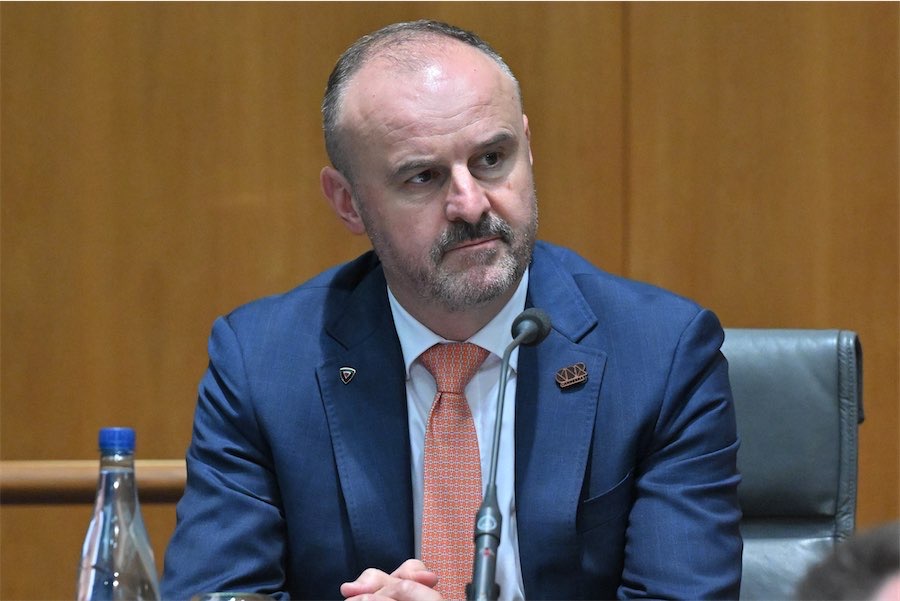
Andrew Barr… sad state of affairs when a chief minister doesn’t understand ministerial responsibility. Photo: Mick Tsikas
“If this is the test by which the Barr government is measured, no minister can ever be held accountable for anything. Just throw some public servants under the bus when things go wrong,” writes political columnist MICHAEL MOORE.
It is a sad state of affairs when a chief minister does not understand ministerial responsibility.
Michael Moore.
No wonder the administration of the ACT is in dire need of a shake-up. After nearly a quarter of a century in power, Canberrans should expect that Labor ministers would understand their responsibilities and their leadership role.
Ministers are responsible. If a portfolio area is performing badly, it is the responsibility of the minister to provide the leadership to turn it around. No matter how badly a portfolio has been handled in the past – the appointed minister sits in the hot seat and has an obligation to improve the situation.
Liberal leader Mark Parton and Greens leader Jo Clay censured Education and Housing Minister Yvette Berry. In doing so, they relied on “the role that the Assembly plays in holding the government to account, particularly in the context of the Westminster conventions on ministerial accountability in our system of responsible government”.
Andrew Barr explained his view: “Ministers are accountable to the Assembly. They must answer questions, explain decisions, be transparent about shortcomings, and accept scrutiny”.
However, he followed up by pointing to “what ministerial responsibility does not extend to (as) ministers do not personally administer large and complex directorates”.
In his explanation: “Directorates and agencies are led by officials with delegated authority and professional responsibility for operational matters. “The reality, which is well understood in Westminster systems, is that ministers are responsible for oversight, policy direction and response, not the day-to-day execution of every function within their portfolios.
“On that measure, Minister Berry is discharging her responsibilities”. Maybe… under that measure.
If this is the test by which his government is measured, no minister can ever be held accountable for anything. Just throw some public servants under the bus when things go wrong.
There is an irony in the approach of the chief minister, as it was Labor – with the support of a couple of independents – who used an individual public servant’s failure on an administrative matter to force Kate Carnell into a position where, on October 17, 2000, she had little choice but to resign as chief minister.
When an area of the public service has been failing through systemic issues (rather than an individual’s decisions) and a minister has not acted to rectify it, the minister must be held responsible.
Fortunately, we now have a minority government that must answer to the Assembly. And the current Assembly is unlikely to accept the chief minister’s approach of the flick pass to public servants.
Early in his speech on the no-confidence motion, Parton emphasised that “ministers must be responsible for outcomes, be they good or bad”.
The system of directorates that was introduced by Jon Stanhope introduced a system of split responsibilities for heads of the directorates (are they directors?). These directors answer to their minister, but they also answer directly to the head of the Chief Minister’s Directorate.
Sections 13 and 14 of the Public Sector Management Act need amending. They simply put too much power in the hands of the administrative units and chief executives.
It is time to review the Public Sector Management Act and recognise that the system of directorates and the split decision-making processes adds to confusion. This undermines the Westminster traditions upon which the ACT parliament and government are based.
On the one hand, this process means that a minister remains responsible for their portfolios. However, through the bureaucrats, the chief minister must also be responsible to a significant degree.
A successful censure (or even more challenging) a successful no-confidence motion in a minister therefore has significant ramifications for the chief minister.
The Greens have been put in a slightly awkward position. Minister Tara Cheyne reflected on the Greens time in government and particularly regarding former MLA and Education Minister, Shane Rattenbury. Ms Cheyne argued: “Westminster conventions are not a coat that you check at the cabinet-room door and collect again on your way back to the crossbench”.
She went on in an attempt to defend her colleague, arguing that the ACT education system has been in decline since the 1970s. She attempted to blame the poor performance on every minister, federal and local, since that time.
Ministers are responsible for turning things around. Trying their best is not good enough. It is the outcome that counts for a successful minister.
Michael Moore is a former member of the ACT Legislative Assembly and an independent minister for health. He has been a political columnist with CityNews since 2006.
Anthony Albanese wants politicians to turn down the heat, but a crossbench senator’s angry outburst and fresh questions over a $6 million golf club grant have turned it back on him, writes political columnist MICHELLE GRATTAN.
"To be credible, the ACT Government has to stop its obfuscation and commission an independent assessment to evaluate if bus rapid transport could deliver the benefits of light rail at lower cost," writes planning columnist MIKE QUIRK.




Leave a Reply