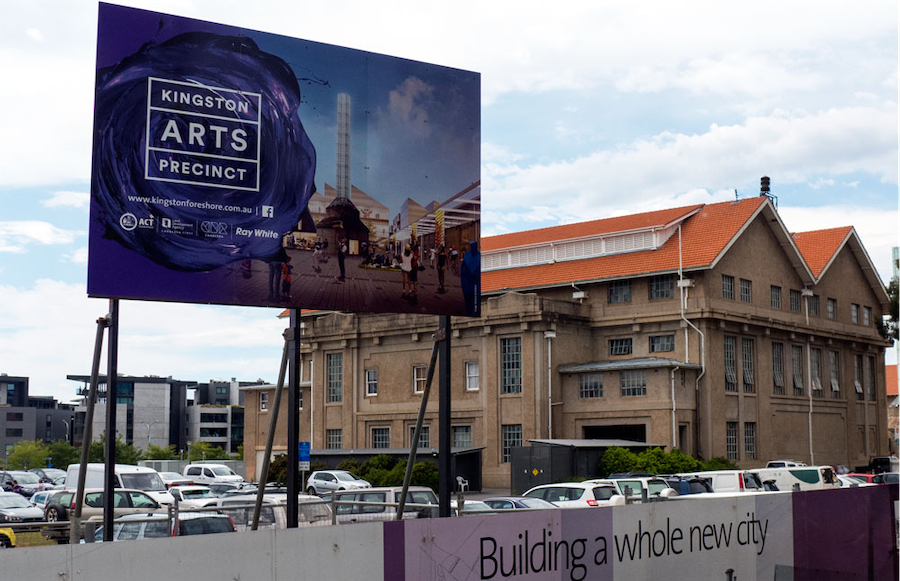
With tenders called, with ‘indecent haste’, RICHARD JOHNSTON says we’re back pretty much at square one again, after 15 years of fruitless effort around the moribund Kingston Arts Precinct.
Local residents have been engaged for more than 15 years in consultations over the Kingston Arts Precinct.
It was supposed to be a vibrant hub of the foreshore, a home for arts groups with gallery space and a theatre, some retail space and housing, while conserving the important heritage assets of the former Powerhouse (now Glassworks), Fitters Workshop and others.
The first phase involved extensive investigations and reports by consultants to the ACT Government leading to adoption by the Government of the Kingston Section 49 Indicative Master Plan in 2014. The then Land Development Agency (LDA) put out a “Request for Proposals for the Sale and Development of The Kingston Arts Precinct” in 2015, which resulted in Geocon being declared the successful tenderer in 2019.
Unfortunately, it became clear that Geocon and its architects were not interested in the government’s 2014 Master Plan or the local community’s views, and came up with their own, very dense development proposal, completely surrounding the important former Powerhouse building and screening it from external view.
After two years of fruitless argument, Geocon and the government parted ways. The LDA was abolished and the (now) Suburban Land Agency (SLA) took back control of the development in 2021.
There was then a period of good community involvement leading up to the production of a place brief (a vague but “feel-good” document) that was supposed to lead into the production of a “Concept Estate Development Plan”.
However, interaction with the community seemed to cease in 2023 and the project fell into a proverbial black hole until it was announced last year that delivery of the arts facilities was now to be the responsibility of Infrastructure Canberra (iCBR), while the SLA would handle the release of the mixed-uses part.
Then, late last year a subdivision design application (SDA), with about 70 supporting documents including an estate development plan, was put out for public comment. This resulted in 25 representations, particularly about unresolved traffic and parking issues, and interfaces with surrounding development.
In response the SDA was “amended” to only relate to the new block boundaries, many of the supporting documents were removed and the issues raised in the representations were kicked down the road to be dealt with in subsequent development applications. The only planning controls retained in the amended SDA were:
- A “setback zone” on the mixed-use site (to preserve a view of the Powerhouse).
- A “mid-block link” (Trevillian Quay “extension”).
- Emergency service vehicle access easements.
- An “urban grain” requirement – that new buildings should
be “in character” with the foreshore.
Not much to show for 15 years of effort.
The Territory Planning Authority (TPA) subsequently approved this version of the SDA.
In response to the Kingston & Barton Residents Group’s complaint that this process was not meaningful consultation (as per section 11 of the Planning Act 2023), the TPA said: “Consideration under this section and the Planning (Good Consultation) Guidelines 2023 is not a consideration in the DA process.” (Or anywhere else apparently!)
The TPA “also noted that development impacts from future development proposals are considered once applied for” (presumably by iCBR and the private developer). All of the representations (including another seven on the second-stage “consultation”) were not relevant to the TPA’s considerations of the SDA.
Then, just before the recent ACT Budget, the chief minister announced that the arts facilities to be delivered by iCBR would be put on the backburner as one of the “savings” of infrastructure expenditure.
Only the mixed-uses component (ie, the money-making part) would proceed, together with a new public carpark – size and access arrangements to be negotiated with the private developers.
The SLA then proceeded, with indecent haste, to put out another request for tenders. Apparently, they were under some pressure to do this before the end of the financial year.
So we’re back pretty much at square one again, after 15 years of fruitless effort. Is this an example of the wonderful new “outcomes-focused” planning system?
Key features of that seem to be minimising any upfront controls on what developers can do and downgrading community involvement in planning matters.
Richard Johnston is a life fellow of the Planning Institute of Australia and president of the Kingston & Barton Residents Group Inc.
News all day, every day at CityNewsQBN.com.au.



Leave a Reply