
“Increasing the budget deficit by $547 million is worryingly imprudent – unless, of course, the government simply had no choice.” And it had no choice, say JON STANHOPE & KHALID AHMED.
The ACT budget is going backwards by $547 million and the Labor government will be forced to borrow to pay all or part of the interest bill over the four years to 2028-29.
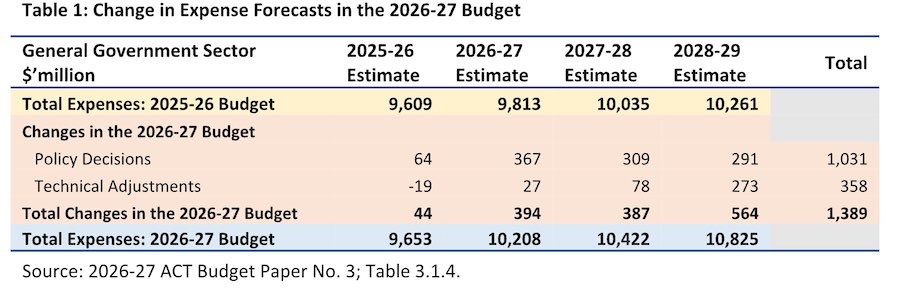
In previous articles on the current (2026-27) budget, we highlighted that from 2025-26 to 2028-29, expenses were forecast to increase by $1.389 billion above the 2025-26 budget forecasts.
We also said this increase would be only partly funded by increased revenue of $842 million. In other words, the budget is going backwards (ie, additional operating deficits) by $547 million.
Cash deficits total $2.3 billion over this period and the government will be forced to borrow to pay all or part of the interest.
The additional revenue ($842 million) comprises a windfall of $702 million from increased Commonwealth grants (Specific Purpose Payments and National Partnership Payments), and a net $140 million increase from other sources including taxation, GST revenue and fees and charges (insert link).
This figure is boosted by another windfall of $381 million in cross-border payments from NSW for health services.
However, taxation revenue will decrease from the previous forecasts. Clearly, without the increased federal grants and cross-border payments for health services, the overall revenue take would have been reduced.
The reason the government could not hold the forward estimates at the level declared in the 2025-26 budget is in part, because of the overly optimistic revenue forecasts, that we have previously noted, and in addition because of the need to abandon previously unprincipled and now untenable measures (such as the health levy). It’s a vivid example of the chickens coming home to roost.
There are also new policy measures on tax breaks for developers that the government has sought to offset through arbitrary increases in flat taxes and levies – which while apparently small for some, undoubtedly severely impact those for whom every dollar counts.
Table 1 details the changes to expenditure forecasts in the 2026-27 budget, aggregated into impacts of policy decisions and technical adjustments, as presented in the budget papers.
It is unreasonable for a government that asserts that a budget is “reasonable”, to add more than $1 billion in additional expenditure, when it has accrued a deficit of more than $7 billion, has mounting debt, and spiralling interest costs that have precipitated successive ratings downgrades.
Increasing the budget deficit by $547 million, as the government has done, is worryingly imprudent – unless, of course, the government simply had no choice.
Of particular note is the $564 million increase in the expenditure forecast for 2028-29.
That’s the year in which the budget was forecast, with great fanfare just four months ago, in the Budget Review, to return to surplus. We ask the question, why did the Treasurer not adhere to that forecast surplus, instead deferring it, as always, to next year? The answer is, of course, because he had no choice.
The differentiation between policy decisions and technical adjustments is moot. In principle, the forward estimates should present fairly and accurately, to the extent possible, the cost of current policy decisions in the budget and forward years.
Unless there is a change in service standards or targets, for example, wait times in hospitals or learning outcomes in schools or smaller class sizes, an increase in expenditure reflects an underestimation of the cost of an existing policy in the previous budget.
It may, of course, be packaged as policy decision(s) and new initiative(s), as indeed we have noted previously. Stark examples of this are the budget blowouts of more than $200 million in each of the past two years, which were presented because of new initiatives.
Similarly, technical adjustments, unless arising due to changes in accounting standards/policies or unforeseen changes in forecasting parameters, reflect a technical deficiency in forecasting, or inadequate provisioning – that is, just poor budgeting.
For example, a “technical adjustment” reflecting the ongoing cost of enterprise agreements negotiated during the year simply reflects an inadequate provision in the budget for an increase in wages.
Accordingly, a significant proportion of the technical adjustments appear to reflect the impact of past policies not reflected in previous budget estimates. For example, technical adjustments include (Table 3.1.5, Budget Paper 3):
-
Increase in expenditure of $35.3 million, attributed to “finance leases”, with $11.3 million of that expenditure incurred in 2025-26.
-
Increase in interest costs of $71.6 million, with the profound explanation that higher expenses are “primarily due to the impact of borrowings”.
These are quite clearly the impact of policy decisions in previous years that were either not included in the budget or were not properly provisioned.
The budget: how about heartless, thoughtless, lazy and regressive?
In July 2025, in our comments on the 2025-26 budget, we observed: “Expenditure growth is an ‘anaemic’ 2.6 per cent per annum, which is not even enough to cover inflation and wage growth. Unless some magic efficiencies have been found in this budget, it is impossible to accept that service levels can be maintained with the budgeted funding growth.”
Table 2 reveals the change in employee expenses in this budget compared to the 2025-26 budget.
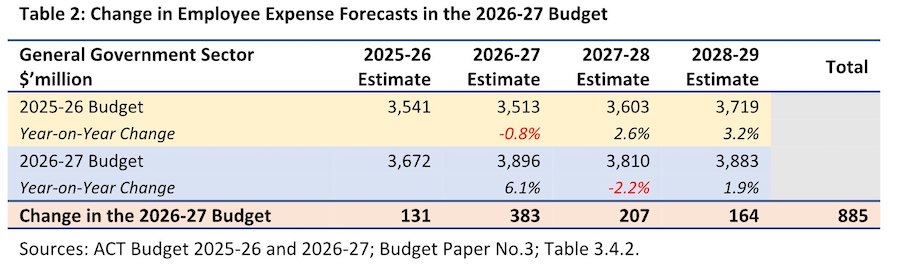 The table highlights that the expenditure forecasts and profile in the 2025-26 budget could not be sustained with an actual decrease (-0.8 per cent) in 2026-27. Accordingly, this budget adds $383 million to employee expenses in 2026-27.
However, the budget does not address the problem we highlighted, instead pushing it out. While the budget now provides for a 6.1 per cent growth in employee expenses in 2026-27, it forecasts a decrease of 2.2 per cent in the following year (2027-28), which would require a “fix” in the next budget, presumably packaged as new initiatives.
Across the four-year period, the budgeted increase in employee expenses totals $885 million, constituting 64 per cent of the total increase in expenditure of $1.389 billion. Increased superannuation costs commensurate with wages add a further $185 million, taking the employee-related expenses to $1.07 billion.
An increase in interest costs is the next significant contributor to the expenditure increase in the budget. We will discuss this in a separate article.
It is not clear if the increased employee costs relate to the additional Commonwealth grants revenue being utilised for health services, in other words, more nurses and doctors? However, this isn’t apparent from the staffing tables or the expenditure tables in the budget papers.
Table 3 reflects the change in health expenditure incorporated in the budget.
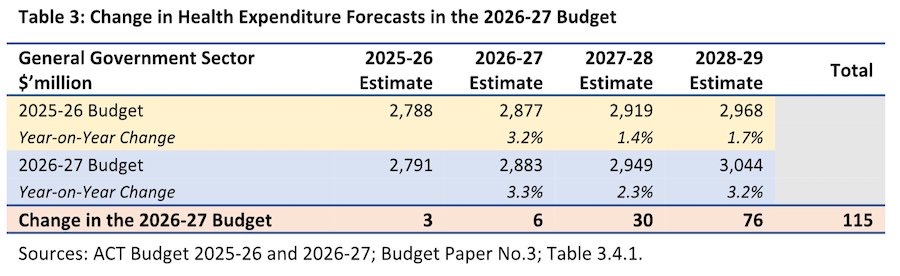 The budget has provided for only $115 million in additional health spending over the period 2025-26 to 2028-29. In reality, the nominal growth in health expenditure, averaging only 2.9 per cent annually, as reflected in the above table, is in fact a cut in real terms when health inflation, population increase and growth in demand are considered.
It is reasonable to conclude that a large proportion of the grants funding will not be utilised for the stated purpose, but rather to improve a bottom line that would otherwise have been much worse.
So, what is the real story on the expenditure side? It is clear that the chickens have again come home to roost, as with previous untenable and fanciful expenditure forecasts in previous budgets, with the likelihood of the pattern being repeated next year.
Notably – and concerningly – the Commonwealth’s generous grant funding has assisted in camouflaging the parlous state of the ACT’s finances.
It’s provided a measure of support, without which some services (health in particular) would be worse than they are.
The deficit and level of debt, already out of control and in a tie as the highest in Australia, would also be even more perilous.
Jon Stanhope is a former chief minister of the ACT and Dr Khalid Ahmed a former senior ACT Treasury official.
News all day, every day at CityNewsQBN.com.au.



Leave a Reply