The restriction of detached dwelling supply in the ACT has increased the cost of detached dwellings and transferred demand to surrounding NSW resulting in increased car-dependent development.
“Given the government’s ineptitude… it’s time for the Assembly to force a reappraisal of the city’s infrastructure needs and planning,” writes planning columnist MIKE QUIRK.
The quality of Canberra’s development is suffering from policies lacking the strength and flexibility to effectively manage the forces shaping the development of the city.
Mike Quirk.
The National Capital Development Commission’s Y-Plan, which guided development from the 1960s to the early 1990s, was an effective response to the parameters shaping the city at that time.
Based on substantial analysis and responding to the population’s preferences for low-density living and car use, it established new towns each with a variety of centres including major office employment to reduce travel and delivered timely and cost-effective infrastructure and facilities.
In keeping with changing demands, higher-density housing was provided near centres, the Kingston-Griffith redevelopment area was established and dual occupancy policies introduced.
It was considered best practice and a remedy to the fragmented “sprawl” occurring in other capital cities, characterised by developments that lacked employment, facilities and services, were costly to service and resulted in extensive car-dominated travel and the loss of agricultural land and habitat.
Since the 1990s development has been guided by compact city policies that have built on the legacy of past planning and focused on increasing the share of development in existing areas especially near centres and transport stops.
They were formulated in response to demographic changes (leading to underutilised infrastructure and changes in housing demand), a greater awareness of the environmental impacts of development and greater complexity in dispersing employment.
The strategy has been successful in increasing population in established areas.
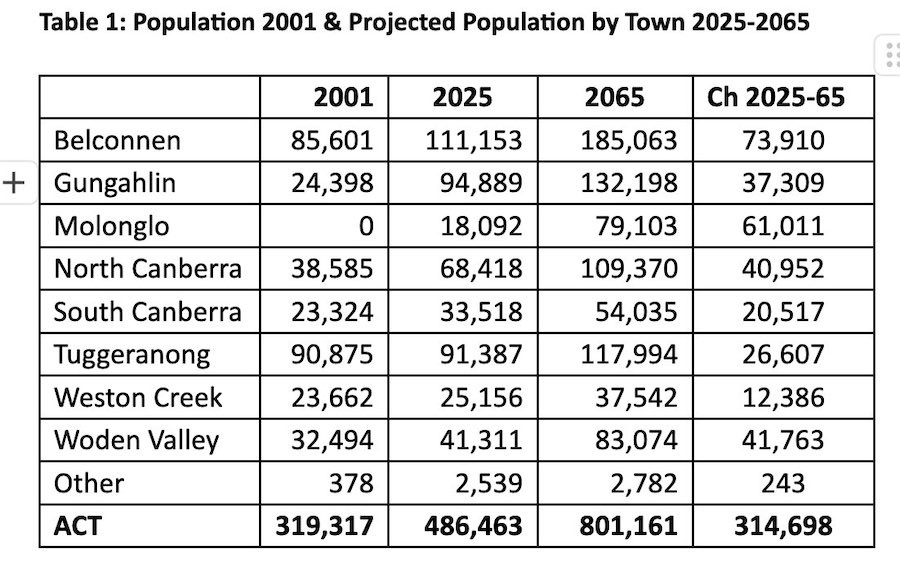
The population in 2001 and projections to 2065 by town, shown in Table 1, reflect the strategy.
The projections were not based on assessments of infrastructure, travel and environmental costs, housing choice or affordability.
There has been no assessment of the level of benefit the strategy currently provides. Recent modifications requiring 70 per cent of land releases in established areas and 90 per cent to be multi-unit dwellings have not been justified. Nor has the intention to establish an Urban Growth Boundary by June 2027 been informed by assessments of all potential land supply in the ACT.
Governments have failed to consider the transport and infrastructure implications on the location of commercial development.
There have also been delays in the provision of schools, shops, roads, bridges and public transport in Gungahlin and Molonglo. The absence of major office employment in Gungahlin, which increased travel and infrastructure costs, is a consequence. It stemmed from a decision in the early 1990s to give individual federal government departments the freedom to negotiate accommodation requirements directly with developers.
The restriction of detached dwelling supply in the ACT has increased the cost of detached dwellings and transferred demand to surrounding NSW resulting in increased car-dependent development. The inadequate consideration of the region is a major policy deficiency.
Many residential developments have been poorly constructed and designed, are inappropriate and do not meet housing preferences or the needs of households; have led to increased hard surfaces (leading to increased runoff), the loss/inability to establish vegetation and the creation of heat islands. It is too early to assess whether the “missing middle” reforms are improving outcomes.
The superficiality of the planning is apparent in the recent Southern Gateway Design Study. Where is the analysis demonstrating the benefits from repurposing the corridor exceed the costs? What alternatives were considered?
There has also been a breakdown in the process of prioritising infrastructure most evident in the adoption of light rail, despite no evidence it is superior to bus rapid transport, or why it was prioritised over the construction of government housing.
A review of the strategy is needed to address current deficiencies and to consider the impact of changing development parameters including rapid changes in climate, home-work relationships and the use of electric and autonomous vehicles (EaAVs).
Climate change is producing a hotter and dryer climate and the likelihood of severe droughts. The adequacy of the city’s water supply and sewerage treatment infrastructure, need urgent consideration.
Changes in home-work relationships and the likely increased use of EaAVs will change the way the city and region functions, altering demand for and location of travel, facilities, housing, offices, shops, cafes and the demand for and viability of public transport.
Given the government’s ineptitude and the need to effectively prioritise billions of dollars of infrastructure funds, it’s time for the Assembly to force a reappraisal of the city’s infrastructure needs and planning.
Mike Quirk is a former NCDC and ACT government planner.
Political columnist MICHELLE GRATTAN says Anthony Albanese’s apparent snub of Jim Chalmers has reignited scrutiny of their underlying tensions, as Labor’s leadership succession takes shape.
"Angrification makes it easier and quicker to find a political leader and social media platform where you can weaponise the broader anger on an issue," writes political columnist ANDREW HUGHES.
"Despite the potential benefits of developing a national plan there are major obstacles, primarily stemming from state and local governments seeing it as a threat to their autonomy," writes planning columnist MIKE QUIRK.






Leave a Reply