
For marathon swimmers, the Strait of Hormuz represents one of open-water sea swimming’s most unusual challenges, writes CLIVE WILLIAMS.
Thanks to Trump, much of the world has become familiar with the Strait of Hormuz – the strategically vital waterway that links the Persian Gulf with the Gulf of Oman.

However, for marathon swimmers, the Strait represents something entirely different: one of open-water sea swimming’s most unusual challenges.
At its narrowest point, the Strait measures roughly 39 kilometres across, but any swim across is likely to cover significantly more distance due to strong tidal flows, complex currents, and navigation adjustments during the swim.
For marathon swimmers the natural comparison is with the English Channel, still regarded as the benchmark in marathon swimming. Since Captain Matthew Webb’s pioneering crossing in 1875, the Channel has become the sport’s defining test of endurance, cold water tolerance, and navigational skill. More than 1700 solo crossings have been officially recorded.
The Channel’s shortest straight-line distance is about 34 kilometres, but swimmers are typically carried far off-course by tides and drift, often covering 40-50 kilometres or more.
Swim attempts are governed by the Channel Swimming Association, which permits only a standard swimsuit, cap and goggles. Escort boats are mandatory in one of the world’s busiest shipping lanes. A fully supported Channel attempt typically costs around $10,000.
The Strait of Hormuz presents a very different challenge. While the narrowest crossing is about 39 kilometres, the distance swum could stretch much beyond that.
In April 2026, American marathon swimmer Marcia Cleveland became the first person to complete a solo swim across the Strait.
Starting from Oman and heading toward Iran, she covered about 42 kilometres in 5 hours 57 minutes, taking full advantage of favourable tidal flows.
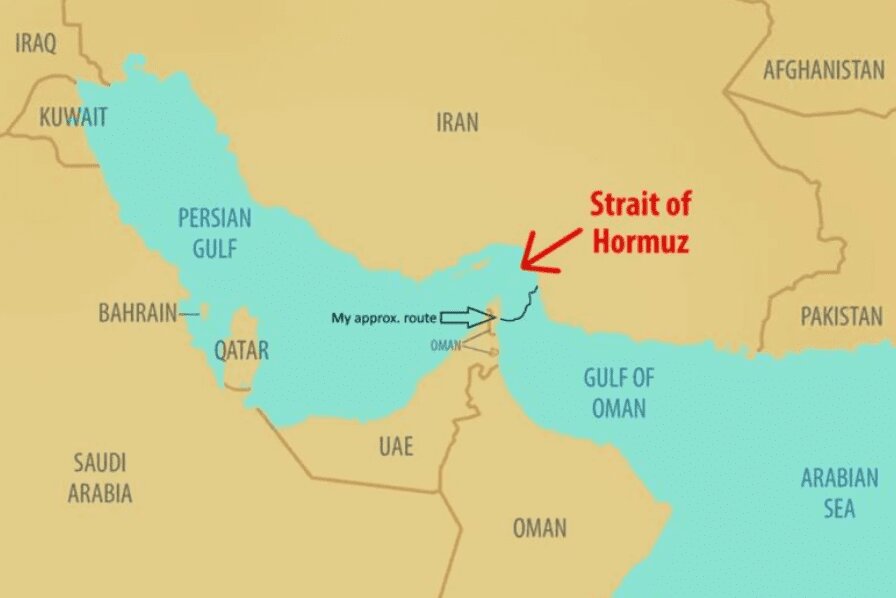
Earlier Iranian endurance swims in the region had taken place over longer distances, not across the Strait, making Cleveland’s crossing a unique achievement.
For a swimmer, the English Channel and Strait of Hormuz differ dramatically in character.
The English Channel is defined by cold water, powerful tides, and notoriously changeable weather. Tidal currents can exceed 4-6 knots, creating currents that push swimmers off course. Success depends heavily on precise timing around slack water and neap tides. Even so, Atlantic weather systems can quickly generate steep chop and difficult swells.
The Strait of Hormuz combines strong tidal movements with complex underwater topography inside one of the world’s busiest maritime corridors, busier even than the English Channel.
While natural swells and chop are less of a problem, commercial tankers and naval vessels create significant wake turbulence. Surface conditions can also shift rapidly where the waters of the Gulf of Oman meet the highly saline Persian Gulf.
Water temperatures are the sharpest contrast. English Channel swimmers typically face 15-18°C temperatures during the traditional July-September season, requiring extensive cold-water acclimatisation to avoid hypothermia. Hormuz waters are far warmer – often 24-30°C – which eliminates cold-related risks, but heightens the dangers of dehydration, overheating and fatigue.
Marine life also differs markedly. The Channel features jellyfish, seals, and occasional porpoises, with sharks rarely regarded as a serious threat.
The Strait of Hormuz supports a richer warm-water ecosystem that may include dolphins, turtles, reef fish, sea snakes and several shark species. Swimmers must also contend with oil pollution and the complexities of military activity.
The English Channel has earned its status as marathon swimming’s most recognised achievement, with records ranging from elite sub-seven-hour crossings to extraordinary multi-way swims by athletes such as Gertrude Ederle and Sarah Thomas. Hundreds of swimmers attempt it each year. The longest recorded crossing took just over 29 hours.
By contrast, the Strait of Hormuz remains a new frontier. Any crossing will require extensive logistical planning, including permissions from both Oman and Iran, organisation of an escort vessel and careful consideration of the prevailing security situation.
While the Strait of Hormuz lacks the English Channel’s 150-year tradition, it presents its own formidable mix of powerful currents, intense heat, extreme shipping density, rich and potentially hazardous marine life, and military-related dangers.
Clive Williams’ past marathon swims include the Hong Kong Tolo Channel, Rip swim in Victoria and Bosphorus swim from Asia to Europe. Hormuz is on his bucket list.
News all day, every day at CityNewsQBN.com.au.





Leave a Reply