
COLIN STEELE reviews six books, whose authors featured recently in the Australian National University Meet the Author series, that cover a wide range of important issues in Australian and global politics.
Most of the reviewed books reflect the increasingly fragile framework of democracy.
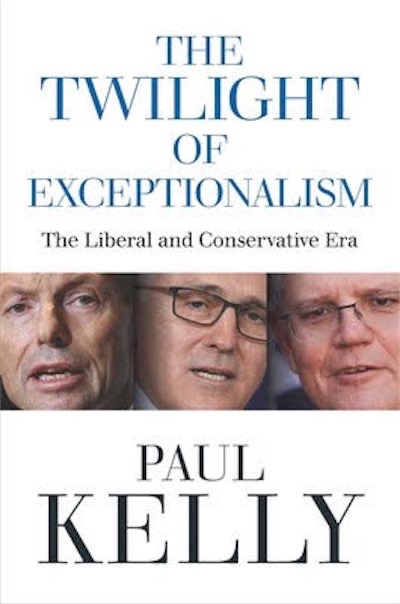
Paul Kelly’s The Twilight of Exceptionalism – The Liberal and Conservative Era 2013-22 (Melbourne University Press, $59.99) concludes a magisterial trilogy on modern Australian politics, following on from Comprising – The March of Patriots (2009) and Triumph and Demise (2014).
The latest volume, comprising nearly 700 pages of very readable text, incorporates much new material and interviews with key individuals, including with former prime ministers Tony Abbott, Malcolm Turnbull and Scott Morrison.
Kelly documents how “three temperamentally and ideologically divergent prime ministers” faced the challenges of economic performance, climate change, cultural polarisation, technological change and geo-strategic threats.
He concludes this Liberal decade was essentially one of under-performance by the Coalition in meeting the nation’s challenges, glimpses of which have also recently emerged for Labor.
JOSHUA Black also looks back at how the political story has been told in Performance Politics: Australian politicians and the stories they tell (NewSouth, $44.99) since the 1970s.
Black documents and analyses the personal political narrative, as revealed in political memoirs, autobiographies, documentaries, media coverage, personal papers and original interviews.
He comprehensively reveals the power and frailties of key individuals in the last half-century of Australian politics as told through their personal narratives.
JAMES Walter and Carolyn Holbrook in Australia Fair? Democracy, Bureaucracy and the Making of Modern Australia (Melbourne University Press, $39.99) provides another retrospective, this time since World War II, reflecting, in part, that policies rather than personalities change Australia.
They chart the changing approaches in Australia to three key policy issues, namely immigration, indigenous affairs and housing, documenting how social change, ideological differences and power dynamics over the decades have impacted Australia’s political landscape and society.
The authors also examine how politicians received advice on these issues, how it was enacted as well as the changing nature of that advice. An analysis with much relevance to current debates.
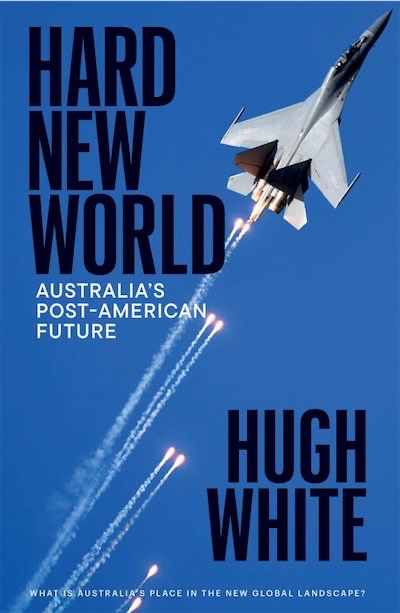
THE volatile geopolitical global landscape is comprehensively detailed in Hugh White’s Hard New World – Australia’s Post-American Future (Black Inc $36.99), which realistically analyses Australia’s place in a world turned upside down by Donald Trump’s erratic diplomatic decisions on the one hand and China’s increasing trading and military power on the other.
White concludes that Australian complacency in relying on the American alliance, including AUKUS, is no longer an option. White criticises both main political parties for abdicating their responsibility to confront American foreign policy and defence changes impacting on global geopolitical instability.
GEORGE Megalogenis in Three Shocks – Who We Are Becoming in the 21st Century (Penguin, $36.99) also examines three key issues, namely population changes in migration, Megalogenis noting that more than half the population today is either born overseas or has at least one migrant parent; the feminisation of the workforce, with professional women being the largest sector replacing blue-collar male workers and finally the volatile global political landscape.
Megalogenis argues that these factors, along with growing societal inequalities, are dramatically changing the electoral status quo, so that we are moving to a multi-party system which could mean more minority governments at the national level in the future.
TRUMP is a key figure in John Keane’s Demagogues and Despots: Democracies on the Brink (NewSouth $32.99), which covers countries such as Russia, Iran and Saudi Arabia, as well as those run by popularly elected “demagogues”, such as Erdoğan, Netanyahu and Trump.
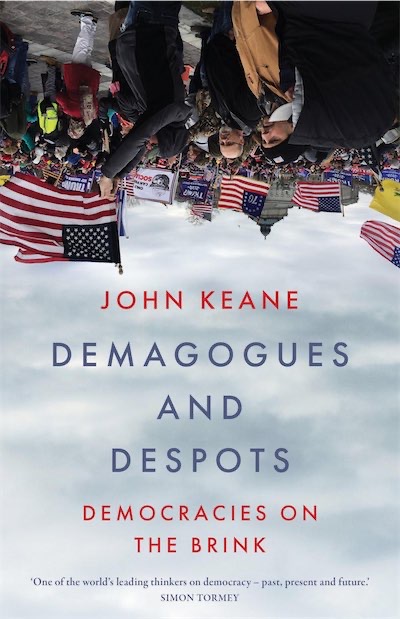
Keane argues the new despotism, which operates a pseudo-democratic type of government, is achieved by winning or enforcing public loyalty through government handouts, election-rigging, legal enforcement, media manipulation and focused misinformation distributed through social and commercial media.
The author reflects on the global weariness of the electorate in the face of growing inequalities with the result that voters feel the major parties are increasingly self-focused and that democracy is no longer working for individuals.
Keane and Megalogenis, in their ANU conversations, reflected on the current decline in polling for the two main parties, with voters emotionally moving further to the right, such as One Nation, or to the left, or centre left with the Greens and independents.
Keane ended with a few green shoots of optimism on how to fix democracy in a fractured world, noting especially that more equitable economies are crucial, for a thriving civil society.
News all day, every day at CityNewsQBN.com.au.




Leave a Reply