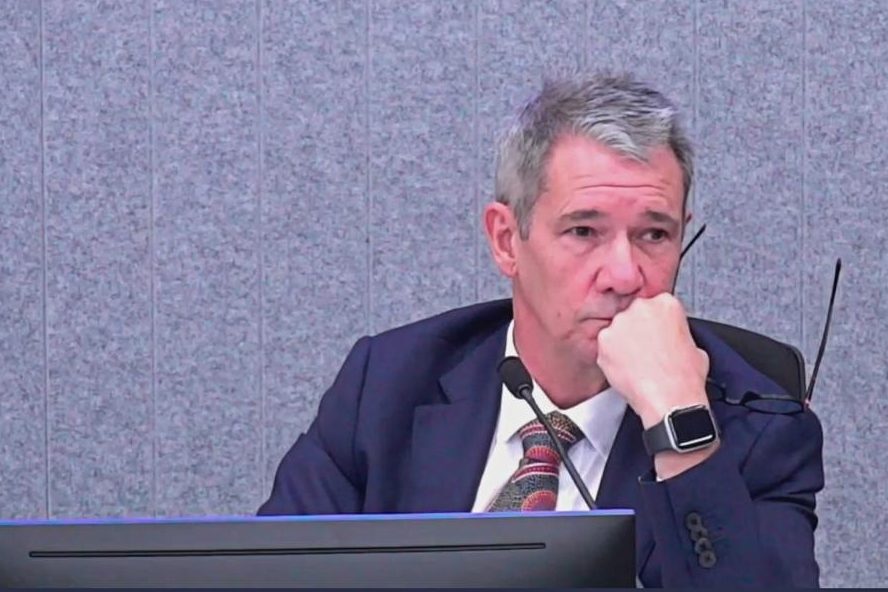
“I was taken aback by a Canberra Times article that, to be blunt, attempts to rewrite history about an infamous case and its aftermath. The article paints our former DPP, Shane Drumgold, as a victim of each and all of Murdoch media, Walter Sofronoff, local politicians and the ACT Bar Association. He was not a victim,” says HUGH SELBY.
The need for reporting accurately has been muddied by the speed and quantity with which news comes and goes from our screens.

It’s so easy to mislead because readers and viewers can’t remember earlier accounts.
A few days ago I wrote about aspects of this problem in the context of some current political and media approaches that cause worry.
Even so, I was taken aback by a Canberra Times article on June 30 that, to be blunt, attempts to rewrite history about an infamous case and its aftermath.
The article paints our former director of public prosecutions, Shane Drumgold SC, as a victim of each and all of Murdoch media, Walter Sofronoff KC, local politicians and the ACT Bar Association.
He was not a victim, but others were his victims; for example, police officers and among his staff.
He still claims, nearly three years later, that there was no good reason to be “pushed out of his job”.
He’s wrong. There were multiple good reasons, arising from his conduct (all exhaustively set out in the Sofronoff Report and, bar one, upheld in the ACT Supreme Court) why he could not continue as the DPP.
Why is he treading this path? As a career prosecutor he would have been familiar with the tenets of criminal law practice that are set out below.
He would have made submissions about these tenets in many cases.
These tenets reflect our experience as human beings.
There is no suggestion that Mr Drumgold should, or could, be charged with criminal offences.
Contrition and remorse
In nearly 90 per cent of criminal cases the accused pleads guilty. The result is that for most criminal law lawyers, be they prosecutors or defence, much of their work is appearing in sentencing cases.
Sentencing is not straight forward, and never has been, because the punishment must reflect not only the gravity of the offending but also the personal circumstances (history and future prospects) of the offender.
A key element of those personal circumstances is the extent, if any, to which the offender has shown contrition and remorse for their conduct.
Contrition and remorse means that the offender demonstrates an understanding not only that their conduct was wrong, but that it caused harm and pain to the direct victim and to others associated with that victim.
The ACT’s Crimes (Sentencing) Act, 2005, in section 33, deals with the issues to be addressed when sentencing. From a long list the following are relevant in this article: any injury… or damage resulting from the offence; whether the offender was in a position of trust or authority when the offence was committed; and, whether the offender has demonstrated remorse.
Rehabilitation is one of the goals of sentencing, sometimes achieved, sometimes not. The notion of rehabilitation is often limited to the answer to the question: “Has the offender re-offended or not?”
For statistical purposes that narrow approach is understandable; however, rehabilitation also encompasses the extent to which the offender has developed an improved sense of self-awareness about their own character and inclinations, along with a true understanding of how wrongful conduct by them victimises others.
How an offender behaves when their sentence is complete can tell us whether claims of contrition and remorse at the time of sentencing were sincere or concocted for the occasion.
As every repeat offender, and every experienced criminal law practitioner, knows, time provides the opportunities to discern some truths.
Put another way, the passage of time provides a good opportunity to measure whether important lessons have been learned and acted upon.
After three years there has been no change
The serious errors of professional judgment that Mr Drumgold made as DPP in his preparation for, and conduct of, the criminal trial of Bruce Lehrmann were exhaustively covered in the Sofronoff Report.
A short distillation of them can be found here and here.
Here are some of the problems with the claims in The Canberra Times article:
- Mr Drumgold called for an inquiry, but it was into the police conduct, not into his conduct. At the Sofronoff Inquiry the police witnesses presented better than he did.
- It makes no mention of his performance when being cross-examined at the Sofronoff Inquiry. It was not good.
- It doesn’t report that he went to the Supreme Court, which found no fault with nearly all the serious adverse findings about his conduct.
- There was, and is no basis for the chief minister, or then attorney-general or Murdoch media to apologise to him.
- There was, and is, no discernible basis for any compensation being paid to him.
- He asserts there are reports that clear him. Respectfully, that’s incorrect. The ACT Bar Association took external advice and decided not to proceed against him by way of disciplinary action. That decision has no effect upon the Sofronoff findings.
If Mr Drumgold was to publicly say: “I stuffed up. I am now a much better person, and a better lawyer because I have reflected and learned a lot”, I would congratulate him.
Alas, nearly three years later, given The Canberra Times article, that’s not on the horizon.
Former barrister Hugh Selby is the CityNews legal affairs writer and has written widely on the disbanded Lehrmann trial and the Sofronoff Inquiry, and its aftermath.
News all day, every day at CityNewsQBN.com.au.





Leave a Reply