Investigating takes more than a papertrail, it takes questions
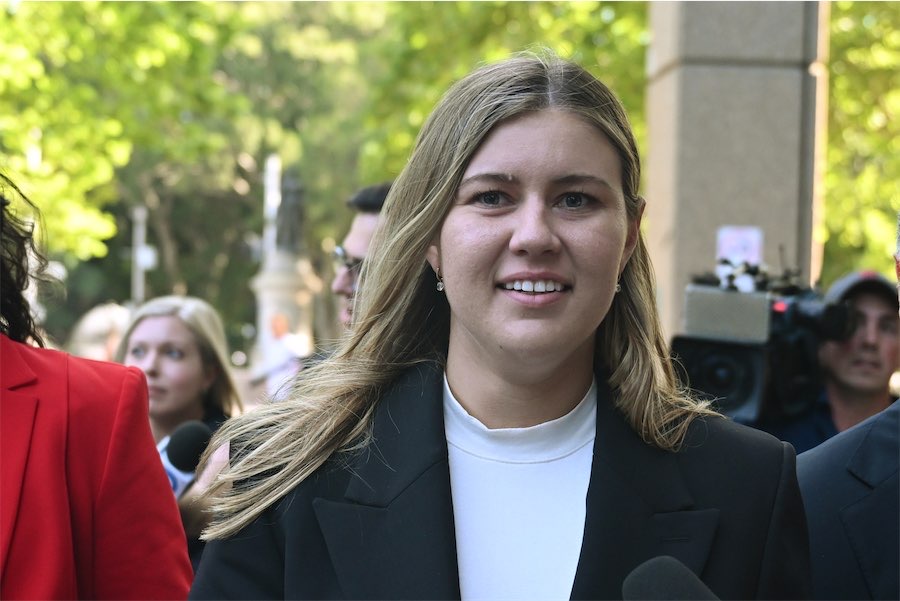
Brittany Higgins was paid $2 million by the Albanese government… was credible, supporting evidence produced before the payout? If so, why was it not recorded? If it wasn’t produced, then what was said in any meetings to justify any payment of public funds to Ms Higgins? (Dean Lewins/AAP PHOTOS)
“There are three Commonwealth agencies set up to investigate maladministration and maintain standards, but apparently lacking in the basic investigative skills to do their jobs.” Former barrister HUGH SELBY says if you don’t ask, people don’t tell.
There’s something that police take for granted in their work, and that’s talking to people to gather information and ask questions to find out what happened.
Hugh Selby.
If you don’t ask people don’t tell.
What of other investigative agencies, such as the National Anti-Corruption Commission (NACC), the Australian Public Service Commission, and the Ombudsman Office?
How well do they stand up to scrutiny of their investigative work?
This article samples investigative failures at the basic level of failing to ask questions when questions must be asked.
We begin by recognising that an absence of evidence to prove or disprove an allegation is not evidence that there is no such evidence. It is evidence only that so far such evidence has not been found.
That failure to find the evidence can have several causes; for example, that no one has thought to look for such evidence because they are unaware that such evidence may be helpful; or, no one wants to look for the evidence because such evidence, once found, might be embarrassing; or, no one has the skill set to search for the evidence.
An interesting example of the first type, with evidence replacing common supposition, is the medical response to peptic ulcers.
Free AI reports that,
For a long time, doctors treated stomach ulcers as a lifestyle illness caused by stress and spicy food;
In the 1980s, Australian researchers discovered Helicobacter pylori bacteria in the stomach linings of ulcer patients; and,
This showed that a bacterial infection, not lifestyle, caused the vast majority of ulcers.
This changed the treatment from lifelong antacids and stress management to a simple, short course of antibiotics.
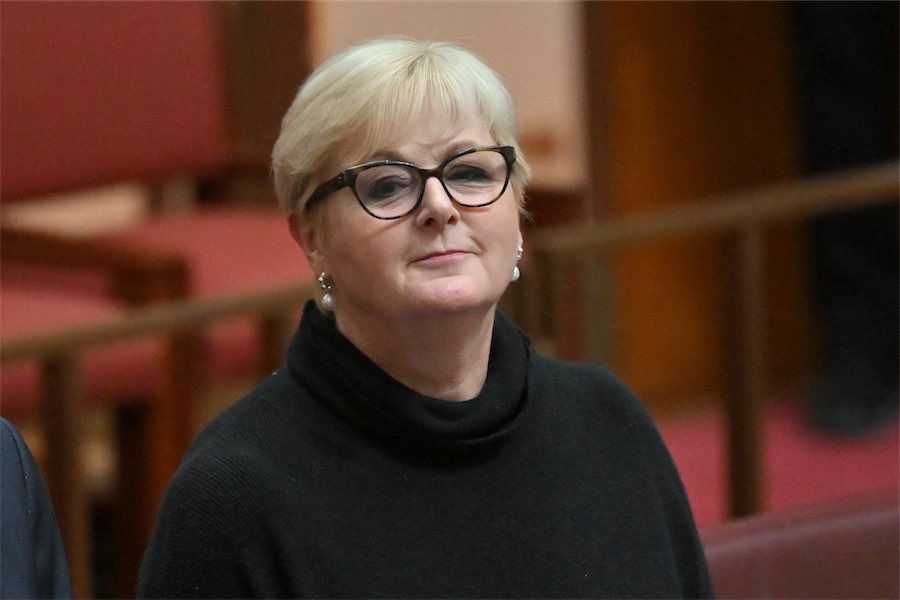
Former senator Linda Reynolds complained about the payment to Brittany Higgins to the NACC which, it was reported, examined the paperwork and, on that basis, decided that there was nothing to see. (Mick Tsikas/AAP PHOTOS)
What the NACC didn’t do, but should have
An example of the second type, where evidence – if found – may open a can of worms, is the improper payment to Brittany Higgins of some two million dollars by the Albanese government.
The payment was improper because there was no proven factual basis for it.
Former senator Linda Reynolds complained about that to the NACC which, it was reported, examined the paperwork and, on that basis, decided that there was nothing to see.
Anyone who thinks that an investigation of nefarious conduct should, as a matter of course, be limited to the paper records is one or more of naïve, incompetent, being disingenuous to others who trust them (such as a gullible public) or corrupt.
The disclosed paper trail that led to the agreement to pay Ms Higgins was a necessary, but not sufficient, step in the investigation of Ms Reynolds’ complaint.
It needed to be followed by probing questions, in private, using the NACC’s coercive powers to uncover what was said, as distinct from written, prior to the written agreement being reached.
Was credible, supporting evidence produced before the payout? If so, why was it not recorded? If it wasn’t produced, then what was said in any meetings to justify any payment of public funds to Ms Higgins?
To put this in the clearest terms: competent litigators examining the paper trail for the Higgins payout would have been put on notice that there was a lack of recorded evidence to support the payment.
That would have raised concerns that could only be explored by examining witnesses.
We should assume, unless the NACC proves the contrary, that it was competent litigators who were given the task of examining the paper trail. In which case he or she or they would have recommended asking questions; questioning that never took place.
Why was that? We can only ponder.
If the NACC does prove the contrary then one has to ask, sadly, how the vast budget to support more than 200 employees in the NACC can be justified.
It takes skill to question well
Which provides a segue to the third explanation for evidence not being found – that those expected to search for it lack the skill set to dig.
It might come as a surprise to many readers, fed an entertainment diet of confessions by the baddy or baddies between commercials, that good investigative questioning is an acquired skill that requires good instruction, good mentoring, making and learning from mistakes, and – for the few lucky ones – talent that most of us lack.
Good questioning takes time. It requires the questioner to listen carefully to the answers and use those answers to form the next question. It can be guided, but not driven, by a pre-interview script.
The now former head of the NACC, Paul Brereton, was reported (AFR, August 19, 2024, article by Michael Pelly and Max Mason) to have said in a speech given in Darwin that witnesses were “more comfortable” with giving their evidence in private sessions than in public examinations.
He might have added that for those asking the questions – unless it is a case of “shooting tethered ducks” (which is where the evidence against the witness is compelling and the public questions are just the coup de grace) – the private session is preferred because the questioner has as much time as they need to work out what should be the next question.
Where witnesses have something to hide then they are “most comfortable” when nobody asks them questions.
Senator Lidia Thorpe, a member of the Senate’s Legal and Constitutional Affairs Committee, has recently placed on notice a long list of questions to the Ombudsman and the Federal Court about what was done, and not done, in response to a whistleblower’s allegations. (Mick Tsikas/AAP PHOTOS)
The Federal Court Registry
Senator Lidia Thorpe, a member of the Senate’s Legal and Constitutional Affairs Committee, has recently placed on notice a long list of questions to the Ombudsman and the Federal Court about what was done, and not done, in response to a whistleblower’s allegations that there were serious irregularities in the appointments of various senior people in the Registry of the Federal Court some years ago.
The Australian Public Service Commission conducted a paper trail investigation and, save for one appointment, found nothing to see. Its investigator did not ask probing questions, or apparently any questions, of those responsible in the Federal Court administration for the interviewing and selection of candidates.
When the whistleblower sought a review by the Ombudsman office the same “see nothing, hear nothing, ask nothing” approach was followed.
It is stating the obvious, which was apparently not obvious to the investigators both at the Public Service Commission and the Ombudsman Office, that the absence of those primary documents required an investigation to find out why this was the case: the responsible Registry staff had to be compelled to reveal what had happened or not happened, at whose instructions, for what reasons.
The selection process for another appointment went so awry that a judge of the court put thoughts about it in writing.
The position was advertised at Senior Executive level. Interviews were held in which a representative of the Public Service Commission participated. A recommendation to appoint a named person was endorsed by that panel participant.
That successful applicant was not appointed to the Senior Executive position. Instead, he was appointed to a lower-level position with a false explanation that this happened because the Public Service Commission “vetoed” the appointment.
It later emerged that there is no documentation explaining the re-assessment by the Court bureaucrats of the job level to a lower classification.
Even without that knowledge the judge advised the Chief Justice, in late 2018, that: “The so-called ‘veto’ is a red herring… to prevent [Mr X] being awarded the position.”
What had happened was described as, “what is being done to [Mr X] is both unfair and unprincipled”. (same letter)
These remarks by a person with years of judicial experience don’t inspire confidence in the correctness of the non-actions of the staff of Commission and the Ombudsman.
What happened may be rather more than just maladministration. The Commonwealth Criminal Code, section 142.2, covers the offence of abuse of public office. It’s an offence carrying five years jail for an official to use influence, or engage in conduct, that is deliberately done to dishonestly either obtain a benefit for themself or another, or cause a detriment to another person.
Contrary to the views of the staff with the Public Service Commission and the Ombudsman Office this is not a “nothing to see here” situation.
To the contrary, there is sufficient evidence from the documents that exist and those that “don’t exist but should” to warrant an AFP criminal investigation about dishonestly giving a benefit of a senior appointment in one case, and dishonestly denying a benefit of an equivalent senior appointment in another.
Although these actions occurred eight or more years ago there is no time limit on prosecuting serious offences.
All of which shows that there are three Commonwealth agencies set up to investigate maladministration and maintain standards, but apparently lacking in the basic investigative skills to do their jobs.
But it doesn’t matter, really it doesn’t, because the cracks and stains can always be papered over, again and again and again.
Former barrister Hugh Selby is the CityNews legal affairs columnist. His free podcasts on “Witness Essentials” and “Advocacy in court: preparation and performance” can be heard on the best known podcast sites.
"The selection of our judiciary is quaint. The community might reasonably expect that applicants demonstrate a capacity to write a decision prior to appointment. That doesn’t happen." HUGH SELBY has some ideas to speed up slow judgments.
"After weeks or months in orbit, astronauts experience dramatic but short-lived symptoms. Many describe an overwhelming heaviness, as if their arms and legs are made of lead." Whimsy columnist CLIVE WILLIAMS looks at weightlessness.
"Disappointingly, the latest data reveals, again, that the ACT is not a high-performing jurisdiction when it comes to closing the gap," writes indigenous advocate JULIE TONGS.







Leave a Reply