
An eccentric, a lover and a brilliant spin bowler, ROSS FITZGERALD and DICK WHITAKER remember an extraordinary Australian cricketer.
Australian cricket has had its fair share of eccentrics, but perhaps one of the most talented and unpredictable of them all was Leslie O’Brien Fleetwood-Smith, known universally at the time as “Chuck”.
Leslie was born on March 30 1908 in the Victorian country town of Stawell. He attended the local state school and then switched to Xavier College in Melbourne, a Roman Catholic day and boarding school begun by the Jesuits in 1872.
Fleetwood-Smith fitted in well here, and earned a place in Xavier’s First XI cricket team when he was only 15 years old.
He was a right-hand bat and left-arm spin bowler and in his younger days could bowl out of either hand – a rare form of ambidextrousness. As he continued to develop, his bowling evolved into that of a left-arm wrist spinner, who could strongly “tweak” the ball because of the strength in his fingers and wrist.
His actual delivery was also faster than most other spinners, and he developed a bag of tricks that allowed him to turn the ball both ways, and included a sharply “kicking” top spinner.
His main weapon was unpredictability
But perhaps his main weapon was unpredictability. He could bowl a long hop that the batsman would easily smash for four but then his next delivery could be an unplayable marvel that was capable of dismissing any batsman.
When fully-grown Fleetwood-Smith was broad shouldered and powerfully built, but there is considerable discrepancy in his published height. Wikipedia lists this as 6’5” (195cm) but in both ESPN Cricinfo and Cricbuzz it is given as 6’1” (185cm). However, an existing photograph of the 1934 Australian team, showing him standing in the back row, reveals him to be well short of Bill O’Reilly who has been more consistently recorded in the cricket literature as being 6’2’’(188cm). It’s likely that Fleetwood-Smith was, in reality, around 6’ (183 cm) in height.
Fleetwood-Smith’s cricket star continued to rise from the early 1930s when he played district cricket for St. Kilda, followed by Shield cricket for Victoria, and then in the Australian team for the 1934 Ashes tour of England. He was then a regular in the national team for the remaining years of the 1930s as well as a prolific wicket taker in Shield cricket.
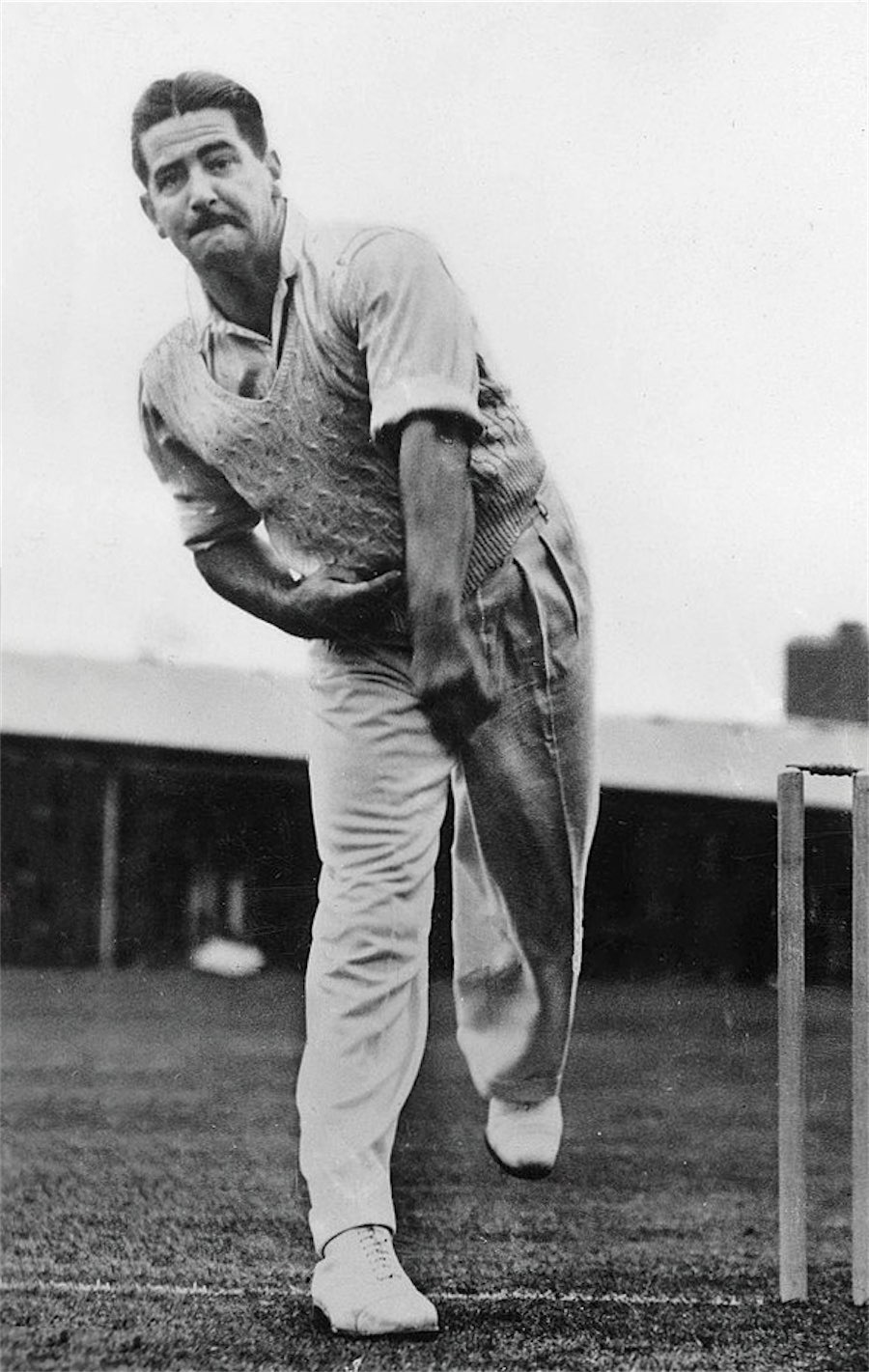
After Australia’s great win in the Fourth Ashes Test in Adelaide during January and February 1937, it was generally agreed that Bradman and Fleetwood-Smith together won the match for Australia, particularly for their second innings efforts. Bradman’s brilliant 212 runs and Fleetwood-Smith’s bowling figures of 6 for 110 turned the tide in Australia’s favour.
Neville Cardus, the well-known cricket scribe of the day, in a lengthy and admirable description of Fleetwood-Smith in action, wrote: “Fleetwood-Smith won the match by wonderful spin. He quickly overwhelmed Hammond, Loyland, and Ames with balls, deadly in their swift break and beautiful in their seductive curve through the air. I cannot imagine the batsman who could have avoided for long – the snares of Fleetwood-Smith.
“Some purist in the crowd stated that Fleetwood-Smith’s trouble is that he often pitches too short or too full; But this is the secret of his ability to worry, the finest defence. His bad bowling can never really be trusted. At any moment he is likely to spin an unplayable masterpiece. To folk who love cricket for other than competitive reasons the capriciousness of Fleetwood-Smith’s attack, is a constant delight.
“Perfect art, as Oscar Wilde said, is absolutely useless. But Fleetwood-Smith’s bowling was inspired by the evil spirit of the grotesque. I have seldom seen bowling more incalculable and original than this. And Bradman used him too much as a change bowler; a diamond cutter was used to cut wood. O’Reilly with all his guile and skill could do nothing on this wicket. Fleetwood-Smith alone could evoke the demons hidden in the ground.”
Fleetwood-Smith was feted as a hero, and after the match large cheering crowds gathered in front of grandstand until he finally emerged to acknowledge their applause. Soon after he was also accorded a civic reception in hometown Stawell.
As well as his freakish ability, Fleetwood-Smith was famous for his eccentric on-field behaviour. He was known to sing various tunes (I’m in the Mood for Love was a favourite), engage in bird-calls and smoke cigars in the outfield, as well as chat with spectators with his back to the play.
He would often practice his golf swings when out near the boundary. Chasing imaginary butterflies was another favourite pastime. The spectators loved his antics.
He adored women and women adored him
He adored women, and women, in return, adored him back. He was handsome, with film-star looks and a dark moustache. He had an undeniable resemblance to Clark Gable and Errol Flynn, both regarded as two of the most handsome men in the world at the time. According to teammate and fellow spinner Bill O’Reilly: “Chuck had sex with more women than you would have hot dinners.”
O’Reilly also remarked that “Chuck, you must remember, was just silly, and totally around the bend … But as for his cricketing ability … well, if I only had half of it, I never would have been worried about bowling against a team which had 11 Bradmans”.
The second half of Fleetwood-Smith’s life deteriorated as his two marriages ended in divorce and he became increasingly addicted to alcohol.
Unfortunately, his alcoholism soon took over his life and he eventually became destitute and homeless and was charged with vagrancy and theft in 1969.
However he still had friends in high places, including the huge cricket fan ex-prime minister Sir Robert Menzies, who helped him back on his feet and he was able to reconcile with his second wife on the condition that he remain sober.
Widely known as a “wayward genius”, Fleetwood-Smith died at St Vincent’s Hospital in Fitzroy, Melbourne, in March 1971 well before his time, aged 62. As far as we know, he hadn’t been drinking.
Ross Fitzgerald AM is Emeritus Professor of History and Politics at Griffith University. Dick Whitaker is a widely published author and lecturer in the fields of meteorology and Australian history.
News all day, every day at CityNewsQBN.com.au.





Leave a Reply