“In my view, very few employment roles at the AMC are improving prospects of employment on release or contributing to a reduction in reoffending,” writes ACT Custodial Inspector REBECCA MINTY.
Like Julie Tongs, I also question the utility of the ACT’s prison employment numbers in the Productivity Commission’s Report on Government Services 2026 (ROGS).

They shows that the Alexander Maconochie Centre has the highest rate of non-indigenous employment and the second highest rate of Aboriginal and Torres Strait Island employment of any Australian prison. (“Jarring revelations in new justice report”, CN June 18).
In December, my office published our latest Healthy Prison Review, a comprehensive independent analysis of the performance of the AMC. We concluded that until ACTCS converts detained people job numbers to “Full Time Equivalent” numbers, ROGS data on prison employment is fairly meaningless.
In my view, very few employment roles at the AMC are improving prospects of employment on release or contributing to a reduction in reoffending.
There are 40 distinct types of roles for men and 12 distinct roles for women, of which most occupy just a few hours a week and do not develop skills or align with vocational competencies.
For example, being a “sweeper” on an accommodation unit requires as little as an hour or two of work per week. In comparison, some roles (eg commercial kitchen, bakery, bulk stores) are six-hour shifts a day on 3-5 days a week and are highly valued. But these opportunities are limited with few resulting in training qualifications or competencies.
I support Julie Tongs’ request for ACT Corrective Services to provide more information, particularly meaningful data about employment rates at the AMC.
Rebecca Minty, ACT Custodial Inspector
Low-cost solution for our electric fire engines?
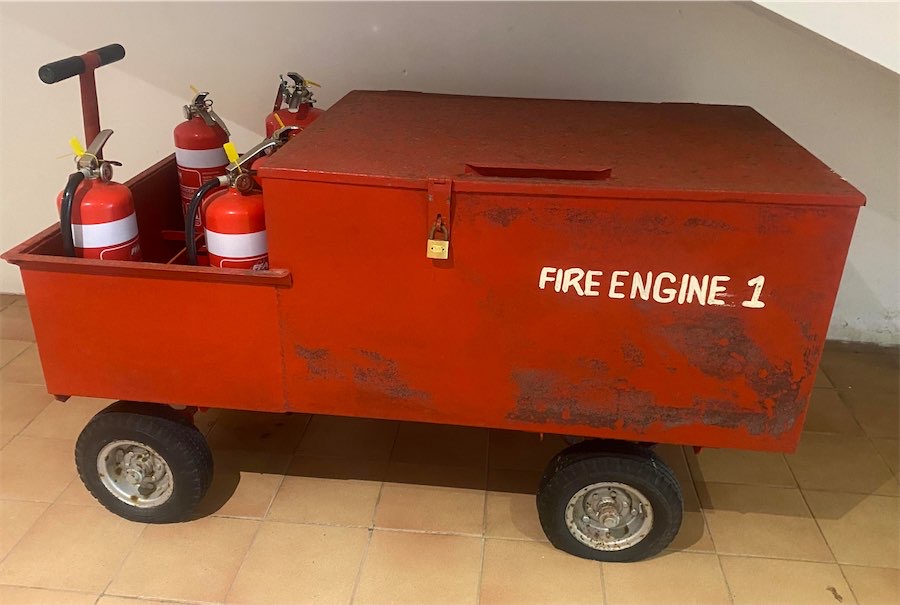
On a recent visit overseas I came across a fire engine at the hotel I stayed at that could solve the problems of the ACT’s electric fire engines, which have spent most of their time out of service.
They seem to need endless repairs, are too heavy because of the batteries, cannot carry as much water, require more time to charge than to fuel, have a shortage of charging points, fire brigade personnel find them too noisy and uncomfortable and they cost twice as much as normal fire engines.
The hotel model is cheap, not heavy, has no electric or diesel motor, the only moving parts are its wheels, stores easily, requires little maintenance and repairs and helps keep its operators fit and healthy moving it about.
Ric Hingee, Duffy
Dragging their heels on footpaths
How ironic that Michael Moore’s article, “Planned city ‘bombed’ by complacent government”, (CN June 18) was accompanied by a photo of a suburban street with a footpath.
Governments took 90 years to build a footpath to the entrance to the Northbourne Oval.
Only three quarters of Canberra’s streets have footpaths. That started to improve from about 2012, when the Territory Plan was amended to require every new street to have a footpath. That requirement was removed in 2023.
Leon Arundell, Downer
Hanson doesn’t fit the news media’s model
Andrew Hughes (“Here’s why Pauline Hanson will never ever be PM”, CN June 11), the real reason why Pauline Hanson will never be PM is because that is not the role the news media wants her for.
For one thing, she doesn’t quite fit the Trump “bogey man” role the media here have auditioned for, “Love yah work Clive but hey, sorry, the twerking didn’t quite do it for our audience numbers”. Also, she could never deliver such one-liners as, “This is going to be great television” with as much authority as The Donald.
No, those media owners who want to fully embrace the infotainment model of news delivery should be looking for someone who knows how to work the outrage industrial complex for full effect. Someone like Kyle Sandilands, perhaps?
Michael A Crowe, Hawker
As poll looms, One Nation will appear shallow
Andrew Hughes enumerated the obstacles facing One Nation becoming a major force in Australian politics (“Why Pauline Hanson will never ever be PM”, CN, June 11), including the party’s likely lack of party management, full-time teams in every state/territory, lack of diversity and above all the timing of its tilt for power, ie a lot of water will go under the bridge before the next election.
One Nation’s shallow “policies” cut through now but, closer to the federal poll, are likely to be seen as lacking in depth and populist.
During the Joh for Canberra campaign, Joh Bjelke-Petersen referred to the media as “feeding the chooks” – shades of Pauline Hanson?
Herman van de Brug, Holt
It’s all about the numbers
When is a journalist going to point out that a little over 1500 Australians were asked which party they would vote for if an election was held now?
When I studied statistics we were encouraged to use samples of at least 30 per cent of the total population to get a safely significant outcome. Fifteen hundred is 0.01 per cent of 18 million Australian voters.
Bryant Allen, via email
The government does need courage
It is interesting looking back at Michael Moore’s column from early April headed “Looking for the courage to right the tax wrongs”.
He notes that, currently, our tax system transfers wealth from those who can least afford it to those already seriously wealthy.
He asks, will the government have the courage in the next budget to introduce a fairer system.
Given the extraordinary cries from the investor class with the government’s proposed small readjustments in the tax system, it seems that the government does need courage to redress the system to support wage earners and hopefully lead to better housing affordability.
Adele Stevens, via email
University funding models need to be reformed
Prof Clive Williams’ critique of universities, “Where universities have gone wrong” (letters, CN June 18), hits the nail squarely on the head in his assessment of the problems facing the university sector and the structural incentives within.
Among his insightful observations, I would add that these structural distortions are not necessarily a function of individual universities running amok or being poorly run.
Rather, successive governments’ funding models have caused universities to nudge academics into these behaviours to optimise funding, promotions and mobility to other universities.
The results are perverse: excellent minds spending their time writing articles and chapters few read at the expense of sharing that knowledge with young, inquisitive minds desperate for knowledge.
To fix the problem, we need to reform university funding models, including by allowing domestic fee-paying students, curbing the over-reliance on fee-paying foreign students and rewarding academics for both excellent teaching and research.
Robert McMahon, Forrest
Safer pastimes than spearfishing
Another spear fisherman has been killed in a shark attack off Michaelmas Island – the second in WA in the last few weeks. A third spear fisherman was killed off the Great Barrier Reef on May 24.
As well as leaving families and friends distraught, these tragedies put other swimmers at risk.
Sharks do not instinctively hunt humans, but it is well known that they are naturally drawn to the low-frequency vibrations and blood of struggling, speared fish.
In fact, the International Shark Attack File, the world’s only scientifically documented, comprehensive database of all known shark attacks, classifies the majority of spearfishing incidents as “provoked”, in that fishermen are invading the shark’s territory and stealing their food, as well as spreading blood in the water.
There are far better, safer and kinder pastimes that do not include violent and agonising deaths of humans and other animals alike.
Dr Desmond Bellamy, PETA Australia, Sydney
Amazed at the generosity of people
At my local shopping centre St John’s were doing a non-perishable grocery drive.
I was amazed, when everyone is doing it tough, the generosity of people.
Good work, St John’s.
Meryl Morgan, Macquarie
I won’t be voting for Labor, Liberal or the Greens
I am writing to express my strong opposition to the killing of kangaroos in Canberra.
Kangaroos are an important part of our natural heritage and play a vital role in maintaining ecological balance.
Many kangaroos are killed each year in Canberra’s culling program. While some argue that population control is necessary, I believe that non-lethal methods should be explored wherever possible.
Killing these animals causes suffering and can disrupt ecosystems. Cold-blooded murder is no way to manage wildlife in nature reserves.
Kangaroos are unique wildlife species that attract tourists from around the world and symbolise Australia’s rich biodiversity. As responsible citizens, we should protect and conserve them rather than rely on widespread killing as a solution.
I urge the authorities to invest in humane wildlife management practices, support scientific research, and strengthen conservation efforts to ensure the long-term survival and welfare of kangaroos.
I will not be voting for Labor, Liberal or the Greens in any Canberra elections and urge others to do the same.
Brenda Davis, via email
The real reason for killing kangaroos
The ACT Government’s “conservation cull” is a well orchestrated sham. The so-called science used to justify killing thousands of kangaroos on Canberra’s urban nature reserves was debunked by CSIRO in 2014.
A 2021 citizen science project counting kangaroo numbers also exposed the errors in the methodology used by the government.
In 2025 a doctoral thesis uncovered the real reason for killing kangaroos every year – urban development.
Therefore, the government’s “conservation cull” is merely a smokescreen that helps developers.
Alex Kucharska, via email
A word from Queenie’s proud dad
A Canberra-born performer is returning home, not just with a new theatre production, but with a story that began here more than 50 years ago.
My daughter, Queenie van de Zandt, is bringing her new Australian musical Middle Raged: A Musical Meltdown to the Canberra Theatre Centre in July.
The show celebrates women in midlife with honesty, humour and heart, but behind the production is also a very Canberra story: a young girl who discovered performing through local schools, community theatre and Canberra stages, and who has gone on to build a remarkable career across Australia and overseas.
As a Canberran of 56 years, and as Queenie’s proud father, I have watched with pride as this journey comes full circle, from those early Canberra stages to a major Australian production returning home.
It is about family, perseverance, community and the way Canberra helps people find their voice.
Hans van de Zandt, via email
Ignoring physics, biology and engineering
Sorry, Mike Quirk (letters, CN June 4), but stories about intermittent versus nuclear electricity generation ignore physics, biology and engineering.
Weather-dependent intermittent solar panels and windmills don’t work at night, when overcast or raining, or during calms.
Nuclear power plants simply replace a coal furnace with a nuclear reactor to raise steam. They need no more water than any coal-fired plant.
Regretfully, CSIRO GenCost Reports have misled politicians about nuclear power costs (refer my letter, CN June 4).
We humans are carbon-based life forms living in a carbon-based world, like all other living creatures. Demonising CO2 is akin to demonising life.
Biomass increase from increased atmospheric CO2, measured by specialist NASA satellites in the past decade or so, includes greater crop growth for a growing world population. And more trees to build its homes.
Canberra trams have increased rates while seeing a one per cent fall in public transport patronage! Snowy 2.0 pumped hydro cost has blown out from $2 billion to $42 billion! The Alice Springs to Darwin railway has reduced container shipping times from Asia to southern Australia by a week. Whoops.
However, Australia has exported most of its industry to China these days, so maybe intermittent electricity will suffice after all.
Anthony Hordern, Jamison
I like wood heaters, but not in suburbs
There’s been much debate about the pros and cons of wood heaters in the ACT.
Take an evening walk around your neighbourhood and you’ll soon find out where they are.
A recent letterbox flyer provided good advice to owners. One point being to buy/use seasoned wood. Good advice, but therein lies the problem, as most suppliers in the ACT region don’t sell properly seasoned wood.
It takes nearly a year for wood to truly season after its cut. In that time it shrinks in size as it dries out, takes on a silver/grey look and will ring like iron bars when knocked together. Fresh-cut wood is full of colour and moisture, which affects the burn quality and will have a heavy thud sound when knocked.
I lived on a country property before moving to Canberra. I was lucky to have the space to have wood delivered and piled in a paddock for next year’s use, with the previous year’s delivery silvered off. Most Canberrans don’t have this luxury in their yards, so there’s no scope for seasoning delivered wood.
Unseasoned wood produces a less-efficient burn with more emissions. I actually like wood heaters, but not in a suburban setting.
Just as the ACT Government is promoting the move away from the use of gas in homes, so too should new build codes not permit wood heating.
Murray Parker, via email
News all day, every day at CityNewsQBN.com.au.



Leave a Reply