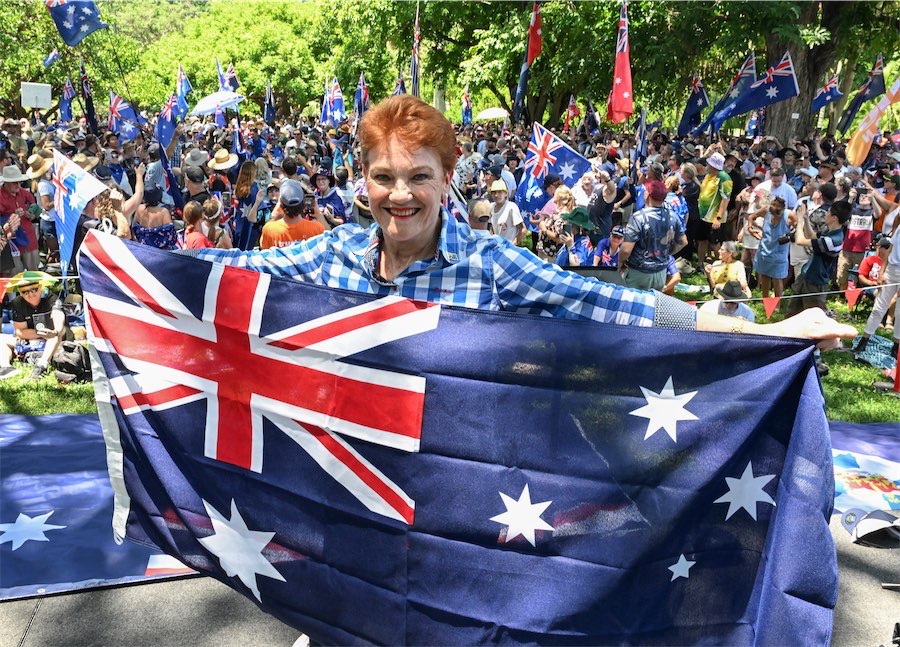
“The next election is more than 700 days away. Two more budgets. A lot of water under the bridge. Things will be a lot different to now, especially economically. That difference, just in time alone, is One Nation’s biggest foe,” writes political columnist ANDREW HUGHES.
So many times in the last month that I’ve now lost count, I’ve been asked: will Pauline Hanson become prime minister one day?

The answer is no. Opposition Leader, maybe, but even then it could be perhaps for just one term.
Why no? Firstly, the calendar. We are mid-2026, barely past the one year mark since the last federal election. Labor will go the full term. How do I know?
The recent report by the Joint Standing Committee on Electoral Matters (JSCEM), one of the most influential committees in parliament that decides the management of campaigns and elections, discussed the idea of a fixed four-year term with an expanded House of Reps of around 180, and a Senate of 80, to reflect our population now getting up to 28 million.
Labor wanted the fixed four-year term but lost. That would also indicate that they’ll go full term, which likely means May 20, 2028, as the last possible date for a half Senate, full House election.
That’s more than 700 days away. Two more budgets. A lot of water under the bridge. We can’t yet see the actual way our lives will be by then, but I’m guessing interest rates falling, demand steady and a housing market recovering. Things will be a lot different to now, especially economically.
That difference, just in time alone, is One Nation’s biggest foe. How can they convince us by 2028 that they are an alternative government in all the ways important in how a government engages with us? They are a long, long, way from there.
Okay, a second point. Party management. The Liberal Party Review of the 2025 election noted that a significant issue in their failings was due to party management issues. Political parties are now significant organisations, with Labor and the Liberal parties employing hundreds nationally. Each has turnovers in election years in nine figures.
To be a party of government you need full-time teams in every state and territory, people who have spent likely decades learning about politics.
Take Labor, the number one player in Australian politics, as an example. A traditional party official in Labor will have started young, usually in late teens either at university or as a shop steward for their union for the job they worked. Sometimes it is both.
Then, if seen as having potential and getting tapped on the shoulder by a factional heavy, it’s becoming an organiser. Learning the ropes of engaging with people, sometimes in hard campaigns where ugly things are said to you and by you in the furnace of industrial issues. And you don’t win all the time, so you get to feel what it tastes like to lose and see good people hurt.
In addition, you attend Labor branch and faction meetings, experiencing what solidarity really means. Again, loss. Again, sometimes seeing bad triumph over good.
By your late twenties/early thirties, if not chasing a parliamentary career, you are ready to run the party machine at a state election or assist federally.
You organise thousands, are adept at using databases, making content, and long ago gave up weekends and most weeknights. Family, if you have any, are all too often alone on the couch while you run numbers and wars at branch meetings or community events.
It is a pyramid hierarchy and it ain’t changing because it has worked for decades. It is also a reminder of who and what you are, and the history of the party and those before you.
This is what is required just for party management to be in a position to govern. One Nation’s getting there, but are still years away from being at Labor’s level.
Third, anger. Column after column in this publication have discussed one key theme in their own contexts: anger and frustration at government, institutions and organisations. We have put up with this because what other choice did we have? Blue or red?
Turns out more than what we thought: teals, independents, Greens, Family First, and so on. Even micro parties such as Legalise Cannabis and the Animal Justice Party have the kind of passion and dedication that has seen their bases growing steadily after every election.
Our anger and frustration will find a home to where we fill it most closely. We are as emotionally diverse as we are politically in 2026.
Talking of diversity. Diversity is the strongest in our cities. And cities are where One Nation is the weakest. If you can’t win the cities, then you can’t win government. That’s just a numerical fact.
And One Nation will not win a large Australian city.
But they will damage a lot of careers in Australian politics in the next couple of years because while they won’t win government, they will win seats and influence a lot of people. And isn’t influence real power?
Dr Andrew Hughes lectures at the ANU Research School of Management, where he specialises in political marketing.
News all day, every day at CityNewsQBN.com.au.


Leave a Reply