Music / New Worlds, Canberra Community Chorale. At Wesley Uniting Church Forrest, June 21. Reviewed by NICK HORN.
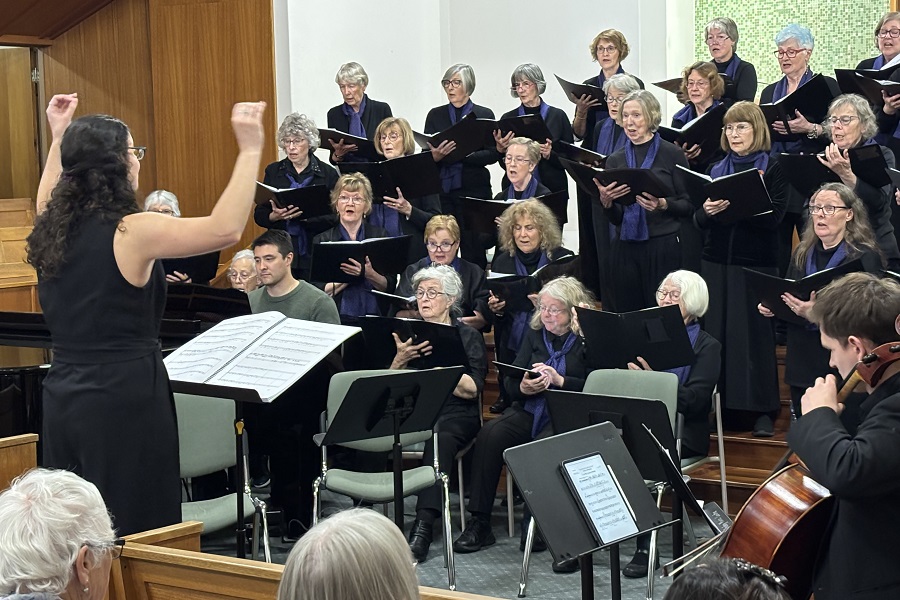
The Canberra Community Chorale, directed by Olivia Swift, presented Australian premiere performances of three substantial contemporary choral works to a large and appreciative audience in the Wesley church, a very sympathetic venue for choral performance.
The choir of over 50 singers was ably accompanied by Lucas Allerton on piano and electronic keyboard with a small string orchestra led by Michelle Higgs on violin. The orchestra provided warm and solid support for the choir throughout, and Swift kept the massed choral and instrumental forces together with clear, persuasive and disciplined authority.
Centuries of Meditation (2012), by Bulgarian-born Dombrinka Tabakova, consists of settings of poems from a collection by English 17th century mystic Thomas Traherne. From the opening lines, sung over rippling strings, the work evokes the poet’s vision of the sublime in a minimally melodic, incantatory style. It proved difficult for such a large choir to clearly articulate the difficult text. However, when the choral writing was pared back, as it was during the setting of The Cross—with women’s and men’s voices, by turn, delivering verses in a semi-plainchant fashion—the performance was more effective.
The Sweetening of the Year (2026), Dan Walker’s composition was commissioned by the Chorale, sets the poem of that title by Australian John Shaw Neilsen with extracts from Shakespeare’s A Winter’s Tale. This was the musical highlight of the afternoon, a breath of melodic fresh air from the bright orchestral introduction right through to the quiet contentment of the final couplet. Walker, a former director of the Chorale, has a wonderful lyrical gift. This work was commissioned for the Chorale, and Walker’s familiarity with its sound appears to be reflected in the way the singers relaxed and opened up to its inviting vocal lines and evocative harmonies.
Californian-born Christopher Tin’s Song Offerings (2024) are settings of poetry for which Bengali Rabindranath Tagore won the Nobel Prize in 1913. This was more rhythmically driven than the previous works, and most effective in the opening Let My Country Awake. The reduced accompaniment of piano, double bass and two cellos gave the music strong drive and variety (Allerton’s contribution on piano was notable). Translated—by Tagore—from Bengali into a sort of English prose-poetry, it is unsurprising that the singers struggled with articulation. Moreover, the sheer volume of words set by Tin inhibited effective attention by the Chorale to the evocation of the emotions and spirituality of the text. Despite Swift’s patient efforts, attention to precise rhythmic figuration flagged as the performance progressed.
Olivia Swift is to be commended for offering the Chorale the opportunity to engage with new music (particularly Dan Walker’s work) in a program of variety and interest. There is no doubting the hard work that has gone into the preparation of this concert, and the enjoyment and energy demonstrated by the Chorale in its performance.
News all day, every day at CityNewsQBN.com.au.


Leave a Reply