By Poppy Johnston
Housing choice is everything when it comes to bee-ting the heat.
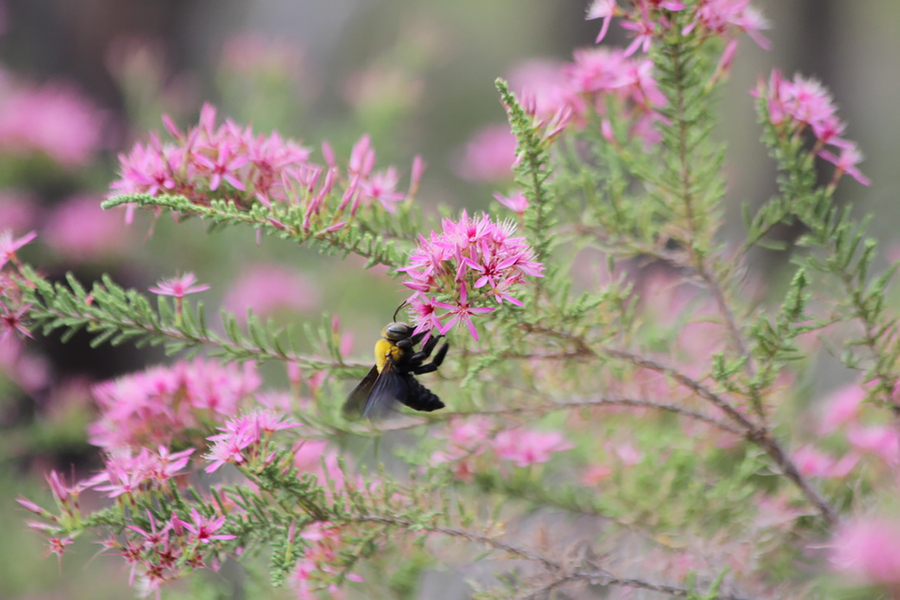
From Adelaide to the tip of Cape York in far north Queensland, evolutionary physiologist Carmen da Silva has been busy catching native bees from flowering plants in elongated butterfly nets.
To better understand climate adaptability of the ecosystem heavyweights, the research fellow from Macquarie University’s Pollinator Futures Research Centre has tested the heat tolerance of dozens of species.
She and her colleagues from other Australian universities discovered resilience to extreme temperatures was dependent on the nesting behaviours.
Insects that live in plant stems are typically the most heat tolerant as their homes offer less protection from the elements than their ground-nesting or hollow-dwelling peers.
Yet Dr de Silva said plant-stem nesters were still the most vulnerable to human-caused climate change as they had no safe place to hide when temperatures were extreme.
By contrast, the 70 per cent of bees that nest underground are best able to cope during sweltering hot days, as they have a cool refuge, despite having generally lower heat tolerance.
Tropical bees were found to be the most at risk from climate change, consistent with other findings that animals closest to the equator live close to their thermal limits so struggle to withstand further temperature increases.
Australia has more than 1700 native bee species.
The insects provide all-important pollinating services for ecosystems as well as crops.
While Dr de Silva said it was difficult to quantify the scale of native bee contributions to agricultural output, stingless varieties were known to play a major pollination role for tropical fruits and nuts, such as macadamias, lychees and watermelons.
It was therefore doubly important for more tropical ecosystem conservation to provide cool microclimates for sensitive species, Dr de Silva said, as well as action on emissions.
Queensland’s honey bee populations have also been hit hard by the parasitic varroa mite, she added.
“It’s really important that we have these native bees as backup pollinators.”
The Nature Communications study, also involving researchers from The University of Sydney, La Trobe University, Flinders University, University of Wollongong, Adelaide University and The University of Queensland, further confirmed heat tolerance can evolve in native bees.
The insects can adapt to climate change over multiple generations but not via phenotypic plasticity, referring to an organism’s capacity to acclimatise to new conditions within their own lifetimes.
News all day, every day at CityNewsQBN.com.au.




Leave a Reply