 Carol Wapshere… “It’s okay to just stand there and say, no, I am going to be here.”
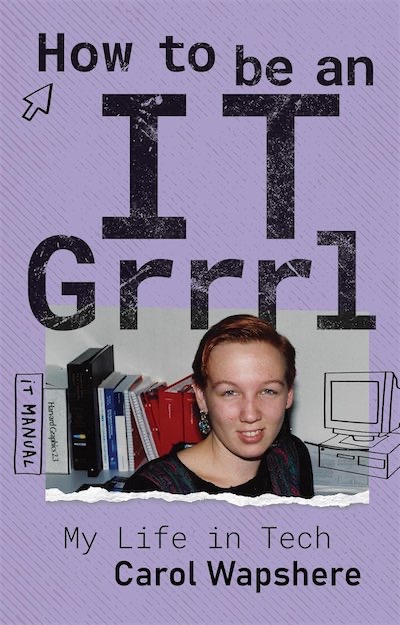
Carol Wapshere’s memoir, How to be an IT Grrrl, traces a career that spans decades, countries, and a tech industry that was not built with people like her in mind, reports DHWANI PATHAK.
Carol Wapshere still remembers what it felt like to finally find her people.
After years of severe bullying in primary school, high school shifted something. “I found other nerdy girls,” she says. “Girls I could talk about books with and I wasn’t going to get beaten up for it.” It was small, but it changed everything.
That instinct, she says, is what led her to her first break. A programming class, one of the first her school had ever run, caught her attention. She kept asking for more.
“I’d get all excited about something and start having a big discussion with the teacher,” she says. In 1985, when Apple came calling, that same teacher thought of her.
She grew up in Sydney and attended Sydney Girls High School, but her career and family life took her across continents, living and working in Australia, London, Brussels and Geneva as her husband’s work led the family overseas, before they eventually settled in Canberra.
Carol’s memoir, How to be an IT Grrrl, traces a career that spans decades, countries, and a tech industry that was not built with people like her in mind. But it is just as much a story about identity, creativity, and staying the course.
Music runs quietly but firmly through that story.
“I’ve always been very drawn to music,” she says. “It’s been a constant.” Her father, a classical music enthusiast, introduced her to the violin early on, though not always gently. Practice came with pressure. For a time, it pushed her away.
She returned to it later on her own terms.
At university, she joined a band. The violin was the only instrument she had, so she made it work. “I fell in love with the whole process,” she says. That idea, of building something together, carried over into her work in IT. “I get that in IT as well,” she says. “Having a project, something we’re making together.”
In the absence of role models in tech, Carol looked elsewhere. In the early ’90s, it was women in alternative music, especially the “Riot Grrrl” movement, that stood out; women who took up space loudly and unapologetically in male-dominated scenes. “I learned something from that,” she says. “It’s okay to just stand there and say, no, I am going to be here.”
That mindset stayed with her as she built a long technical career, something she points out is still uncommon for women.
“There were no older women I could look to,” she says. “None staying technical.” The pressure to move out of hands-on work was constant. She ignored it.
An identity and access security specialist, she continues to work in IT in a hands-on technical role, a path she says remains rare, while also turning her focus to storytelling through her book.
Her career also unfolded alongside raising a family, a balance she admits was not always straightforward.
At one point in London, with a six-month-old child and a job she found unfulfilling, she came close to leaving the industry altogether. “I was basically working just to pay a childminder,” she says. “It didn’t feel worthwhile.”
Instead, she took her husband’s advice. She returned to Australia briefly and negotiated a part-time role. “I could build a server in London from my living room in Brussels,” she says.
At the time, she was working around 10 to 15 hours a week while raising young children. It was enough to stay connected. “I got to keep my brain engaged… that satisfaction of fixing something.”
For Carol, that flexibility is one of tech’s most overlooked strengths. “What other career could have given me that?” she says.
Still, the challenges never fully disappeared. She describes sexism in the industry not as overt moments, but something quieter and more persistent.
“Death by a thousand paper cuts,” she says.
It is the small assumptions. The offhand comments. The times someone asks when the “technician” is arriving, not realising she is the tech lead. Or when a colleague assumes a man must have set something up for her.
“Those little things… it erodes your confidence,” she says.
Over time, those moments add up. And for many women, they become a reason to leave.
“I want women to know there is this kind of career,” she says.
On what’s next, she says, “I feel like I’ve told my story, and now I want to hear from other women,” as she plans a podcast by the same name.
She says she already has “half a dozen volunteers” and wants to focus on “that difficult 30s period” where many consider leaving.
“Here’s some women who’ve done it… everyone’s going to have their own way,” she says.
How to Be an IT Grrrl by Carol Wapshere is available as a book (rrp $35) and an e-book online, and from the National Library bookshop, and Paperchain.
News all day, every day at CityNewsQBN.com.au.





Leave a Reply