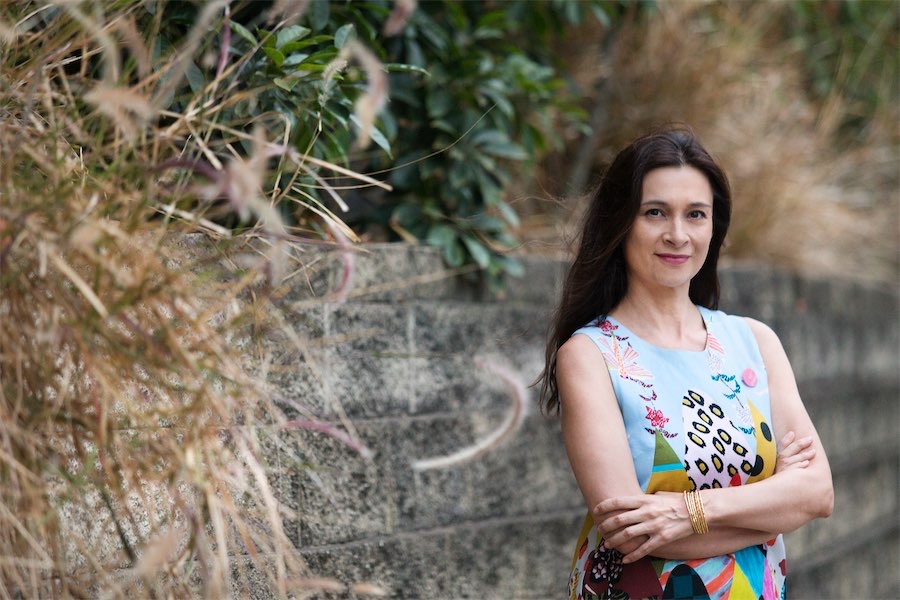
Mirandi Riwoe’s Queanbeyan-connected novel, A Short History of Longans, will be prominent among the unexpected local and regional stories featured at the “biggest yet” 10th Canberra Writers Festival, writes arts editor HELEN MUSA.
Mirandi Riwoe’s new novel, A Short History of Longans, is a sophisticated work of historical fiction spanning more than 200 years and featuring a distinctive Queanbeyan connection.
Her book will be prominent among the unexpected local and regional stories featured by director Andrea Putnis at the “biggest yet” 10th Canberra Writers Festival this month.
The festival showcases an international line-up that includes acclaimed New Yorker writer Susan Orlean, author of The Orchid Thief; Scottish author Andrew O’Hagan and Australian Gold Dagger Award winner Michael Robotham, speaking about his first Australian-set novel.
Mirandi Riwoe says she spent a great deal of time in Queanbeyan and drew on local history while writing the book.
“My mum lives there and I’ve spent a lot of time there, that’s why I set it there,” she says, recalling how, when her daughter was 12, they spent a cold month living at her mother’s house in Queanbeyan.
During that time she consulted Errol Lea-Scarlett’s Queanbeyan District and People, which sparked her interest in the district’s history.
After a preface concerning Ah Yang, a fictional Chinese bushranger loosely inspired by the notorious Sam Poo, often described as Australia’s only Chinese bushranger, the novel opens in 2049, when 75-year-old Daniel Connolly discovers that a storm has toppled a longan tree that has been in his family for generations.
From there, the story moves backwards through four interconnected 50-year periods, gradually revealing how the tree came to Australia and uncovering a complex web of family relationships stretching across two centuries.
Among the key characters are Wendy, Daniel’s aunt, who lives with early-onset dementia; his great-aunt Ruby Wong, a Chinese Australian actress pursuing Hollywood dreams in the mid-20th century; and Daniel’s great-great-great-grandmother Maria Barrett Connolly, an Irish orphan whose life becomes entwined with that of Ah Yang, resulting in a continuing Eurasian family line.
While Ah Yang is fictional, it is through him and Maria that the novel explores the often-overlooked histories of interracial families in colonial Australia.
The longan itself, a delicious tropical fruit related to the lychee, has personal significance for Riwoe. She first encountered longan trees at a temple near Innisfail in Far North Queensland more than 25 years ago and was struck by their size and beauty.
“My dad has grown multiple longan trees, so they’re part of my family,” she says.
Riwoe’s own family history also informs the novel. Her Chinese-Indonesian father adopted the surname Riwoe in the 1960s, when Indonesian authorities required ethnic Chinese residents to take Indonesian names.
She says that as she has grown older she has become increasingly interested in her Eurasian heritage and the experience of living “on the dash” between cultures, themes that run throughout the novel.
“I realised that although I’m not Chinese enough for some people, I’m not white either,” she says.
“It’s such a privilege to have access to that world and to be living between cultures.”
The novel also builds on Riwoe’s longstanding research into Asian diasporic histories, including her earlier work on the Australian gold rush in Stone Sky Gold Mountain and her studies of Asian communities in 19th-century Britain and literary depictions of the “sinister Oriental”.
She says each section of the novel was inspired by different interests, from her personal experience of dementia in the family to the life of pioneering Chinese-American screen star Anna May Wong, who partly inspired Ruby Wong’s storyline.
Riwoe’s book, of course, is among hundreds being discussed at what Putnis says will be the festival’s biggest program yet, celebrating reading at a time when artistic expression faces increasing pressures and people are spending more time scrolling on screens.
“We want to celebrate books and pass that love on to the next generation,” she tells me.
To that end, the festival will embrace books of every kind, from science fiction, fantasy and speculative fiction to cookbooks and the more familiar literary genres. Its newest initiative will be a stronger focus on young readers, signalled by a featured Kids and Young Adult Day at the National Library on October 17, creating what Putnis describes as “a festival within a festival” aimed at engaging younger Canberrans.
The festival will also continue its collaborations with Canberra’s broader literary community, including poetry events with That Poetry Thing at Smith’s Alternative and the announcement of Canberra Youth Theatre’s Emerging Playwright Commission Award.
Mirandi Riwoe appears in conversation with Qin Qin at the National Archives, October 18 as part of Canberra Writers Festival 2026, October 15-18. All information at canberrawritersfestival.com.au
News all day, every day at CityNewsQBN.com.au.


Leave a Reply