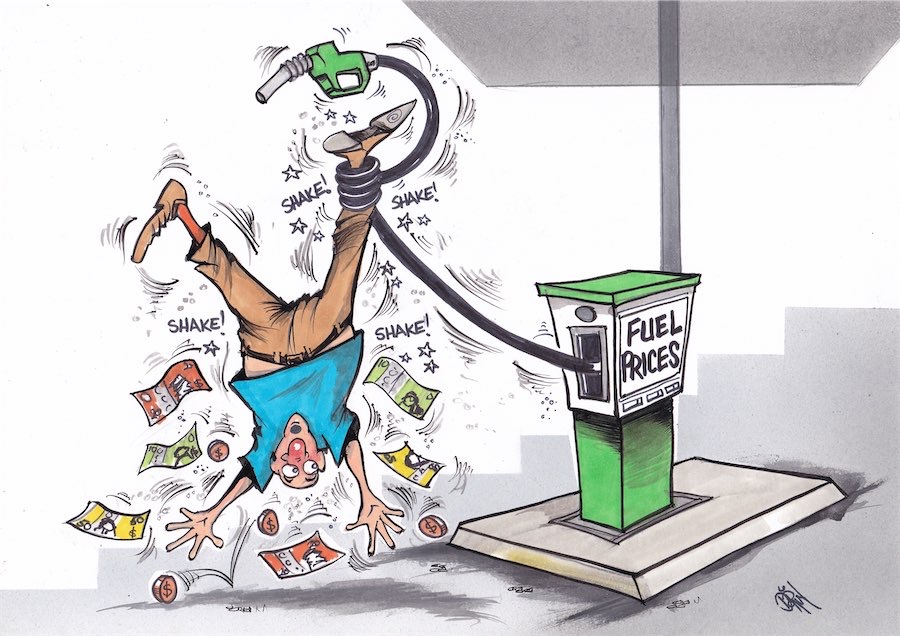
Letter writer REBECCA HENSON, of Hughes, would love to know how come last year the chief minister said electricity prices were going down and this year they’re going up!
IN the July 2022 (wasteful) “Our CBR” newsletter, the Chief Minister said, and I quote: “From this month, ACT residents will see a decrease in electricity prices, and have the lowest standing offer of any jurisdiction in Australia”.

Why then, on 21 June – not quite a year later – did I receive emails from ActewAGL advising that my gas and electricity prices are going up?
I really would love an explanation, but it seems to be a Labor thing with Albanese saying Australians will save $275 a year on energy at the last federal election and Barr has spruiked the same lies.
And on the matter of the abysmal state of Canberra’s disappearing bushland and habitat destruction, last September a “report card’ was published titled “New report card grades every federal electorate for threatened species recovery”.
Via the WWF website, users can search their suburb/electorate to view the “score”. The score ratings are A-F and Hughes ranks E. Second last. Upsetting, but no surprises here. Featured was the Swift Parrot with habitat destruction and invasive species such as cats, being the main culprits. Vassarotti should be bloody ashamed of herself. Rant over.
Rebecca Henson, Hughes
‘Softly, softly’ spin raises suspicions over budget
THE spin and drip of ACT budget news came “softly softly” this year. This suggests that the devil is in the detail, somewhere.
Perhaps this is in ministers’ bottom drawers, ready for a fast airing when the unpublished schedule of government business pops another dense tranche of paperwork into the ether for scant public awareness-raising purposes, and quick passage through the Assembly.
It is in such ways that the new planning system continues to glide closer to full consideration and fast implementation, starting with a full-scale trial phase that isn’t a trial, except for those trying to navigate it, and about which no one is being transparent (“The disingenuous spin that is never questioned”, Paul Costigan, CN June 28).
Meanwhile, more tamping-down public communications strategies are being rolled out, presumably to pacify the public about the government’s much touted yet still poorly defined future planning “outcomes”.
While the chief minister keeps encouraging visions of “gentle urbanism”, the massive West Basin development area that will house mainly large built forms and much hard surfacing is now promoted by a key government official as “the new Acton Waterfront neighbourhood”.
Major developers of complexes along and near Northbourne Avenue are also keen to formally name and promote their massive building structures as the “XYZ Village”, hoping no one will notice that there is no room for a copse of trees on their overly cramped sites, let alone a village green.
These language spinners continue to underestimate the intelligence and perspicacity of the Canberra community.
It is time to prioritise honesty, integrity and transparency in ACT government and property industry communications and their public claims.
So far, the spin offers no evidence that the current unbalanced drive for dense residential development, and little else, will be swiftly turned around for the betterment of new and existing suburbs and their residents.
Sue Dyer, Downer
Use a peninsula bridge for light rail
A PEDESTRIAN bridge connecting Acton Peninsula to Lennox Gardens is apparently back on the agenda – to better connect the National Museum, the Australian Institute of Aboriginal and Torres Strait Islander Studies, and the ANU, with the other central national area attractions. Better still, the bridge should carry light rail (no cars or trucks). It could very feasibly be part of the Civic to Capital Hill section of the Civic-Woden tramline; most importantly, saving Commonwealth Avenue, and its bridges from ruination.
If the tramline must be dragged over City Hill, then take it to Acton Peninsula via Acton Foreshore (the tramline could provide a clear “ownership” demarcation between the wide lakeside public domain, and the looming private development there).
Jack Kershaw, Kambah
Why single-block redevelopment doesn’t work
COLUMNIST Paul Costigan does a good job shafting the spin and misinformation around the “housing crisis” and how to fix it (CN June 29).
One aspect he doesn’t mention is that single-block redevelopment, as favoured by the development industry, “Greater Canberra” and, apparently, the ACT government clearly doesn’t work.
It fails to significantly increase residential densities or the supply of affordable housing (witness the knock-down-rebuild massive new single house in Griffith that recently sold for $6 million!). It also removes significant established tree cover and fails to provide sufficient site open space for new planting.
The only solution to addressing the “missing middle” in established residential areas, ie new medium-density housing with diversity and substantial on-site tree cover, is government intervention to facilitate the amalgamation of substantial sites for redevelopment in accordance with strict requirements.
I can recommend an excellent recent book by professors Peter Newton, Peter Newman and others on this very topic. It is called “Greening the Greyfields” and is available as a free publication.
There are also good examples of what can be achieved on large sites with good planning controls and good design, including generous communal open space, in the redevelopment of Kingston from the ’80s-’90s and in the early developments of the Kingston Foreshore. Unfortunately, sites were subsequently allowed to get smaller, densities significantly increased and space for tree planting largely disappeared. The only ones who profited from this retrograde movement were the developers, and probably the government.
Richard Johnston, Kingston
Rangers don’t know laws they’re enforcing
I AM part of a team of volunteers who watch and listen outside the Canberra reserves throughout the government’s annual kangaroo slaughter.
Our job is to count how many shots are fired and note whether our counts tally with the number of kills the shooters report to the government and to record any shooter activity that breaches the law.
The ACT’s legislated Animal Welfare Code of Practice for the Humane Shooting of Kangaroos and Wallabies (non-commercial) 2014 states that shooting must not occur in adverse conditions. A government spokesperson is on the record as citing fog, strong winds and wet weather as examples of adverse conditions.
On Monday, June 26, I was on watch at Red Hill Nature Reserve. It was very windy, with BOM reporting gusts between 26 to 30 km/h. When I heard a gunshot, I approached a ranger’s ute parked nearby and knocked on the window. A ranger opened the door and I told her that, according to the code, the shooters should not be shooting because it was too windy. She said she wasn’t aware of any code.
This is a damning indictment of the ACT government’s alleged concern for animal welfare during this publicly funded mass slaughter that has now claimed the lives of well over 40,000 healthy kangaroos – that Canberra’s own rangers don’t even know what laws they are supposed to be out there, enforcing.
Robyn Soxsmith, Kambah
Why do Greens have no issue with killing kangaroos?
THE ACT Greens state on their website that “animals are sentient beings with intrinsic moral status, deserving to be free from direct and indirect harm caused by humans” and that “animals are not provided with the moral consideration they deserve”, yet the party has no issue with spending millions of taxpayer dollars on contracting shooters to slaughter thousands of kangaroos every year in the territory.
Where does bludgeoning joeys to death fit into their claim that animals deserve respect? Where does waging war and terror on sentient beings fit into any of the claims on their website?
The government needs to be held accountable for the pain and suffering inflicted upon sentient beings who deserve respect and to be provided with the moral consideration they deserve.
Whitney Richardson, via email
‘Roos rollicking in the sand bunkers
I HAVE read with sympathy those concerned regarding kangaroos there are “ hardly any left after the cull last year” on the Red Hill reserve. The mystery is solved.
There are hundreds and hundreds on the Federal Golf course. I invite all those concerned to drive or walk into the clubhouse, relax, enjoy a coffee and ask at the pro shop where to walk in the tree line between the fairways.
Visiting twice a week I can vouch for the fact that there are usually mobs of 250 or more enjoying the grass, shade and water facilities. Many also enjoy rollicking in the sand bunkers.
Members frequently have difficulty moving them out of harm’s way, they are so tame. They arrived in the drought, multiplied and have never left. Rest assured there is no shortage of kangaroos in the Red Hill vicinity. The club values and protects them as an asset to the natural beauty of the course.
Mike Prunty, Monash
It’s looking like a development cull!
I FEEL the need to get this off my chest. What I’ve noticed is that the ACT government claims the recent kangaroo cull (which has seen the killing of 40,000 kangaroos in 15 years) is for “conservation” of the Earless Grassland Dragon.
Okay, I understand that BUT If this is the case, why is the government clearing areas of kangaroos and then covering those same areas in housing developments?
I’ve also heard the government is currently clearing Red Hill of kangaroos whilst advertising a major new retirement village in the area.
If what I heard is true then it looks more like a “development cull”.
Karl Herzog, via email
The questions that weren’t asked
EVERY three or four years a survey is conducted to gain opinions of ACT residents about kangaroos and their management.
The last survey in 2022 randomly contacted 605 people from the White Pages directory to answer 17 questions asking about the ethics of culling under certain circumstances eg to conserve plants, animals and ecosystems and prevent starvation during drought.
Three questions that are not asked is: Do you agree or disagree that
it is humane to pull a joey from its shot mother’s pouch and club it to
death with a mallet? Do you agree or disagree that it is humane to leave
the joey at foot to starve to death because its mother has been shot and its food source gone? To preserve threatened species of flora and fauna, which do you think would have the best outcome: removal of kangaroos or removal of weeds?
The conservator of flora and fauna stated on June 6 that 76 per cent of people accept the cull is necessary. I wonder if people were informed about the cruelty that occurs during the annual culling and the total lack of activity on the removal of invasive weeds, whether they would have a change of heart.
Julie Lindner, Farrer
Sicily visit needs weeks, not days
“WHIMSY” columnist Clive Williams did not give Sicily a chance (“Glad You’re not here…when holidays go wrong”, CN June 22)). Inspired by an interest in the Cosa Nostra and TV detective Montalbano. An eight-day stay.
From Australia, fly to Rome. Catch the train south to the toe of Italy. Cross the straits of Messina – home of the mythical “ravenous monsters” Scylla and Charybdis.
Down to Catania. In Catania, rather than a tour related to a TV detective, there is the cathedral of St Agatha and the home/museum of Sicilian writer Giovanni Verga (1840-1922) for starters.
Sure, there are spells of wet weather. And as Clive points out, Mt Etna is an active volcano. Tourists must take their chances with active volcanoes. Catania has a history of dealing with Mt Etna.
Tourist guides rarely mention Cosa Nostra (the mafia). A visit to the village of Corleone should satisfy a mafia enthusiast.
Throughout Sicily there are monuments, buildings, ruins, stories: all accessible evidence of the occupation of Sicily by Greek, Roman, Arabic, Spanish, French and, of course, Italian people – and there’s their cuisine. Stay a few days in any small Sicilian village. The locals soon become aware of strangers and their interest and co-operation ensure the few days are memorable.
All this in eight days? No way. At least three weeks are required – or don’t bother.
Russell Wenholz, Holt
Stop dividing Australia, prime minister
THE Uluru Statement, which our PM wholeheartedly supports, believes in Truth Telling and it will be ultimately part of the Voice to parliament proceedings.
Prime minister, the only missing thing here is a single heartfelt statement in the constitution: “We recognise the Aboriginal and Torres Strait people etcetera”. Nothing more. No EXTRA Voice.
Stop dividing Australia further. Your goodwill is going down the tube, sir.
Russ Morison, Theodore
Solar panels taking over arable land
WHILE letter writer Eric Hunter (CN June 22) agrees with me on not liking bogong moths, he goes on to say: “Vi goes on to assert that without population controls of some sort…”. That is not exactly what I said.
I stated that if every form of life kept breeding and not dying out for one reason or another, then the world would be overrun. That is not the same as saying population control.
However, I agree with Eric that the human population is getting out of control, but short of doing what China did with the one-child policy, there is not much we can do.
But unlike Eric, I do not agree that the decline in food production would be due to extremes of climate change. All the farmers I’ve seen being interviewed have said the crops are doing well except during floods.
The main problem with crops is the arable land is being taken over by field after field of solar panels and fields of wind turbines and land is rendered difficult to use because of power-lines, plus the blades and solar panels degrade and drop toxins on the crops or soil below.
Vi Evans, via email
Just drops in the global-heating ocean
IN his column “Maybe it’s our species that’s not fit for purpose” (CN, June 29), Robert Macklin wrote “…the almost inevitable runaway heating of the globe leading to mass extinction, perhaps even of our own role as the apex predator”.
Mr Macklin is too “soft” in his assessment: the world has become over-populated, especially in the countries that can least support more people, in terms of food or land to produce it; and in some cases potable water, or the funds to pay for these vital life-support materials. sub-Saharan Africa is a tragic example.
Too many advanced economies are still wedded to the fossil fuels that are the main cause of global heating, including Australia. This country is increasing its production and burning of fossil fuels, now predominantly natural gas (methane, a highly potent global-heating gas), despite being blessed with unlimited resources of energy, commonly known as solar energy, from the giant nuclear fusion reactor at the centre of our solar system.
To give credit where it is due, the ACT government has already done more than its fair share of transitioning to solar and wind energy; and to electric vehicles. Unfortunately, these are just drops in the global-heating ocean.
Dr Douglas Mackenzie, Deakin
News all day, every day at CityNewsQBN.com.au.


Leave a Reply