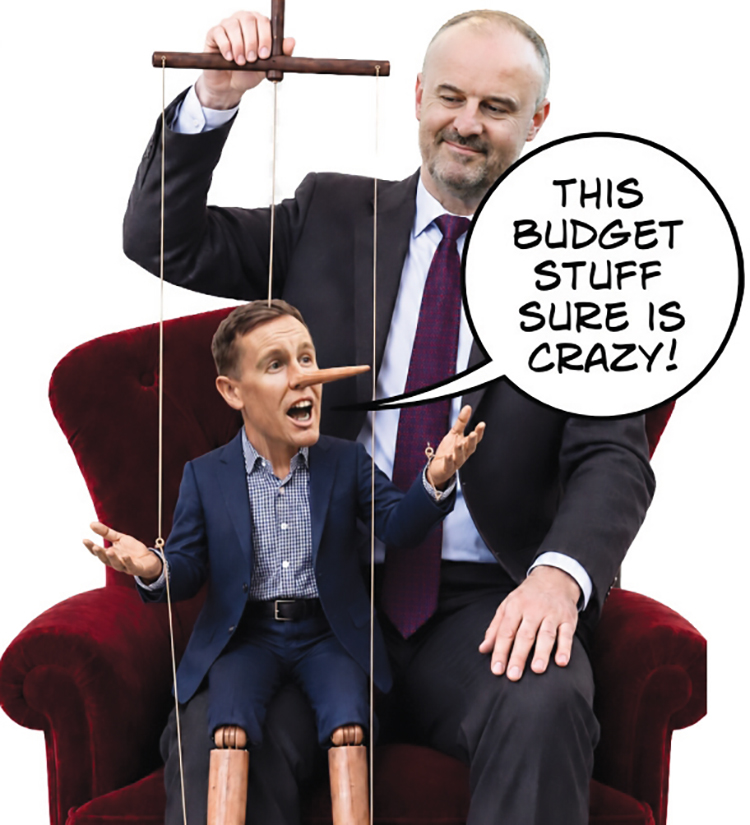
Spinocchio Steel is highly strung – KEEPING UP THE ACT
‘Total Territory borrowings are forecast to reach a staggering $23.7 billion.’ JON STANHOPE & KHALID AHMED take a deep breath and say: ‘The budget is in a worse condition, and its forecasts are even less credible than the previous years’ forecasts.’
Treasurer Chris Steel’s second budget was a relatively quiet affair on the day.
The government had attempted to sell the 2026-27 ACT Budget in the previous weeks through planned media releases and hyped-up stories on, for example, “generational change” spending in housing and “nation leading” stamp duty concessions for first homebuyers.
Even the disturbing cuts to city services and voluntary redundancies were announced early with the main budget day message being of a “measured” return to surplus.
However, even the traditionally accepting mainstream media had some reservations, calling it a mirage.
In this initial article on the budget, we will provide an overview, with further detailed analysis and commentary on individual aspects of the budget in the coming weeks.
We have previously noted the two well established conclusions (among others) by Saul Eslake, economic adviser to the Select Committee on Fiscal Sustainability that: (a) the Territory’s finances as reflected in the 2025-26 budget were unsustainable; and (b) the forward estimates were unrealistic.
For the 2026-27 budget, the obvious questions at the aggregate level are (a): what are the changes in revenue, expenses, net operating balance and debt from the 2025-26 forecasts? and (b) has the financial position improved or deteriorated?
Unfortunately, this budget has confirmed the fanciful nature of the budget forecasts published just a year ago. The budget has gone backwards, adding a further $547 million in deficit over the four years from 2025-26 to 2028-29, despite a significant funding boost from the federal Government for health services.
Disturbingly it appears that only a part of that funding has been allocated to the health budget, with the remainder apparently being utilised to improve the bottom line that otherwise would have been much worse. A return to surplus has been pushed out, as always, to the last forward year.
The budget is in a worse condition, and its forecasts are even less credible than the previous years’ forecasts.
Before discussing the financial estimates, we note the budget has been prepared in an environment of a major conflict in the Middle East that has caused significant disruptions to global supply chains, not just for oil, but also for a range of inputs to the agriculture, manufacturing and technology sectors.
The forecasts of some economic parameters appear optimistic, for example, the Consumer Price Index (CPI) reaching 5 per cent in June 2026 is assumed to drop to 2½ per cent in 2026-27 with the conflict being resolved. We have previously observed a similar normalcy bias in the context of the conflict in Ukraine.
In the present case, the risks are skewed towards CPI remaining higher and, as such, producing potentially over-optimistic budget forecasts.
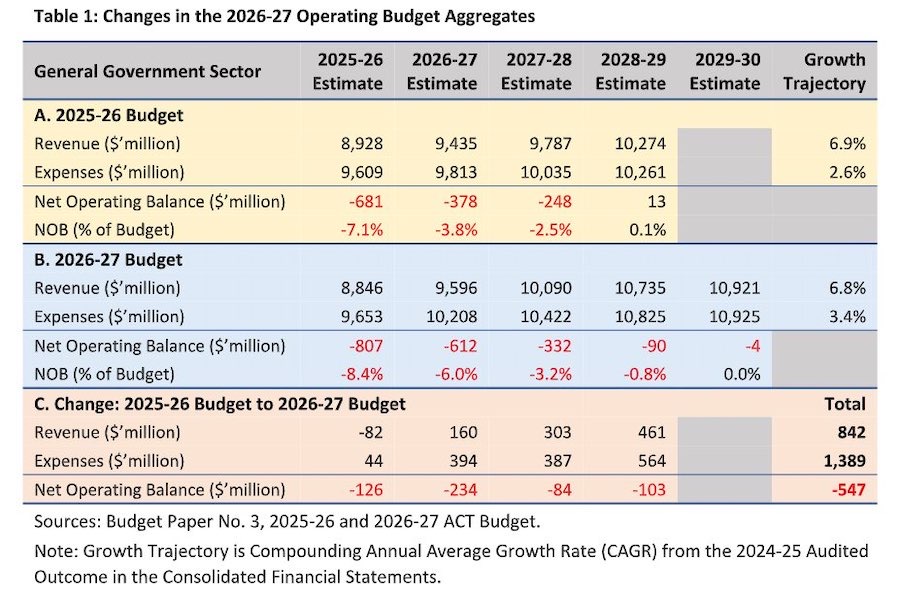
Turning to questions on the state of the budget, Table 1 provides the operating budget forecasts in the 2025-26 Budget (Table 1A), the 2026-27 Budget (Table 1B), and changes to the forecast revenue, expenses and the Net Operating Balance (NOB) in this budget.
The table reveals some seriously uncomfortable facts. For the current year (2025-26), the operating deficit is forecast at $807 million (8.4 per cent of the budget), which is $126 million higher than the original budget estimate. We note this is a preliminary estimate from Treasury, which is likely to change through the audit process.
Over the four-year period (2025-26 to 2028-29), the budget has increased the cumulative deficit by $547 million from the previous forecasts (last row in Table 1). This is due to $1.389 million being added to the previous expenditure forecasts for this period, which is only partially offset by an increase in revenue of $842 million.
Cash deficits over this period cumulate to $2.3 billion, and the government will be borrowing in full or in part in some years, to pay interest on the accumulated debt.
A significant increase in revenue relates to Commonwealth funding for health which was announced earlier this year.
We were understandably of the view that all the additional funds would be committed to the health budget, and that therefore the overall budget position would remain unchanged while pressures in health would be alleviated, to some extent, with the additional funding from the Commonwealth.
Therefore, while we can identify about $545 million in additional funds over the forward estimates period as health grants from the Commonwealth, at best only about $146 million, appears to have been applied to the health budget.
We hope this isn’t the case but unless the government can provide evidence and a reconciliation of the subject Commonwealth funding having been allocated to health, it is quite reasonable to conclude that health has been shortchanged, and that the operating budget would in fact be worse off by at least $300 million, or possibly more, if the federal health funding had been utilised for the provision of health services.
The forecast deficit for 2026-27 is now $612 million (6 per cent of the budget), a blowout of $234 million from the forecast in the last budget.
In the article referred to above, we had attributed a greater likelihood to pigs flying than a surplus being achieved in two years, because it was almost certain that the Treasurer could not contain expenditure growth at just 2.6 per cent per annum (Table 1A).
In this budget, the expenditure trajectory has been lifted to 3.4 per cent (Table 1B). We consider there will be challenges in maintaining expenditure growth even at this relatively elevated rate but lower than the historic rates of growth.
Savings specified in the budget are minor relative to the task. Revenue trajectory is marginally lower at 6.8 per cent per annum, which is about double the forecast growth rate of the economy. The budget is now forecast to return to essentially a position of balance ($4 million deficit) in four years’ time.
There are clearly upside risks to expenditure, downside risks to revenue, and major risks to the quantity and quality of services if the Treasurer Steel were to achieve these forecasts.
The profile of net debt in this budget is consistent with that in the previous budget, ie, still growing across the forward years, reaching $14.1 billion in 2029-30. That is despite the savings and the deferral of $719 million in capital spending factored into the budget. Total Territory borrowings are forecast to reach a staggering $23.7 billion.
Interest costs are forecast to almost double over the budget and forward estimates period, reaching $1.218 billion in 2029-30. According to notes in the budget papers: “Interest expenses are projected to increase by $175 million in the 2026-27 Budget over the 2025-26 estimated outcome. This increase primarily reflects higher estimated borrowing requirements” (Budget Paper 3, Page 166).
To put this increase in interest payments just in one year in perspective, try and imagine what our public school teachers, fighting for better resourcing and conditions, could do for children with, say $175 million – if only the government had maintained debt at the 2025-26 level.
Jon Stanhope is a former chief minister of the ACT and Dr Khalid Ahmed a former senior ACT Treasury official.
Jane Hume has taken aim at Labor’s workplace relations regime, but the Coalition remains wary of promising the sweeping reforms many in its political base want, writes political columnist MICHELLE GRATTAN.
Political columnist MICHELLE GRATTAN says Anthony Albanese heads to Pacific climate talks with pressing problems at home, as another rate rise intensifies the economic blame game.
"For Canberra to become an 'ideal' city, it must address unmet community needs in health, housing, transport, and education. Priorities need to be based on detailed analysis rather than rhetoric," says planning columnist MIKE QUIRK.



Leave a Reply