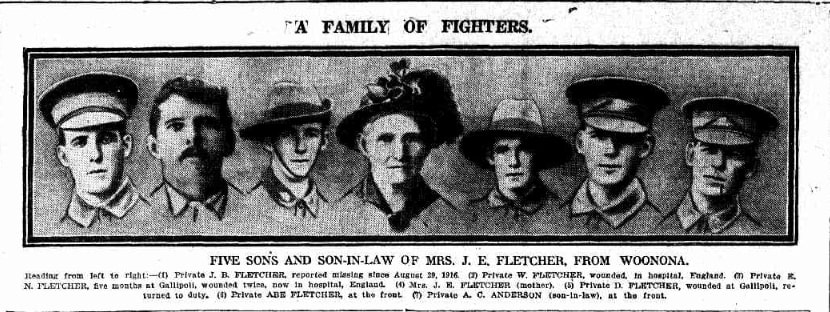
Journalist DARRYL JOHNSTON writes that Anzac Day is also a time to acknowledge women, and especially the many loving and nurturing mothers, wives and sisters who lost their sons, husbands and brothers to war. One such family was the ‘Fighting Fletchers’.
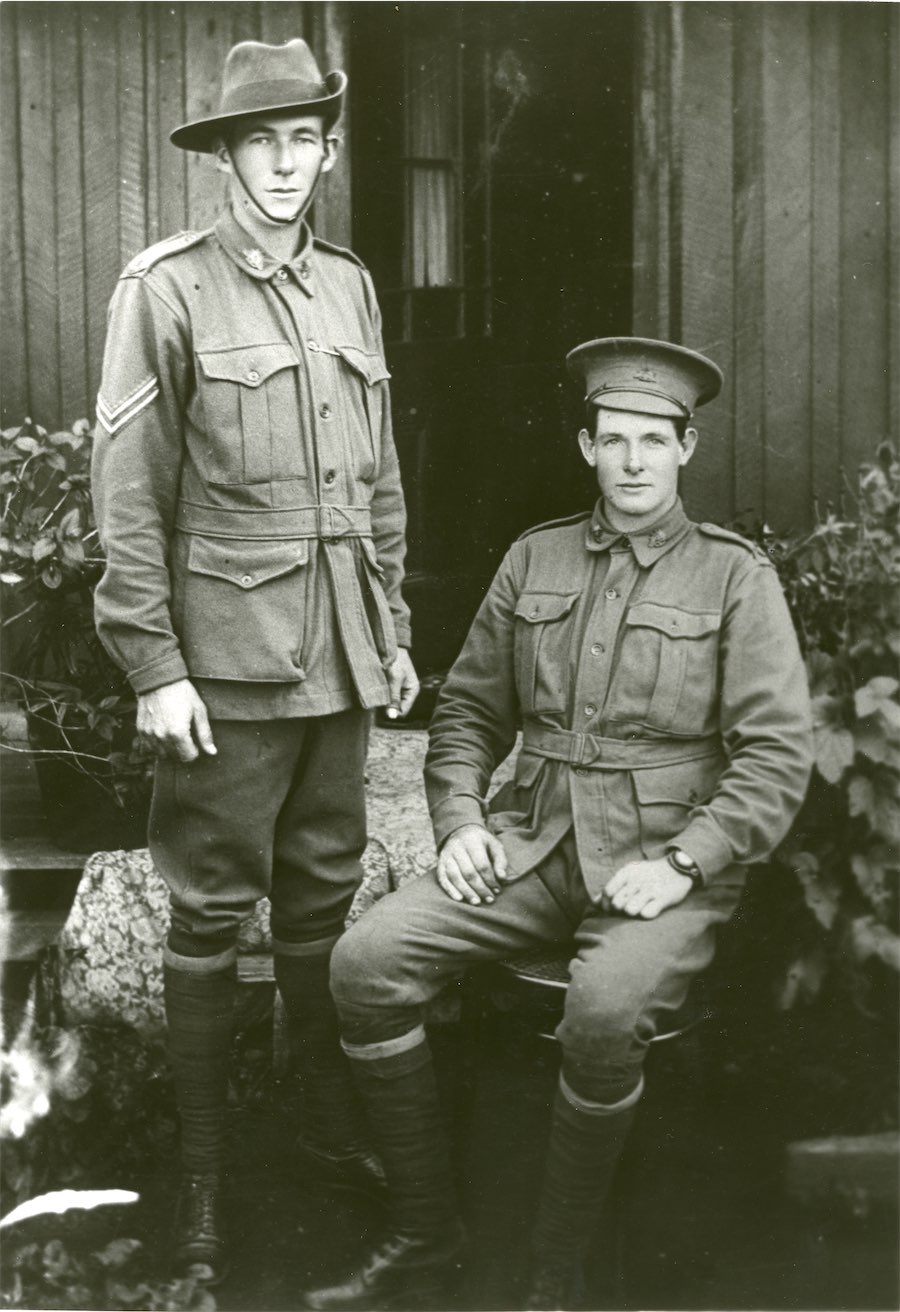
Every Anzac Day we honour and remember those men who laid down their lives for us in times of conflict, to fight for our country, families and our freedom.
It is also a time to acknowledge women, and especially the many loving and nurturing mothers, wives and sisters who lost their sons, husbands and brothers to fight in fields and on shores far from their love and shelter.
Two such women were mother, Jessie Elizabeth Fletcher and wife and sister, Annie Fletcher. Despite all her maternal instincts, Jessie Fletcher reluctantly gave five of her precious eight sons to fight for Australia and New Zealand in a war that was said to end all wars, while Annie gave a husband and a brother.
When conflict broke out in Europe Jessie and Annie were living in the coal-mining community of Woonona north of Wollongong in NSW Wales. Jessie was a widow and Annie was married to her son, John Burnett Fletcher.
Jessie’s coal-miner husband Abraham was killed in an underground rockfall at nearby Bulli Colliery in May 1906. She was left to raise 13 children, eight boys and five girls.
The family was crammed in a small coal-miner’s cottage in Campbell Street Woonona. Much to Jessie’s reluctance some of her sons followed in their father’s footsteps and toiled down the dirty mines.
Coal was firing new industry, a growing economy and in high demand. Digging the “black gold” from tunnels that perforated the mountains was about the only real job on offer in the district.
Opportunity to escape the dirty, dusty, daily drudgery
Safety was secondary and inhaling coal dust, day in and day out, led to Black Lung Disease and the premature death of many miners.
War was an opportunity for men in the district to escape the dirty, dusty, daily drudgery underground. They were seeking better wages, conditions and security. They thought they were embarking on an adventure in service of their King and Country and would return with enough money to start a new and better life for themselves and their families.
Jessie’s son, Donald McDonald Fletcher, was the first to join the war. He was a farm hand and enlisted on February 27 1915 at the age of 18. His 23-year-old coal miner brother, Edgar Norman (Ted) Fletcher, followed weeks later enlisting on March 19.
The brothers underwent training at Liverpool and both would be sent to Gallipoli. Donald was assigned to the newly raised 18th Australian Infantry Battalion and Ted with the 20th Australian Infantry Battalion.
Donald departed Sydney on June 25 1915 aboard the Australian troopship HMAT Ceramic. Ted departed on the same day aboard the troopship Berrima. Family and friends stood on the wharf and waved them farewell.
Both young men were sent to Egypt in preparation for a new offensive on the Gallipoli Peninsula. In August 1915 the Fletcher brothers landed at Anzac Cove. They were part of reinforcements after the fateful Anzac landing on April 25 that was to be declared Anzac Day.
Donald’s Battalion conducted a costly offensive in which he was wounded and evacuated to hospital in England and eventually repatriated to Australia.
Signed up for a second tour of duty
Ted was also wounded in action at Gallipoli and evacuated to England. He rejoined his unit in May 1916. It had been transferred to France where he was later hospitalised suffering from shell shock and then wounded a second time while fighting near Pozieres. Ted was evacuated to England, repatriated to Australia in June 1917 and eventually discharged.
Not long after Ted returned home, Donald signed up for a second tour of duty. His battalion had been withdrawn from Gallipoli, sent to Egypt to be rebuilt and transferred to France where he rejoined them on August 28 1917.
The 18th Battalion had participated in most of the major battles fought by Australians on the Western Front and marched into Belgium where Donald saw further action around Ypres. On September 20 1917, during one of the first battles on Menin Road, Donald was reported missing. He was later declared killed in action. He was just 21 years old. In all, 5013 Australian soldiers lost their lives in the battle of Ypres. Donald was buried at the Divisional Collecting Post Cemetery outside the town.
He was posthumously awarded the 1914/15 Star, the British War Medal and the Victory Medal which were sent to his family in Woonona. Ted also received the 1914/15 Star, the British War Medal and the Victory Medal. He died in 1967.
The ‘boy’ soldiers and sailors
Jessie’s youngest son, Abram, was a “boy soldier”. He was born in March 1899 and only 15 and seven months when he enlisted in October 1915, yet he claimed on his enlistment application he was 21 and seven months. During World War I, the minimum enlistment age was 21 years or 18 years with the permission of a parent or guardian. But, hundreds of young men lied about their age and served before reaching 18 years. The Australian War Memorial has identified more than 200 “boy soldiers” and “boy sailors” who died in service.
Abram enlisted in Orange where he was working as a labourer. Following training he embarked the troop ship Anchises on March 14 1916 and joined the ranks of the 31st Australian Infantry Battalion.
Its first major battle was at Fromelles on July 19 1916 and it went on to play major roles in conflicts that are now part of history and the Anzac legend. Abram was hospitalised on a number of occasions, once with diphtheria and then lingering influenza. He was also wounded in February 1917 while fighting in France and evacuated to England.
Following Armistice in November 1918, Abram was invalided to Australia on the troop ship Bakara. He was awarded the 1914/15 Star, the British War Medal and the Victory Medal and died in 1982.
Jessie’s son and Annie’s husband, John Burnett Fetcher, was a coal miner when he enlisted with the Australian Imperial Forces on January 7 1916 at the age of 31. He and Annie had two children and lived in Burnett Cottage in Campbell Street, Woonona.
Annie’s twin brothers, Norman and Owen Murray, were already serving in the war. Norman was with the 3rd Infantry Battalion in France and Owen was with the Camel Corps in the Middle East.
John trained in Liverpool until he, and his new-found mates, shipped out, arriving in Alexandria in Egypt and then Marseilles in France. John joined the ranks of the 13th Australian Infantry Battalion on August 19 1916 and 10 days later he was killed in action.
His mother and wife were initially told he was missing. Their fears were realised several months later and on March 23, 1917 the local newspaper reported under the headline, Patriotic; “Mrs. JB Fletcher of Campbell Street Woonona has received word that her husband Private John Burnett Fletcher has been killed in action after being reported missing since 29 August last. He gave his life for his King and Country.”
Private James Lynch later told an inquiry: “On 29 August 1916 at Mouquet Farm Private Fletcher took part in an attack and shortly after the commencement, two of his comrades saw him lying with both legs badly smashed and they believed him to be dead, and that his burial on the spot no doubt took place.”
Hand-to-hand fighting among the farm ruins
According to war historians, on August 10 1916 Australian soldiers began attacking Germans at Mouquet Farm. The Germans had excavated the farm cellars to create linked dug-outs. The Australians made several attempts to capture the farm until realising the main German defensive position was underground.
The battle was reduced to hand-to-hand fighting among the farm ruins and in the trenches costing 2049 Australian lives and a significant but unknown number of Germans. John was posthumously awarded the 1914/15 Star, the British War Medal and the Victory Medal. He rests at the Courcelette British Cemetery in France.
To add to Annie’s grief, she received news in October 1918 her brother, Norman, had been killed in France. The local newspaper reported on 11 October 1918: “Private Norman Murray, son of Mr TJ Murray, of Woonona, has been killed in action. He was one of the original Anzacs and was due for leave to return to Australia. He held the Military Medal and Bar. His brother, Private Owen Murray, is serving in the Middle East.”
Norman Murray was 23 and is commemorated at Villers Bretonneux Memorial in France among those with no known grave.
Jessie’s son-in-law, 29-year-old, Arthur (Toby) Clarence Anderson enlisted with the Army.
Arthur was also a coal miner and lived in Belmore Street, Wollongong, with his wife and Jessie’s daughter, Maude.
Whether it was ominous, a portend of things to come or just coincidence, he enlisted on September 4 1916, two days after his brother-in-law, John Fletcher, was reported missing in action in France and Arthur joined the same Battalion in which his late brother-in-law had served. At the time of enlisting, Arthur and the Fletcher family were unaware that John was missing and that he had been killed in battle.
On November 8 1916 Arthur embarked the troop ship Port Nicholson for England and eventually France. Perhaps, as he set sail, he was looking forward to meeting his brother-in-law on the battlefield.
Arthur had a checkered military career. He spent time in hospital in England suffering from influenza and recovering after being wounded in action in France. He also spent 60-days in the brig after being charged with desertion.
After the Armistice he returned to Australia on April 10 1919. Arthur was also awarded the 1914/15 Star, the British War Medal and the Victory Medal. He died in Sydney in 1947.
Jessie’s eldest son, William Joseph Fletcher enlisted in New Zealand in July 1917 at the age of 41. He was miner with the Bruce Railway Coal Company in the South Island and had been living in New Zealand for more than 20-years. He was separated from his wife with whom he had three children. William embarked on the Tahiti sailing from Wellington in November 1917 with the New Zealand Expeditionary Force bound for England.
Arriving in Liverpool in January 1918 and then proceeding to France. He served with the 1st Entrenching Battalion and was transferred to the 1st Battalion Auckland Regiment.
In August 1918 he suffered multiple gunshot wounds and was sent to Boulogne-Sur-Mer on the north coast of France before being evacuated to England where he saw out the remaining months of the war.
William returned to New Zealand in January 1919 and was discharged the following month. He was awarded the British War Medal and the Victory Medal. He died in 1963.
Arthur Hall Fletcher was born in Wollongong in 1884. In later life he also moved to New Zealand where he married in 1910. On the outbreak of war, he was serving with the New Zealand Army Reserves as a driver. There are no records to indicate he was sent to war. He died in New Zealand in 1965.
Of the five sons Jessie Fletcher waved off to war, three returned, though they bore physical and mental scars for the rest of their lives.
Neighbours rallied and built Annie a cottage
Annie Fletcher lost a husband and a brother. Many other families in the district lost their men or they returned physically or mentally wounded. Among their community the Fletchers were known as “A Family of Fighters” and the “Flighting Fletchers”.
In response to their service and sacrifice their neighbours rallied and built a cottage in Campbell Street, Woonona, for war widow Annie Fletcher and her fatherless children.
Jessie was given a place of honour at future Anzac Day services in Sydney and Wollongong until she died in 1944. Annie never remarried and lived the rest of her life in Woonona, dying in 1963.
Lest we forget women like Jessie and Annie on Anzac Day and all the women who have paid a heavy price in all wars and conflicts.
There is no understating their loss and grief, because it is the mourning of a woman that is said to have inspired the first Anzac Day Dawn Service. A small group of ex-servicemen saw a tearful mother placing flowers at the foot of the unfinished Sydney Cenotaph in the early hours of Anzac Day 1927. Her son had been killed in the dawn landing at Gallipoli.
The servicemen promised her they would hold a service at dawn every Anzac Day in future. That mother’s grief has since grown into a nation’s mourning and an annual expression of loss.
News all day, every day at CityNewsQBN.com.au.




Leave a Reply