Former planner MIKE QUIRK says the ACT government’s virtue signalling, reflected in the simplistic 2018 Planning Strategy, needs to be replaced by a strategy based on the analysis of potential urban futures.
THE main purpose of the new Planning Act is to improve the implementation of the 2018 Planning Strategy.

The Strategy’s broad direction of increasing housing opportunities close to employment and along major transport routes has been a feature of Canberra’s planning since the early 1990s.
The outcomes desired were a reduction in infrastructure costs, environmental impacts and travel (and associated greenhouse emissions) and the widening of housing choices for an increasingly diverse population. To help deliver the outcomes the Strategy introduced a 70 per cent infill policy.
Unlike past strategies, it failed to analyse the economic, social and environmental implications of alternative distributions of population and employment. The result is the development of Canberra is on shaky foundations.
The efficacy of the required independent review of the new planning system’s operational effectiveness and efficiency and district strategies has been compromised by the failure to review the Strategy before the Planning Act. What constitutes a better outcome cannot be known until a large number of issues are assessed including:
Housing preferences and travel reduction
- How much has travel, especially car travel, been reduced by the increase in housing at centres and along major transport routes? Do residents in higher-density dwellings live close to their employment and how do they travel to work?
- Does the reduced level of detached dwelling release in the ACT adequately meet housing preferences? Are there sufficient, appropriate and affordable opportunities for all household types including those with children, the aged and those on low incomes?
- Does restricting the supply of detached dwellings increase the amount of car-dependent development in the surrounding region and result in the loss of revenue from land sales, rates and Commonwealth grants?
- Are the existing residential policies providing sufficient opportunities for the housing demands of all households to be met? Are current RZ policies preventing the provision of townhouse and dual-occupancy dwellings for households wanting a more affordable/less maintenance dwelling in a familiar location? Should a size limit be placed on such dwellings to improve their affordability? How much up-zoning is necessary?
- Does the trend to smaller household size indicate an increased preference to live in a higher-density dwelling?
- Do higher-density dwellings produce energy and water savings?
- What are the environmental constraints of possible greenfield supply areas?
- Would (a) accommodating more demand in greenfield areas with a range of shops, community and recreational facilities, employment with frequent bus services; and (b) greater employment dispersal and working from home and better bus services reduce car travel, moderate house prices and the need for higher redevelopment in inner areas?
Infrastructure cost savings
- What is the infrastructure capacity available in each district? How much augmentation is required to accommodate future growth?
- What are the infrastructure costs of possible greenfield areas?
Housing affordability
- Given the wide range of factors influencing affordability (taxation policies, lack of social housing, interest rates, lack of supply, migration levels, growing inequality), how does limiting the supply of detached dwellings and increasing the supply of higher density housing reduce house prices, rents and homelessness?
Despite the absence of analysis, the recently released District Population Projections prepared in the context of the 2018 Strategy assume the projected 330,000 increase in Canberra’s population between 2022 and 2060 will be accommodated in the existing Districts (see chart).
Does this indicate an intention to introduce an urban growth boundary before an assessment of the impact on house and land prices, the level of infrastructure savings or the environmental value of possible greenfield areas?
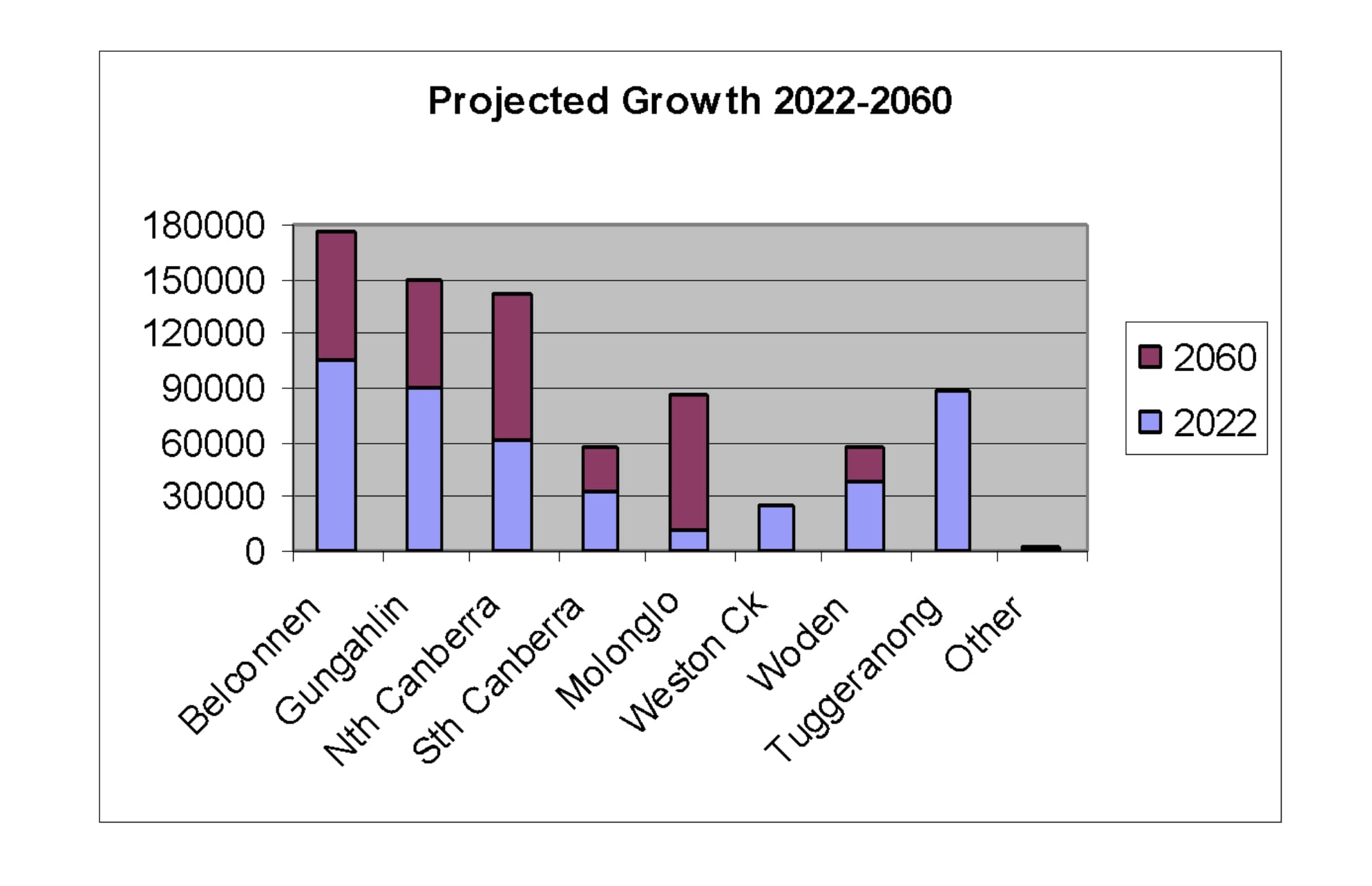 The North Canberra projection is illustrative. The population of the District, which has already experienced substantial redevelopment, is projected to increase from 62,000 to 141,000. Assuming an average dwelling occupancy of two people, the 2060 population would require 70,500 dwellings. In 2021 there were 28,000 dwellings in the District, indicating a requirement for an additional 42,500 dwellings. This compares to an increase in dwellings of 11,200 since 2001.
Where will the additional dwellings be located? Is redevelopment assumed in the RZ1 zone? What are the social and physical infrastructure costs of accommodating this increase? What will be the quality of the urban environments created? What housing choices will be available and what are the affordability implications? Could some of the projected growth be better accommodated elsewhere in areas with projected low growth such as Tuggeranong and Weston Creek or in new greenfield areas?
The new planning system is designed to facilitate the development of higher-density housing and limit community engagement. It is yet to be demonstrated that infill of 70 per cent or more better meets community needs than a strategy based on a lower level of infill. How will it be more effective in improving public transport, pedestrian and cycling networks; reducing congestion; improving facility provision in Molonglo; increasing employment in Gungahlin; reducing infrastructure costs, improving the design and quality of redevelopments and meeting housing preferences?
The government’s virtue signalling, reflected in the simplistic 2018 Planning Strategy, needs to be replaced by a strategy based on the analysis of potential urban futures and that delivers a more socially, economically and environmentally sustainable city.
Mike Quirk is a former NCDC and ACT government planner.
News all day, every day at CityNewsQBN.com.au.




Leave a Reply