By Lucinda Garbutt-Young in Canberra
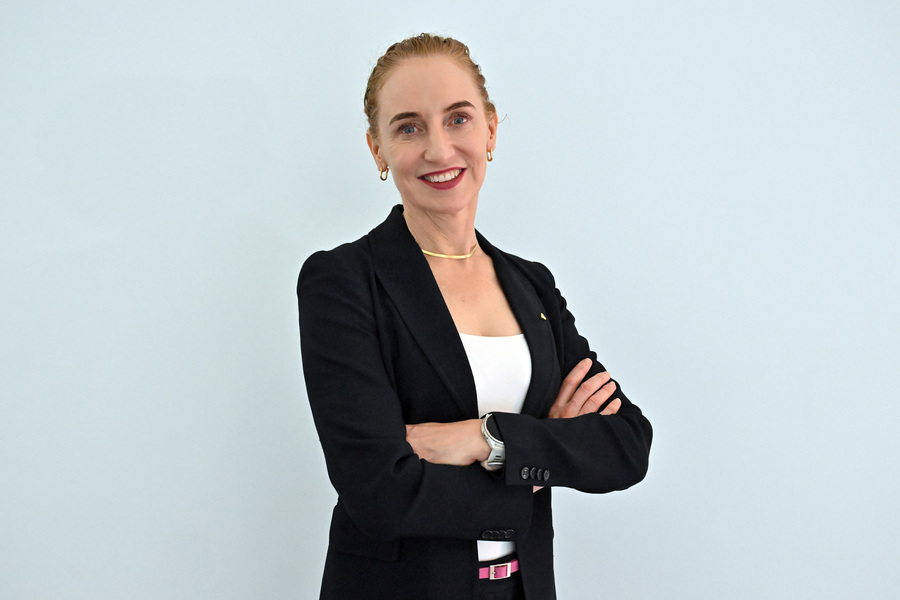
Georgina Long has never stopped asking “why”.
The word used reflexively by many youngsters has become the basis of the esteemed oncologist’s career – and one that brings her great joy.
Through her work as the Melanoma Institute Australia’s medical director, Professor Long helped take the disease from being one of the nation’s most fatal cancers to a better than 50 per cent survival rate in the advanced stages.
Professor Long is the co-recipient of the 2026 Prime Minister’s Prize for Science, announced on Tuesday night, following her being awarded Australian of the Year alongside her co-researcher and friend, the late Richard Scolyer, in 2024.
Despite her achievements, she still thinks regularly of her high school chemistry teacher’s careful instruction, which encouraged her to explore ideas on her own.
“Teachers inspire young people and make curiosity a part of life,” she told AAP.
“Why does the moon grow round, shrink, and then grow round again? Why do waves come in and go out? That curiosity is the basis of science.”
Her desire to keep learning helps patients now, but it also helps to drive future scientific study.
“Science has to have a run time; you have to get the knowledge and the innovation in technology,” Prof Long said.
“We could not do (most of the work being done now) last century.”
Prof Long is working on what she calls the “third space” of uncharted medical research, focused on the early, preventative stages of melanoma.
Much of that work can be translated to other cancers, particularly her most recent work on mRNA vaccines that are personalised for each patient.
The co-winner of the top prize, Anthony Thomas, is one of the world’s most esteemed subatomic theorists and knows more than almost anyone about the densest observable matter in the universe: neutron stars.
“I don’t think I can argue great utility (in my work),” Professor Thomas said.
“For me, that’s one of the great things about this prize. It says that fundamental science that doesn’t produce one dollar is still very important and very valuable.
“While the things I do directly may not produce a usable product in decades – if ever – the people I teach and work with can take and use it in all sorts of places.”
Prof Thomas called for schools and parents to introduce children to a love of learning early.
Primary-aged students should be given a good education in reading and maths before being introduced to more difficult concepts, allowing them the space to explore the world in their early years.
The awards also honour educators at primary and secondary level who have worked to give students a critical understanding of science.
Gabrielle Oslington from Arden Anglican School in NSW and Nicci Wheaton of The Glennie School in Toowoomba were recognised at the 2026 prizes.
Molecular biologist Mark Smythe won the bioscientist prize for his work on psoriasis and blood disorders.
Life scientist of the year was Asha Bowen, who studies childhood skin infections, and Fengwang Li won physical scientist of the year for his carbon efficiency breakthroughs.
New innovator Joseph Richardson also took home an award for his work on nanocoatings, used in hygiene products.
Quandamooka man Chris Matthews was acknowledged as the Aboriginal and Torres Strait Islander scientist of the year.
His Goompi model is used to translate between Indigenous knowledge systems and western mathematics, bridging education gaps.
News all day, every day at CityNewsQBN.com.au.




Leave a Reply