By arts editor Helen Musa
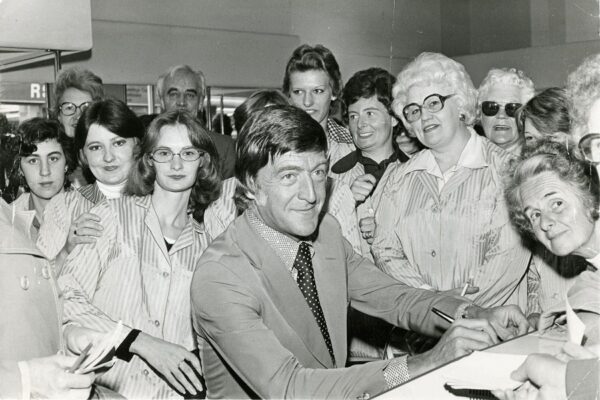
The opening film of the British Film Festival this Wednesday will be My Duchess, starring Joan Collins as Wallis Simpson, the Duchess of Windsor, but as the 2026 event progresses, all eyes will be on a star of a very different kind, Sir Michael Parkinson.
The life and career of the late veteran broadcaster will take centre stage in the world premiere of Parky, a documentary about the man who interviewed some of the biggest names in entertainment, sport and politics.
Remarkably, it was co-directed by Australia’s Luke Mazzaferro with Englishman Luke Cornish (not ELK the stencil artist).
Three other films have Australian connections. Cynthia Erivo stars in Prima Facie, adapted from Australian playwright Suzie Miller’s award-winning play, in A Talent for Murder, Helen Mirren plays Patricia Highsmith, author of The Talented Mr Ripley in a script based on Joanna Murray-Smith’s play Switzerland, and the closing-night film is the Australian premiere of Elsinore, directed by Australian filmmaker Simon Stone.
When I catch up with Mazzaferro by phone, he has only just finished watching the final version of Parky, about the man who became one of Britain’s best-known television interviewers over a career spanning decades, earning a knighthood and the affection of millions of viewers.
An incredibly intelligent man, Mazzaferro tells me, Parkinson seemed equally at ease with Princess Anne, Muhammad Ali, Malcolm Fraser, Madonna and Tony Blair, although his personal leanings were perhaps most apparent when he interviewed Dr Jacob Bronowski, the scientist and presenter of the BBC documentary series The Ascent of Man.
It was about two years ago, when Parkinson’s youngest son, Mike Jr, approached the Australian team through a mutual friend, James Erskine, although much of the film has come together this year.
“It’s not a best-of clip show,” Mazzaferro assures me. Rather, the documentary peels back the layers to reveal the man behind the famous television personality.
Mike Jr had wanted the film to be made in Australia, and Mazzaferro believes there was good reason for that. Parkinson had a strong connection with Australia, where he lived for a time and felt a certain affinity with the underdog. As a working-class boy from Yorkshire, he recognised something of his own experience in Australian attitudes to class and regional identity.
Parkinson believed Australia was a more relaxed society, without the rigid class system he knew in Britain. As Mazzaferro recounts, Paul Hogan once put him right on that score, telling him: “We have it here but we hide it better.”
Nevertheless, Parkinson clearly felt at home here. He became the first non-Australian to deliver the official Australia Day Address.
“Mike told us his father’s show was a window into who he was,” Mazzaferro says, explaining how the filmmakers approached the vast archive of material available to them. They sifted through footage spanning more than 650 programs and thousands of interviews to discover the questions and themes that repeatedly drew Parkinson in.
For Mazzaferro, the real achievement of the documentary is to show that those conversations revealed not only something about the people in the interview chair, but also about the man asking the questions.
Addiction fascinated him. Parkinson himself struggled with alcohol, and Mazzaferro says the filmmakers noticed how quickly he would steer conversations towards the subject when interviewing people such as Richard Burton, David Bowie and Naomi Campbell.
The complications of celebrity life were another recurring interest, explored in conversations with Goldie Hawn, Robbie Williams and Madonna.
His own family life also emerges as an important thread. Born in the South Yorkshire mining village of Cudworth in 1935, the son of a coal miner, Parkinson grew up between two powerful influences. His mother was determined that he would not end up in the pit village and introduced him to the movies, where he became fascinated by Fred Astaire. His father, meanwhile, instilled in him a love of sport.
The documentary suggests that the tensions between these influences helped shape a man who could command a television studio yet remain burdened by self-doubt.
That insecurity extended into his family relationships, seen in a conversation with Tom Hanks, revealing about Parkinson’s relationship with his three sons.
Despite his immense success, Parkinson apparently never entirely abandoned his youthful ambition to become a Hollywood star, although he was happy to make fun of the idea.
He was, Mazzaferro suggests, a man of contradictions, combining the assured manner of the celebrated interviewer with the insecurities of the working-class boy.
One fascinating thread is the longevity of his interviewing career. Parkinson spoke to Bing Crosby and Michael Bublé. Well before the carefully managed publicity circuits, social media and the short soundbite, Parkinson excelled at the long-form conversation. At his peak, his program attracted as many as 15 million viewers an episode.
Parkinson, who died in 2023, was a devoted husband to Mary, herself a journalist and broadcaster.
His interests went well beyond television, into writing, sports journalism and radio, where he presented Desert Island Discs on BBC Radio 4 and hosted a long-running jazz program on BBC Radio 2.
“He ran the whole gamut,” Mazzaferro says.
The British Film Festival, Palace Electric Cinemas, October 28-November 29.
News all day, every day at CityNewsQBN.com.au.


Leave a Reply