By arts editor Helen Musa
Queanbeyan glass artist Matt Curtis has spent decades exploring the possibilities of glass, but his newest work, Salvaged Light, is also a challenge to the way we think about waste.
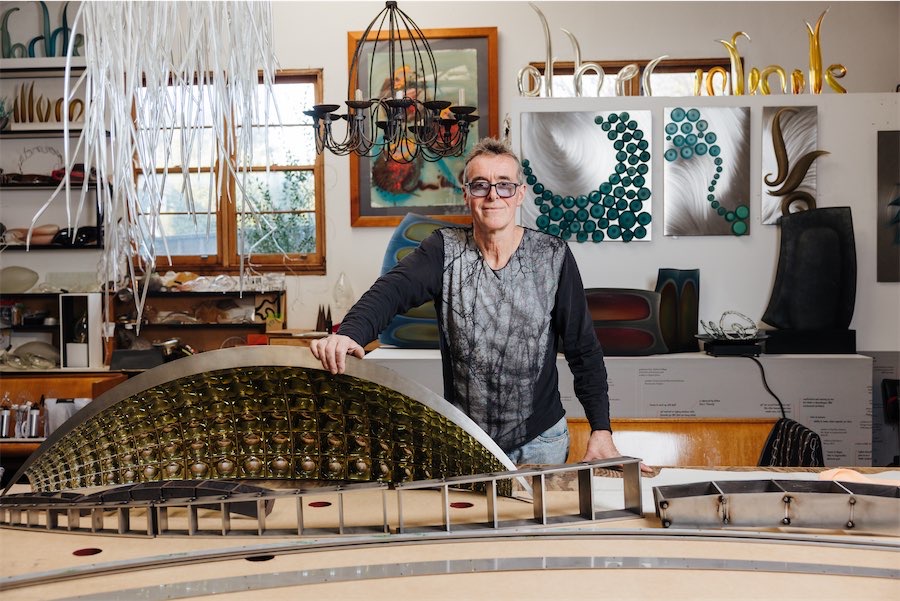
Known for large-scale glass installations including Field of Light, a metallic arc fitted with about 2000 glass lenses on the former site of the RSL national headquarters, he’s been chosen as the face of this year’s Craft + Design Canberra Festival.
This effectively gives him a prominent role in Canberra’s ambitions to become a UNESCO City of Design.
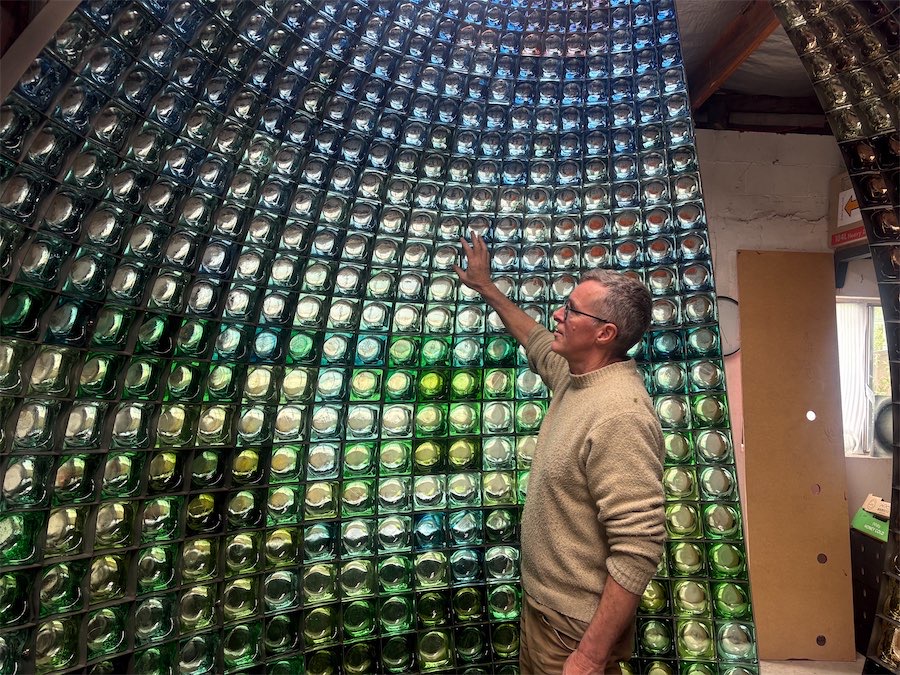
When I visited Curtis at his Uriarra Road workshop recently, he was working on a large curved sculpture made from glass that might otherwise have ended up in landfill.
To the eye, the smooth curves of Curtis’ glass bricks look perfectly natural. However, achieving them has been anything but straightforward.
“I was shocked at how many problems I had in scaling down to create the curves,” he says. “With this work I have hoovered up two tonnes of glass and prevented it from going into landfill.”
Mathematical precision and a detailed chemical understanding of glass are essential to the process, particularly when it comes to achieving colourations that allow light through the red and green parts of the spectrum. Yet Curtis prefers to talk about the philosophical purpose of his work.
“I feel this work has relevance in the nature of what’s going on in the world,” he says, while admitting that he is so close to his work and his thoughts that it’s not always easy to explain them.
Curtis arrived from England as a 17-year-old and has spent much of his working life exploring glass. After 35 years in the field, he is increasingly interested in what the material can say about the world around us.
Salvaged Light, which will be installed between the front fountains on Civic Square, is made from glass pressed into bricks, and Curtis hopes architects will see its potential as a building material.
“I want architects to take it and use it.”
His neighbour in Uriarra Road, artist Alex Asch, has also worked with recycled materials, including television screens. Curtis has experimented with these too, pointing to a translucent window in his house made from old screens.
Other experiments are more playful. In the studio, he shows me an extraordinary small sculpture made from the faintly green-tinted bottles left over from heavy consumption during the covid pandemic. It is his own reminder of that period.
Curtis is happy to move between work that is functional, decorative or somewhere in between.
“I’m not building a career but finding a positive purpose, a positive sense,” he says.
He is sympathetic to Craft + Design Canberra’s UNESCO vision, but says, modestly: “I’m a man in a shed with my dogs. I want to get on with it and make stuff, but I am supportive of getting people to think about our city.”
Craft + Design Canberra artistic director Jodie Cunningham says choosing Curtis as the face of this year’s festival was a no-brainer.
“We’ve been wanting to work with Matt for several years,” she says. Government funding has now made it possible for him to create a large-scale work, while exploring the material’s potential for future use.”
Cunningham says the festival features 500 creators and more than 130 events in keeping with this year’s theme of Dissent.
“Every work in this festival carries a proposition inside it… a repaired garment is an act of dissent… a house designed to need less energy is an act of dissent,” she argues.
Inevitably, given the theme, there are some quirkier offerings, including the family-friendly Canberra Kinetic Sculpture Race, when human-powered, amphibious creations built from bicycles, tricycles and custom frames will travel in an act of dissent from normal biking, from land to lake at the National Carillon.
Craft + Design Canberra Festival, around the ACT, November 5-15.
News all day, every day at CityNewsQBN.com.au.



Leave a Reply