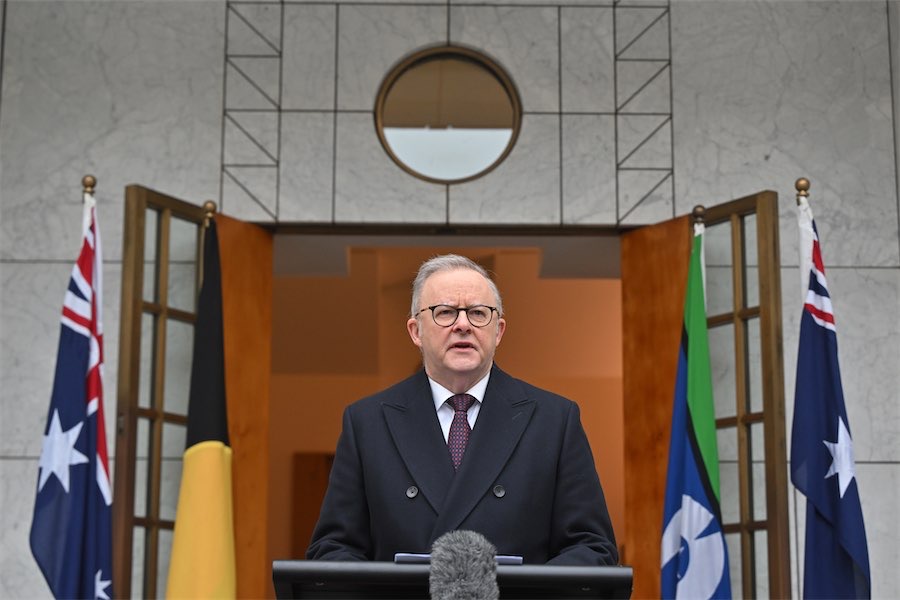
“Going for three or more election wins is difficult. Very, very few can maintain that level of resonance across an entire nation of voters in a compulsory voting system for anyone aged over 18,” writes political columnist ANDREW HUGHES.
While “Melongate” was an unmitigated disaster for the PM, one of the more interesting responses by Labor has been the very subtle but substantial change in brand strategy.

And that is the need to rebrand Anthony Albanese.
This thought was likely there before the disastrous Bush Deep podcast appearance, but the responses to it and increasing dissatisfaction with his leadership made Labor believe it was time to move the PM to the longevity statesman stage of the prime ministerial brand cycle.
We haven’t seen this stage reached by too many prime ministers this century – John Howard being the only other one, and he did his rebrand with the events of 2001.
As he said recently, when speaking about the MS Tampa incident that year, he recruited Labor to assist in the rebrand of his leadership and government.
Bush Deep was perhaps the wake up call that Labor needed. The concern for Albanese long term was always that larrikin leaders, or even a modern-era Chalmer’s branded brawler statesmen like Keating, don’t scream longevity.
For most leaders in the modern era it is usually two (election wins) and done. Basically, that’s five years. Be that here or other Western democracies, the curse of the speed of information consumption in the digital age is that we hit the fatigue factor with our leaders sooner as there is little break from political news.
Going for three or more election wins is difficult. Very, very few can maintain that level of resonance across an entire nation of voters in a compulsory voting system for anyone aged over 18.
Wait, you say? How about locally? Locally, longevity is a different story thanks to the context and political environment of the ACT. Andrew Barr is likely never to be beaten as longest-serving chief minister in the ACT. I hope he sends a thank you card to the Liberal Party on his eventual retirement.
Back to the PM. The idea for rebrand was likely already there because two key metrics were starting to move from a maybe to a trend. That is, Labor’s primary vote and the PM’s net approval rating.
Labor would have known that they needed to turn these figures around, which started to accelerate post Budget and are now stubbornly in the minus 20s. The PM, post-Bondi, has not seen a net positive approval rating.
For another contrast Labor strategists would be aware of, Donald Trump is in the negative mid-teens on net approval, while the PM has had one poll at minus 26 net approval.
Labor’s primary vote has fluctuated this year, but notably since the acceleration in the negative net approval has rarely gone above 30 – a fall of 13 per cent in lost voters in real terms in a bit over 12 months since the last federal election.
Normally numbers like these would be cause for some factional leaders to get out calculators for a leadership change, but Labor’s rules post the Rudd-Gillard-Rudd era mean that unless the leader wants to go, then change is too hard and the only option is Albanese remaining PM until the next election.
So then how can Labor turn around these figures?
The slow and subtle overall strategy is the right choice.
One, this makes past dramas appear to be more anomalies. After all, what right minded PM would actually publicly talk about his sex life with his wife to maybe get a few votes from the 18-34 year old cohort?
Second, sudden and rapid change in this current political climate could scare voters or make them more cynical about any changes.
That means integrating and using the opportunities of the job, especially on the world stage, to act as a statesman leader with wisdom, intelligence and respect. Hello Pacific Islands Forum.
Third, and integrated with the second, is minimising appearances domestically unless consistent with the second. That means avoiding anything confrontational unless he can control the outcome or it reinforces that image of an elder, wise, safe leader.
Fourth is the comms front. All comms where possible need to reinforce the other three points. The social media feed of the PM
Further to this is how the PM handles parliament and pressers – very, very much Howard of the early 2000s. Firm, taking opportunities when presented on issues consistent with the brand, and low-risk, high-certainty on full display. I’m in command, basically.
So will this work? It is a balancing act: go too fast, and we notice, become more cynical, and lose trust. Go too slow, and we’ll be the ones bush deep in what his government and his own brand stand for.
Dr Andrew Hughes lectures at the ANU Research School of Management, where he specialises in political marketing.
News all day, every day at CityNewsQBN.com.au.


Leave a Reply