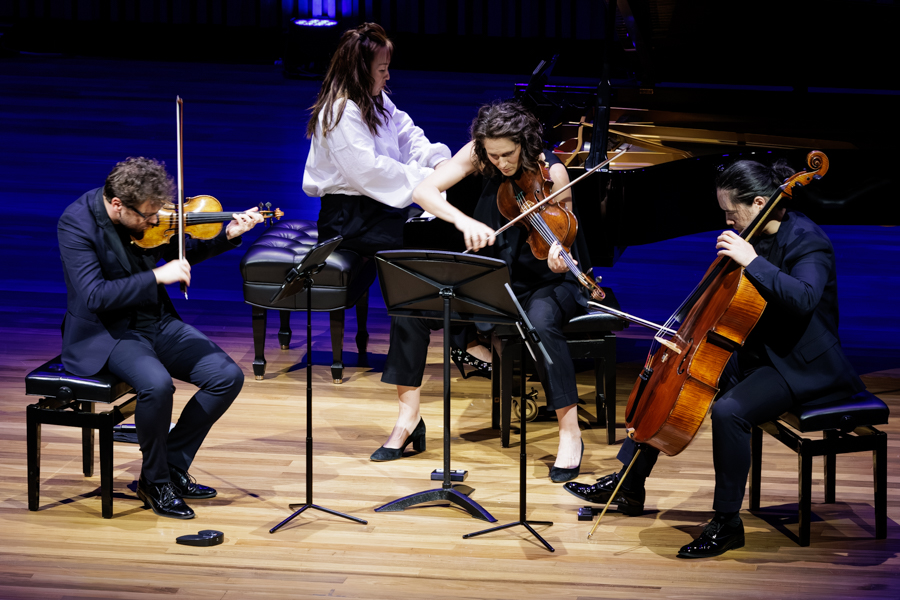
Music / Sitkovesky Trio with Stefanie Farrands. At Llewellyn Hall, August 2. Reviewed by SARAH BYRNE
In another coup for the Snow Concert Hall, artistic director Ana de la Vega managed to lure the storied Sitkovesky Trio to Canberra during their first Australian visit – and it must have been a shock after a fortnight in Cairns (following record heat in Europe) to find themselves in an arctic chill.
Needless to say, they rose to the challenge with aplomb, delivering the Beethoven Piano Trio in D with such expression and panache that the seasoned audience forgot itself so far as to applaud between movements. Wu Qian on piano was particularly marvellous, flawless technique, both graceful and dashing, and extraordinarily sympathetic to her colleagues Alexander Sitkovetsky on violin and Isang Enders on cello.
Hummel gave this piece the soubriquet of the Ghost Trio because the second movement reminded him of the appearance of Hamlet’s father; I can say it evoked more feeling in me than Izzard managed to do. While the first movement is as Allegro Vivace e con Brio as a basket of puppies, the second movement (Largo Assai ed Espressive) has an intense fragility, before the third movement Presto, featuring some lovely conversation between violin and cello, and more remarkable dexterity from Wu Qian.
This trio has frequently been praised for the seamlessness and camaraderie they bring to their music, and it was a great thing to witness in person the ease and familiarity they show with each other and how beautifully they are synchronised. Interesting choices around dynamics, stops and tempo were impeccable and unanimous, seeming completely organic.
This was especially so in the next piece, the lush and pretty Chaminade Piano Trio in A minor, a favourite of the group’s. The finish to the romantic second movement was absolutely heavenly.
After the interval, we were introduced to guest artist Stefanie Farrands, on viola, for the Brahms Piano Quartet in G minor. Farrands holds the principal viola chair with the Australian Chamber Orchestra, and brought with her the magnificent Maggini viola made in 1610, acquired in February by the ACO Instrument Fund.
She immediately merged perfectly into the dynamic of the group, the rich tone of her instrument a great complement to the bold first movement. This was, plainly, a pleasure. The second movement brought more lovely artistic choices around dynamics and tempo, the close and complementary relationships between all the players really paying off. The stirring Andante Con Moto led into the famous Russian-tinged Rondo which kicked off at a rousing pace, showcasing more virtuosic piano on the way to a triumphant close.
The audience brought the players back for three curtain calls, clearly angling for an encore, but it was not to be. We’ll just have to hope they come back soon.
News all day, every day at CityNewsQBN.com.au.


Leave a Reply