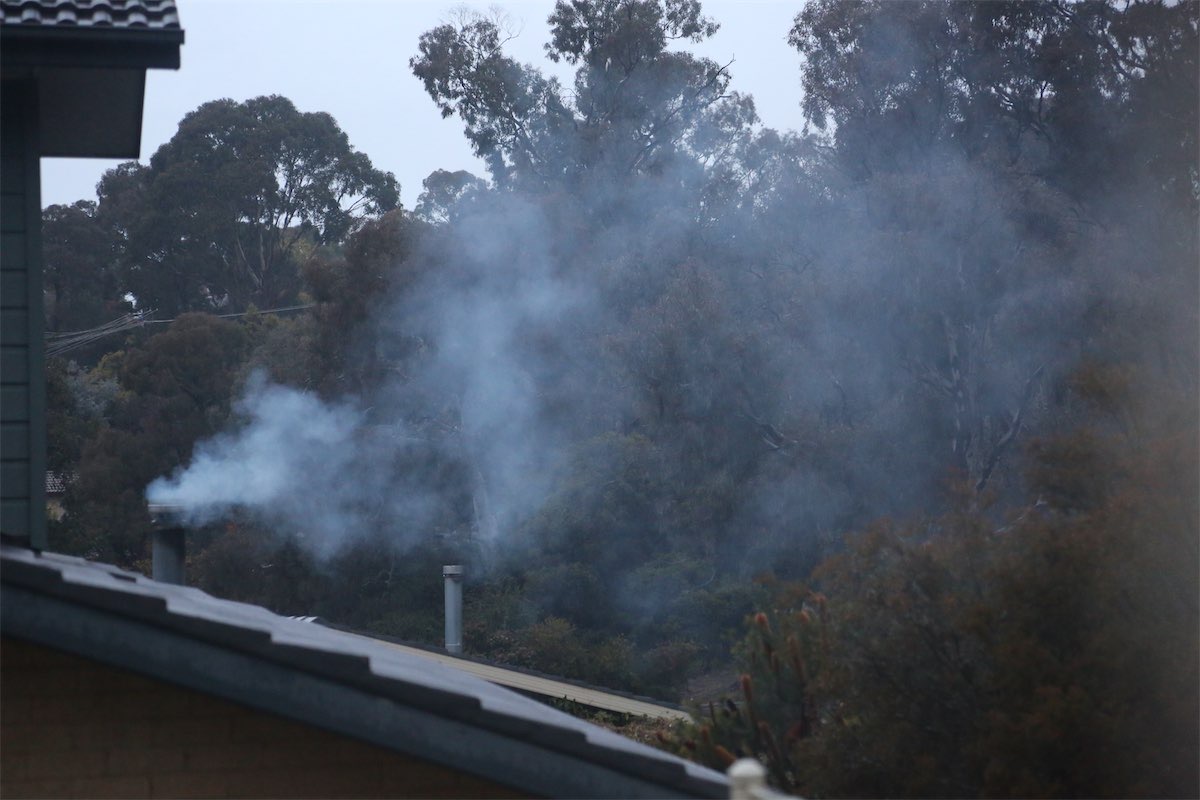
Wood-fire smoke… “Prior to the community complaints we received, I didn’t truly appreciate the extent of air pollution through wood smoke,” says Dr Sophie Lewis.
If the ACT Government is serious about tackling climate change, why does its strategy largely ignore one of the problem’s most significant contributors, asks letter writer DARRYL JOHNSTON.
The ACT Government’s Climate Change Strategy is welcome, but it is disappointing that it gives so little attention to residential wood heaters.
Write to editor@citynews.com.au
This is despite evidence they are a greater contributor to both local air pollution and climate change than natural gas.
Successive ACT governments have been presented with evidence showing that wood heaters are the largest single source of neighbourhood air pollution.
In 2023, then ACT Commissioner for Sustainability and the Environment Dr Sophie Lewis found they were responsible for up to 78 per cent of air pollution in the Tuggeranong Valley.
She also noted that residential wood smoke contains black carbon and other pollutants that contribute to climate change, and that replacing wood heaters with cleaner forms of heating would help reduce the ACT’s greenhouse emissions.
England’s Chief Medical Officer, Prof Chris Whitty, has reported that even modern eco-designed wood heaters produce 450 times more toxic air pollution than gas central heating.
UK environmental policy analyst Duncan Brack has also found that, for the same amount of heat, burning wood emits more carbon dioxide than gas, oil and even coal.
If the ACT Government is serious about tackling climate change, why does its strategy largely ignore one of the problem’s most significant contributors?
Darryl Johnston, Tuggeranong
Nudge, nudge, wink, wink, say no more, squire
A possible culture of unwritten “understandings” at high levels in government, reminiscent of the classic Monty Python “Nudge, Nudge” sketch, needs to be considered by the ACT Integrity Commission’s inquiry into the Phillip pool fiasco.
I suspect that it’s this sort of scenario, underpinned by nudge-nudge pillars of “know what I mean” and “say no more”, that might have played a role in the high-level, behind-the-scenes decision to suddenly reduce (by 50 per cent) the size and functionality of a much needed public pool in a lucrative “urban renewal” and redevelopment site in Phillip.
Hopefully, the inquiry into this reprehensible decision-making, will delve into the realm of unwritten understandings, unrecorded interactions and possibly performance pay incentivisation for adherence to planning and development pathways that best suit developer and ACT Government targets, while leading to long-term negative outcomes for many tens of thousands of Canberrans.
The public interest will be better served if the commission is able to ascertain and address the impacts of written and unwritten cultural expectations, and delivery scenarios that have been shown to run a high risk of becoming unjust or corruptible in our political and public service settings, both of which should know better and need to be seen to perform better.
Sue Dyer, Downer
Leigh’s abilities remain ‘underutilised’
In his article “Factions to his future, Leigh knows when to zip it” (CN July 30) Noel Beddoe writes effusively about Andrew Leigh, the member for Fenner, and in so doing, highlight’s Andrew’s many fine qualities.
I first became acquainted with Andrew when he stood for preselection for the then seat of Fraser. As part of his campaign, Andrew did the rounds of the ALP branches in the electorate. I would be in attendance, as I accompanied my wife Mary Porter and she gave her monthly report to branch members.
During his “spiel”, Andrew would say his priority would be to his constituents and while he couldn’t be as good a local member as Mary, he would certainly try.
A couple of days after winning the preselection we met over coffee. I asked if he was determined to continue to be unaligned. He responded in the affirmative.
Having been a member of a faction in my then four decades of Labor Party membership, I could say with some conviction that his decision would be “career limiting”.
Andrew responded he was very clear-eyed about that, however his principles were such that he had chosen that path and would stick to it.
There is no doubt that should Andrew have aligned himself with a faction, he would today, not only be a minister, but a cabinet member to boot.
While I’m no longer a Canberra resident, I communicate regularly with Andrew and when the subject of factions is raised, he confirms he remains comfortable with his decision.
This exemplifies the man Andrew is, although I remain disappointed his undoubted abilities remain underutilised.
Ian De Landelles, Murray’s Beach, NSW
No fire and brimstone in our story
One of last week’s stories (CN July 30) refers to people rekindling “Curtin’s revolutionary open space”.
I was alarmed until I realised that the story was not about going back to the days when our future wartime prime minister John Curtin was a fervent Socialist preaching revolution at open air rallies on the banks of the Yarra River in Melbourne.
Stephen Holt, Macquarie
‘Shameless’ Labor wastes your money
Is there no end to Labor’s largesse? On top of Climate Minister Chris Bowen about to blow $650,000 on a COP31 Climate Conference Travel Support Program, for young climate activists to travel to Türkiye, as part of the $150 million budget for his “presidency” of COP31, he is now about to spend $4.5 million for some 2000 journalists and other camp followers to spend a few days in a five-star hotel in Fiji, to cheer on what he has to say as President Bowen.
Now we hear that Minister Wells, in November, found $67.6 million for a Journalism Assistance Fund, to subsidise journalists’ salaries of eligible media organisations.
What kind of government can think this stuff up let alone actually fund it with your money? Labor is shameless in the waste of your money.
And what does it say about our sycophantic, left-leaning media to accept these blatant bribes? Hardly there to improve the quality of Australian journalism.
Max Flint, Greenway
The ‘warm fuzzy’ comes at a cost
At present the Woden-Civic bus route is the fastest route and it enjoys its own transit lane.
We know that, if light rail is routed from Civic to Woden, the travel time will practically double. A well-patronised, fast bus route is to be sacrificed to provide an expensive, time-consuming tram.
There has been plenty of cost benefit analysis done reflecting light rail costs twice that of bus rapid transport and that light rail will deliver a profit margin of $0.49c for every dollar invested.
But wait, there’s more. When Stage 1 was introduced, buses were removed. Stage 2B will no doubt remove the buses.
I therefore propose that every politician and Canberra government worker be forced to use the tram where it suits their travel route.
I also propose that every Canberran that voted for Labor MUST use public transport, especially light rail where it matches their route.
I believe Labor voters thought the idea of being a “world-class city” with light rail did so because of the warm fuzzy, not based on least expensive travel.
Public transport MUST be used by commuters, especially those that voted Labor! It’s yours, so use it!
Russ Morison, Theodore
We can afford to reduce our emissions
Suzanne Orr can establish herself as a credible Minister for Climate Change by updating the new ACT Climate Change Strategy to include reporting and reducing emissions per passenger kilometre of public transport travel.
Until that falls below the equivalent figure for car travel, the strategy’s “key action area” to “increase mode shift towards… public transport” will actually increase emissions.
Canberrans, who are in the top 10 per cent of the world’s climate polluters, are among the world’s wealthiest people. We can afford to set an example, by reducing our emissions to a sustainable level.
Leon Arundell, Downer
For buckled tracks, go to Melbourne
In response to Prof Beatrice Bodart-Bailey (letters, CN July 24). How true, but the chief minister can save ACT taxpayers a fortune by just going to Melbourne around the time of the Australian Open.
Even adding his ticket cost to the event would be cheaper than travelling to Europe.
The trams didn’t run there either until the heat-buckled tracks were replaced in over 40-degree heat a few years ago when we were there at the Open.
Sandy Hoare, via email
‘Carbon catastrophe’ puts the frighteners on
Reader Ann O’Hara (letters, CN July 9) is just one of many to have brought the idea of carbon catastrophe, an element critical to the very structure of life on earth (plant and animal), put about by some politicians, by Energy Minister Chris Bowen and by frightened amateurs the world over.
Botanical and geological evidence shows there has been a “global warming” at about 1000-year intervals since the Mycenaean era 3000 years ago, and likely earlier – older tree and stalactite rings are sparse.
Satellite data since early this century shows an increase in the earth’s biomass, a natural photosynthetic absorption of increased CO2.
That is earth’s “Gaia Principle” reaction to maintaining stability within limits – nothing in our environment is absolutely fixed, otherwise there would be no seasons, when life would stagnate.
Adaptation can be as simple as painting your roof white and driving a white car to reflect sunlight. In due course, solar radiation will cycle to a lower level and earth’s albedo (the measure of how much sunlight a surface reflects) will increase its reflectiveness, resulting in global cooling.
Anthony Hordern, Jamison Centre
Goal is endless improvement on a living planet
Letter writer Jonathan Miller is right. Unbounded growth is plundering the planet (“Unbounded growth on a finite planet is impossible”, letters, CN July 23).
But there are different types of growth. A useful distinction is between quantitative growth – more people, consumption and production – and qualitative growth – better health, knowledge, efficiency, creativity, wellbeing and environmental quality.
The challenge is shifting from growth in material throughput to growth in knowledge, services and wellbeing.
Treasurer Jim Chalmers was on the right track in arguing that economic success cannot be measured by GDP alone. Growth that fails to improve wellbeing and restore nature is not progress.
Economies can grow, but they must decarbonise. Scandinavian countries are leading the way. Australia must not only decarbonise its economy but reduce its reliance on exporting coal and gas.
Although Australia was one of 57 countries at the First Conference on Transitioning Away from Fossil Fuels, approving 36 fossil fuel projects in four years demonstrates our continuing dependence on high-emissions extraction.
The goal should not be endless growth on a finite planet, but endless improvement on a living one.
Di Taylor, Manly West
Cull complaints met with indifference
During the first week of this year’s kangaroo “cull” (June 2), evidence was provided to the Conservator of Fauna and Flora indicating the ACT government’s contracted shooters were likely in breach of the Code for the Humane Shooting of Kangaroos and Wallabies (non-commercial) by shooting in heavy fog, rain and gusty winds.
The code stipulates, among other things, that shooting should not be attempted in adverse weather conditions as it could result in a mis-shot instead of instantaneous death.
This is because shooting in rain, thick fog and gusty winds changes the trajectory of the bullet resulting in higher wounding rates that cause kangaroos to suffer in pain.
The shooting activities for each reserve are overseen by an Operations Controller who is an ACT Government employee.
The evidence provided to the Conservator included witness statements, photos, videos, and BOM weather conditions.
Seven separate animal cruelty reports were also sent to the ACT Chief Inspector of the RSPCA.
The Conservator’s response was to say “shooting takes place in all weather conditions” and declined to take further action. As for the RSPCA, we are yet to receive an acknowledgement of our complaints.
Robyn Soxsmith, Animal Protectors Alliance
What actually is artificial intelligence?
Artificial intelligence kills creativity. AI is like half a brain, lacking sensitivity, insight, instinct and foresight.
AI is hard cold pseudo-data masqueraded as flexible. AI is information technology. AI is not rational. AI does not relate with human survival on a planet.
AI does somehow relate with Hollywood-style “science” fiction. Artificial reality.
Artificial intelligence does not make people smart.
What happens to self-drive “smart cars” when the satellite malfunctions? Artificial intelligence is devoid of human cultural permanence.
What does artificial intelligence cost the environment?
"We have public finances that are debt ridden, weighed down by devouring interest beetles, so that once sound limbs (such as education, health, public housing, access to justice) are in danger of dieback.," but HUGH SELBY has an idea..



Leave a Reply