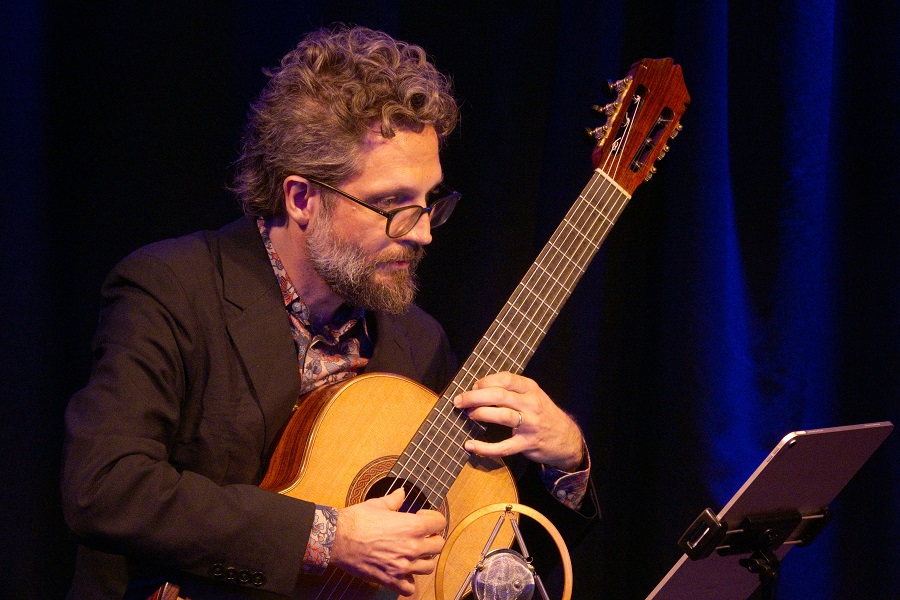
Music / Rupert Boyd. At Smith’s Alternative, July 24. Reviewed by NICK HORN.
Rupert Boyd, a student of Timothy Kain in Canberra more than 20 years ago, has made his name internationally as a solo classical guitarist and the duo with cello, Boyd Meets Girl.
His informal introductions to each work, in the intimate atmosphere of Smith’s Alternative, set the scene for well-received performances of a mix of old favourites with some exciting modern works.
To open, Heitor Villa Lobos’ Gavotta-Choro – a pleasing blend of baroque dance and Brazilian street ballad – was paired with Estuda No. 1, a homage to Villa-Lobos by Brazilian guitarist/composer Chrystian Dozza (heard in Canberra in recital in 2018), Boyd’s performance drawing out a singing melody from flowing arpeggios.
The program followed a thread of music by JS Bach throughout (Prelude, Fugue and Allegro in Eb/D; Prelude in A minor; Prelude and Gavotte in E). While Boyd’s playing of this exceptionally challenging music was assured, it seemed a little mechanical, not finding anything new in this familiar repertoire. The exception was a nuanced rendering of the reflective A-minor prelude, with subtle rubato and expressive effects.
However, Astor Piazzola’s Invierno Porteño (Winter in Buenos Aires, 1969) lit up the room, with constantly shifting tempi building tension and release in the New Tango idiom. Boyd’s playing in this magnificent work displayed a freedom and commitment absent from the classics by Bach, Isaac Albéniz (Sevilla, 1886) and the encore by Francisco Tárrega, Recuerdos de la Alhambra (Memories of the Alhambra, 1899).
Paraguayan Agustín Barrios’ La Catedral (1921) evokes its subject in three different aspects: light coming through stained glass (picked out in ringing, crystalline high notes); a ritual procession (a stately series of dramatic chords) and the street life outside (running Bach-like passages with shifting rhythms). Australian Graeme Koehne’s study “A closed world of fine feelings and grand design” (1997) drew a sensitive performance, with cycles of uncertain questions evoked by rising motifs, inverted in a middle section of growing intensity, followed by a reprise of the opening hinting at new-found confidence.
Hawaiian Byron Yasui’s Fantasy on a Hawaiian Lullaby (1991) was played in sweet swaying slack-key style, with a quietly discordant middle section. Discord was at the heart of the bravura work closing the main program – a jazzy written-out improvisation over Brazilian Antonio Carlos Jobim’s A Felicidade (Happiness), as arranged by Roland Dyens (2001). Jobim’s lyrical line is constantly disrupted by driving dischords stretching the Bossa Nova style, and Boyd was at his best here, relishing the contrast between the tune and its jarring embellishments, using confident dynamic and tonal effects.
The performance (unusually for solo acoustic guitar in a small room) was amplified – justified perhaps by the unresponsive space, and the leakage of lively conversation from the bar area outside. However, the obtrusive level of amplification prevented a fully satisfying appreciation of the live sound quality of the performance. Nevertheless, Boyd’s varied program made for a thoroughly enjoyable evening of finely played music for classical guitar.
News all day, every day at CityNewsQBN.com.au.


Leave a Reply