By arts editor HELEN MUSA
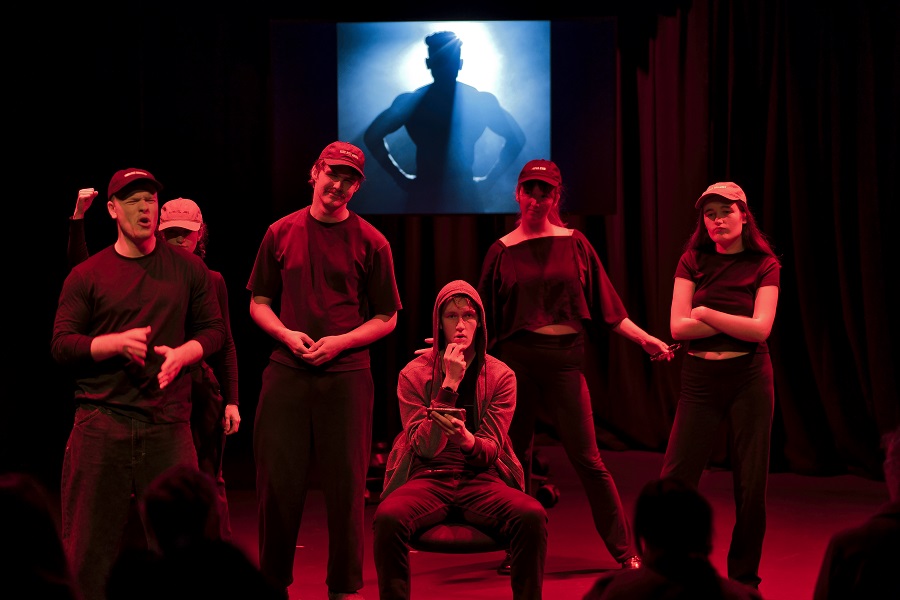
A fascinating pilot program unfolded at The Street Theatre on Wednesday night, using interactive theatre to probe one of the most contentious issues facing young people: online misogyny and the influence of the manosphere.
Presented as part of the Wellspring: Inquiry and Exchange program under the aegis of The Street Theatre and the ANU School of Literature, Languages and Linguistics, Beyond the Algorithm: Challenging the Manosphere was developed with experienced actors from Canberra Youth Theatre and explored how hate and bigotry spread through online communities.
The project was presented as an adapted form of Forum Theatre, the interactive style created by Brazilian theatre practitioner and political activist Augusto Boal. Unlike conventional theatre, Forum Theatre invites audience members to interrupt the action and step onto the stage to change the narrative.
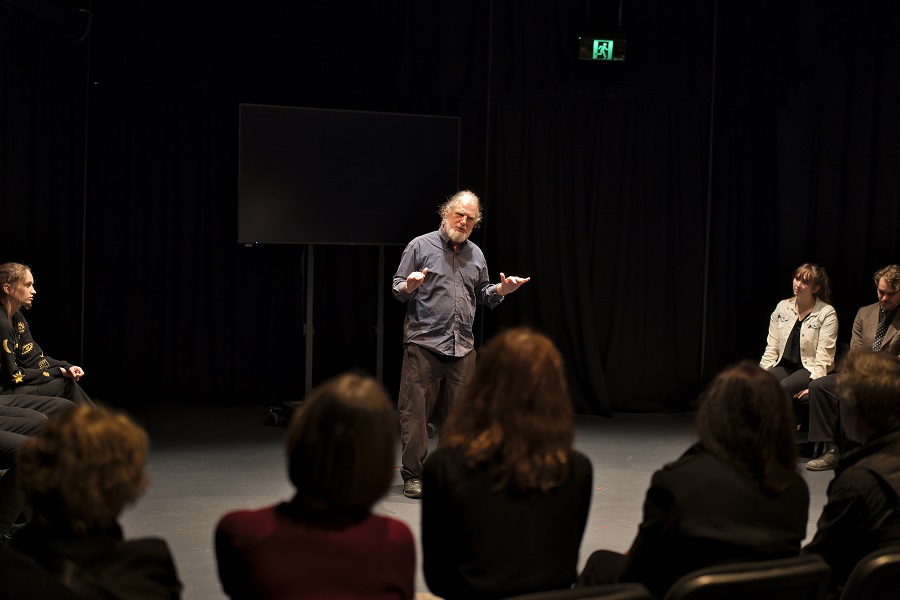
ANU associate lecturer in Italian Studies, Vivian Gerrand, introduced the aims of the program, but most of the evening was guided by Robin Davidson, formerly of Rebus Theatre and a seasoned facilitator of Forum Theatre sessions. That proved invaluable, because the scenario quickly sparked strong opinions across the audience.
The play centred on a teenage boy preparing a class presentation with a girl he likes. An accusation of misbehaviour involving another girl leads him to seek validation online, where manosphere voices assure him he has done nothing wrong, while others accept the accusation at face value. Complicating matters further is a tense relationship with his father.
What made the evening unusual was what happened next. After the initial performance, the actors replayed key scenes and audience members were invited to stop the action and demonstrate how they might have handled the situation differently.
The response was immediate. When Davidson asked whether anyone had seen moments they would change, the room erupted in discussion. Audience members debated whether the characters should have confronted the rumour directly, challenged the online echo chamber, or found a way to listen more carefully to each other.
Those familiar with Boal’s work know that Forum Theatre can become a form of social reckoning rather than simple entertainment. In Brazil, such sessions are sometimes famously volatile.
Davidson, however, kept the evening remarkably well in hand, allowing disagreement to surface while maintaining a sense of shared inquiry.
More than a theatrical experiment, Beyond the Algorithm functioned as a live test of what its creators describe as “theatre-based critical empathy training” for young people. It will be worth watching closely to see where the Wellspring initiative goes next.
Next up in the Wellspring series are: Preserving Australian Modern Dance: Creating a Pedagogy for the Bodenwieser Technique, September 4, and The News: Bound for Botany Bay, October 7.
News all day, every day at CityNewsQBN.com.au.




Leave a Reply