By Helen Musa
Henry Lawson’s The Drover’s Wife, written in 1892, may be Australia’s most famous short story, but in recent years it has taken on a new life through the imagination of theatre artist Leah Purcell.
What began as Lawson’s tale of an unnamed bushwoman defending her children from danger has become a play, a novel, a film and now, in collaboration with composer George Palmer, an opera.
Palmer first suggested the operatic adaptation and has composed a melodic score, while he and Purcell have written a libretto sung in English, with surtitles.
Co-commissioned by Opera Australia and the Queensland Performing Arts Centre, in association with Oombarra Productions and The Balnaves Foundation, The Drover’s Wife premiered in Brisbane earlier this year and soon arrives at Sydney Opera House.
Purcell’s adaptation radically reimagines Lawson’s story. In the original, Aboriginal characters are viewed through the colonial attitudes of the time. Purcell instead reveals the drover’s wife herself to be an indigenous woman, Molly Johnson, and introduces the escaped Aboriginal fugitive Yadaka, who becomes not a threat but an honourable man who helps Molly discover her own heritage.
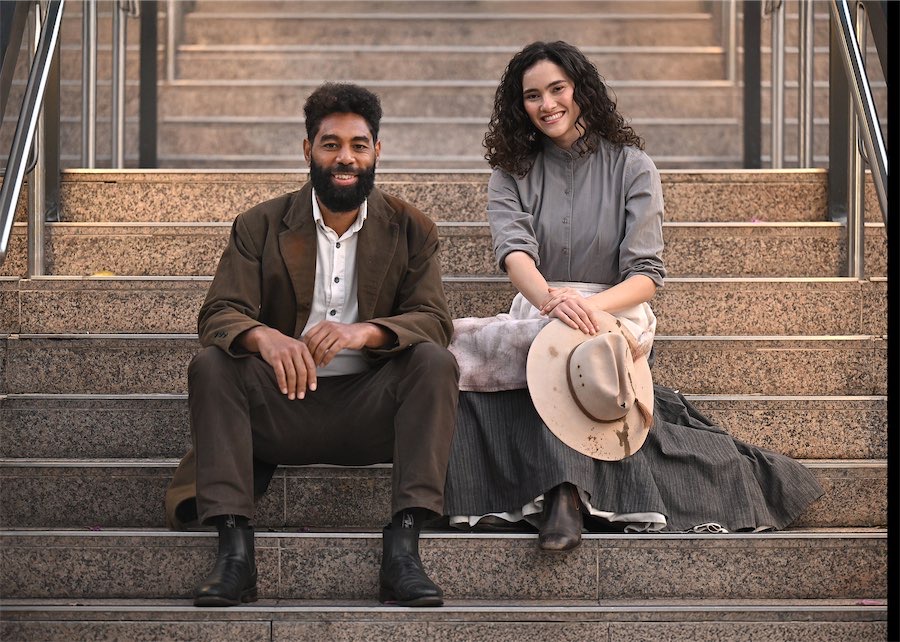
I caught up with the opera’s two leading performers as they prepared for the Sydney season.
For soprano Nina Korbe, Purcell’s niece, the role of Molly builds on an already remarkable career. Trained at the Queensland Conservatorium Griffith University and the Royal Academy of Music in London, where she became the first Aboriginal Australian woman admitted, she made her Opera Australia debut as Maria in West Side Story in 2024, sang Musetta in La Bohème for Opera Queensland last year and has recently appeared in Victorian Opera’s The Pirates of Penzance.
Preparing for Molly meant tracing the character back through every incarnation.
“I did go back to the original Henry Lawson as well as to all the previous lives of this story as told through Aunty, although perhaps the most for me was Aunty’s novel.
“I [also] drew from the women in my life who live on the land, their pragmatic strength and tender loyalty.”
However, as rehearsals progressed something unexpected happened.
“I started feeling Molly come through in my body.
“I’ve never had such an overwhelming sense of a character coming to life almost outside of my control. She is strong, with jagged edges sharpened by years of needing to protect her family, worn down by the weight of the world around her and deeply loving and protective of her children.”
Because Molly has not yet discovered her Ngambri Walgalu ancestry, she never sings in language, but, she says: “It is incredibly moving to hear my First Nations cast members singing and speaking in language… George Palmer has done an exceptional job, sensitively weaving together western classical traditions and First Nations cultural traditions.”
Marcus Corowa has arrived at opera by a very different route. Raised in gospel music through his Aboriginal and Islander family, he established himself as a singer-songwriter before performing with artists including Vika and Linda, Christine Anu and Marcia Hines, and appearing in shows such as Beautiful: The Carole King Musical, Bran Nue Dae, and Barbara and the Camp Dogs.
His first taste of opera came with Kate Miller-Heidke’s The Rabbits for Opera Australia in 2015, followed by productions for Opera Queensland including You Lonesome Tonight, Wonder and Do We Need Another Hero, and Victorian Opera’s The Visitors.
Most of Yadaka’s role is sung in English, but some passages are in Guugu Yimithirr, the language of Far North Queensland appropriate to the character’s origins.
“It was very important that we got permission to sing in this language,” Corowa says.
When Purcell, whom he had known through Brisbane’s Aboriginal Centre for the Performing Arts two decades ago, invited him to create Yadaka, he asked for singing lessons to develop a more open operatic sound.
“I’m glad I did,” he says. “I hadn’t experienced much grand opera and I knew I’d be singing with a full orchestra.”
“It tells a massive story and, yes, as you’d expect with opera, it still feels pretty grand.”
One of his favourite aspects of the work is the gentle relationship that develops between Yadaka and Molly’s son, Danny.
“When he first meets Molly, he’s on the run from the police, but he’s a good guy at the end of the day,” Corowa says.
“They form a friendship and find some love.”
The Drover’s Wife, Joan Sutherland Theatre, Sydney Opera House, from August 7.
News all day, every day at CityNewsQBN.com.au.



Leave a Reply