Musica Viva duo blends virtuosity with musical curiosity
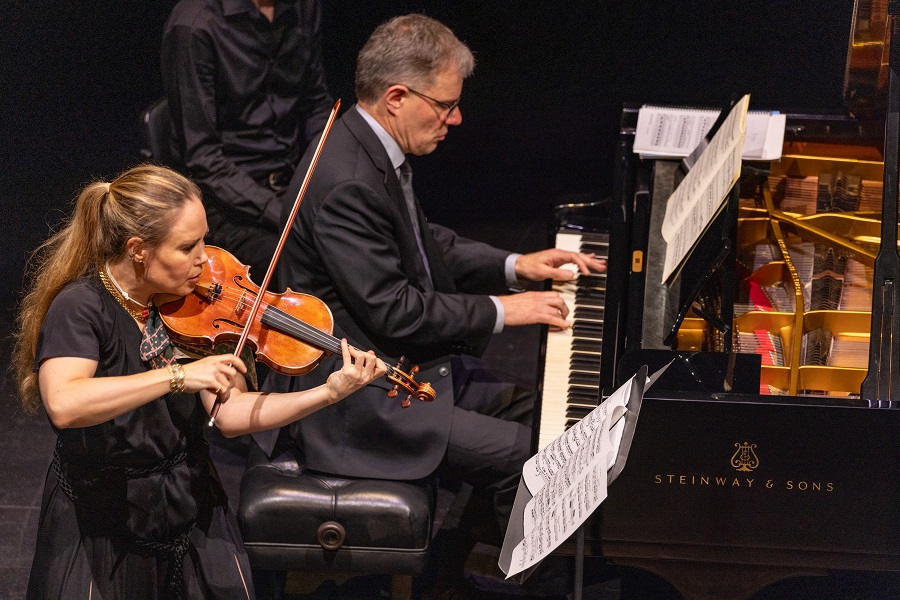
Violinist Leila Josefowicz with pianist John Novacek in The Fairy’s Kiss. Photo: Alex Jamieson
Music / The Fairy’s Kiss, Leila Josefowicz and John Novacek for Musica Viva Australia. At The Snow Concert Hall, July 9. Reviewed by MICHAEL WILSON
Flawless execution and expression are what Musica Viva audiences expect, and this has been the standard in artist selection and programming now for decades. Frequent collaborators for forty years, Leila Josefowicz (violin) and John Novacek (piano) met for an intriguing and ambitious assembly of works which challenged musical convention.
Los Angeles-based Josefowicz is an expressive and physical player, contrasting with the tremendously capable but introspective New Yorker Novacek. Where she marked musical phrasing and highlights and changing moods with her head, face and whole body, he marched along in effortless, lower-key support. This is not to suggest that this program saw the piano in a secondary role. Each work brought out both instruments to equal effect, and the interplay of different personalities was charming and added interest. This was programming at its most thoughtful.
Novacek and Josefowicz are both passionate advocates for contemporary music, and for blending genres. At first glance, opening with Claude Debussy seemed cautious, but his Sonata for Violin and Piano in G minor is a boundary-pushing late work, allowing the violin to soar from guttural textured low notes to singing at the top of its register in the Allegro Vivo.
The violin and piano begin the second movement together – assertively and in full voice – and this highlighted how perfectly in sync these two players were. The Finale included phrases starting at piano-pianissimo and ending in forte-fortissimo, providing great drama.
Polish composer Karol Szymanowski’s three-movement Mythes dwells on three Greek myths. Szymanowski is particularly celebrated for his virtuosic works for violin, and for introducing “a new expression of violin playing”. Josefowicz showed exactly what this meant in ‘Arathusa’s Fountain’, conjuring ethereal, precise, very quiet ornaments high on the E string and then with harmonic double-stops, with the piano leading gentle descents. The effect was exquisite and other-worldly. In ‘Narcissus’, Novacek was suddenly extremely animated at the keyboard, with both instruments uttering statements in the minor key and climbing to a beautifully satisfying resolution back at piano-pianissimo. By dusk, even the big personalities of Greek mythology have little left in the tank, and the playful last movement rounded off an entertaining story-time.
Josefowicz has worked with British-German composer Charlotte Bray extensively, and Bray’s work Mirya is a special joint commission by Wigmore Hall, the Lincoln Center and Musica Viva, reflecting on the struggle for freedom in Ukraine. Darkness, conflict, colour and light were expressed cleverly. An extended high violin solo in the second movement transitioned to a sombre funereal finish. The third movement featured the violin and cello playing notes and chords which agreed, but using very unusual intervals: melodic, yet far from conventional.
Concluding with Stravinsky’s Divertimento from his ballet The Fairy’s Kiss, Josefowicz and Novacek ranged through soaring long notes on the violin underpinned by rhythmic piano, to competitive staccato duels. The last movement, in three different moods, was wild stuff – audacious runs, atonal clashes and each climax outdoing the last.
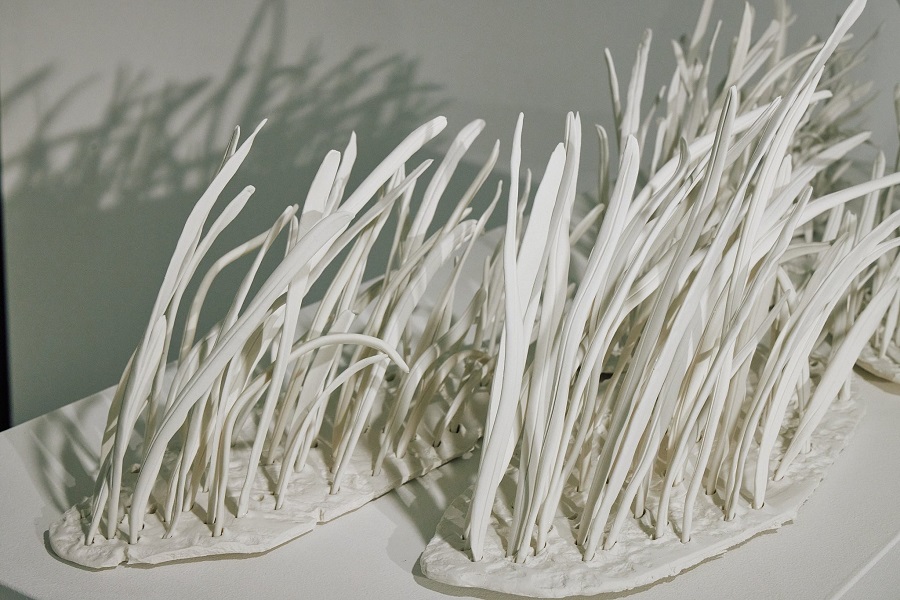
MEREDITH HINCHLIFFE reviews ceramicists Jo Victoria and Sara Ormonde drawing inspiration from the meeting of water and shoreline to evoke the NSW south coast.
ALANNA MACLEAN reviews Edward Neeman and the CSO Wind Quartet showcasing the individual talents within Canberra's larger orchestra in a lilting spring concert.


Leave a Reply