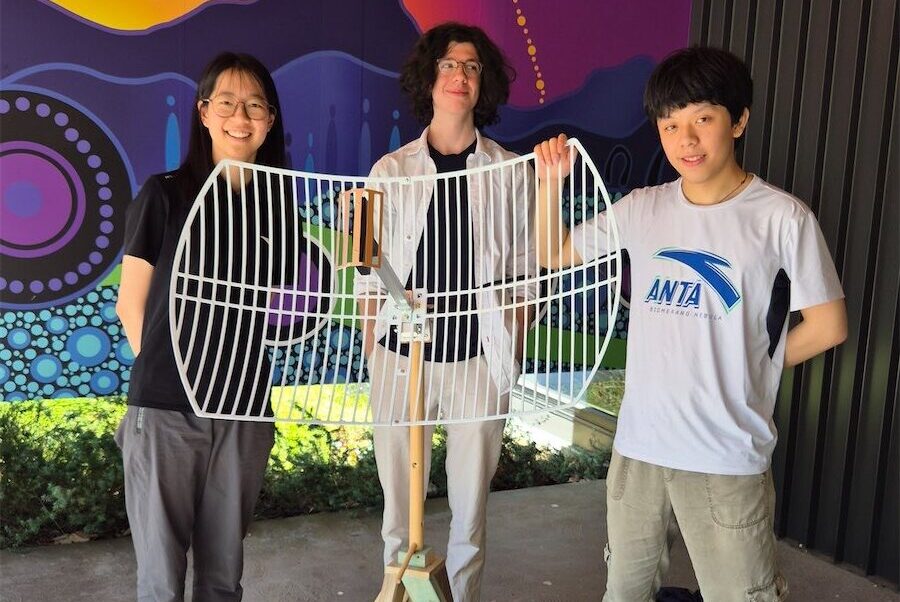
A student-led project is using self-made radio telescopes to inspire science among high school students, particularly those with limited access to STEM resources, reports DHWANI PATHAK.
A group of Narrabundah College students is building low-cost radio telescopes with the aim of taking them into classrooms, giving regional students early exposure to science beyond textbooks.
The challenge, known as the Project for Accessible Radio Telescopes (PART), is to make advanced science more accessible, particularly for students in rural areas.
The PART initiative focuses on building radio telescopes for under $500 and ensuring they are demonstrated in schools, particularly those with limited access to STEM resources.
CSIRO says radio telescopes are used to detect and study invisible radio waves and microwaves coming from space, helping scientists map the universe and find distant stars and galaxies.
Under leader Emma Enyu Zhang and classmates Narayan Dwan-Holland, Kevin Fang, Aliana He and Yanfu Fan the project evolved into a 2026 Global Youth Action Fund-winning project supported by the International Baccalaureate, which will allow the team to travel to regional NSW schools and share their technological creations in workshops with students from years 8 to 11.
The student group will use the telescopes to demonstrate concepts such as waves, signals and data in real time.
“It gives early exposure to concepts like waves and vectors, and you can physically see changes in readings,” says Emma.
The team formed through the Science Mentors ACT program, where they were first introduced to research and hands-on STEM learning.
“Via this program, we came into contact with STEM and felt an extreme interest in science,” Emma says. “We’re united by a love of STEM.”
The group chose radio astronomy for its ability to bring together physics, engineering and mathematics in a practical way. While it is rarely taught in schools, the students saw it as an opportunity to expose others to complex ideas in a simple, tangible format.
“It is a very niche field,” Narayan says. “But it is one of the higher-end sciences that students can realistically engage with.”
Building the low-cost telescopes was a complicated process, says Emma. “We explored a lot of designs, from 3D printing parts to building a horn telescope with cardboard and aluminium, before deciding on a parabolic dish using components from amateur radio astronomy.”
They are also working towards making the telescopes more interactive, with plans to allow students to take part in assembling parts of the equipment.
“We want students to participate in building parts of the telescope,” Kevin says. “It extends the outreach beyond just radio astronomy.”
To fund their first telescope, the students raised about $300 through school fundraisers.
“We sold baked goods and ice cream,” Emma says. “That was a really exciting moment.”
Even after securing equipment, getting the telescope to function properly took time. Much of the work involved trial and error, with repeated testing and redesign.
The team spent months trying to detect a signal from the sun before realising a key assumption was wrong.
“We kept getting no signal,” says Kevin. “Then we checked if the sun was a strong source, which it wasn’t.”
“If we don’t run into these mistakes, we won’t be able to test properly,” says Emma.
The project is still evolving. “It’s definitely not in a final stage,” says Yanfu. “We still have a lot of problems to address.”
Despite the challenges, there have been some key milestones with the team already providing workshops to Crookwell High School in regional NSW and to a rural school in China.
Workshops have also shown the impact of the project particularly in schools where students have limited access to hands-on STEM experiences.
“That’s how we knew we made a difference,” Yanfu says.
Balancing the project with school commitments remains an ongoing challenge. “We prioritise our studies,” Yanfu says. “But when we have time, we commit to the project.”
While the telescopes themselves are modest compared to professional instruments, the team says the goal is not to make major discoveries.
“It’s the scientists who make discoveries. For us, it’s about giving students that sense of discovery and hopefully inspiring them to see science as something they could pursue in the future,” says Kevin.
Looking ahead, the team has workshops scheduled for at least three more schools by the end of the year.
“Maybe one of the students we inspire will go on to make those discoveries,” Emma says.
News all day, every day at CityNewsQBN.com.au.



Leave a Reply